Chevrolet · Bolt EUV · 2022
2022 Chevrolet Bolt EUV
4
Recalls
21
Complaints
5/5
Safety Rating
The 2022 Chevrolet Bolt EUV has 4 recalls and 21 owner-reported complaints on file with NHTSA. Overall safety rating: 5 out of 5 stars. Most reported issue: steering (8 reports).
Source: NHTSA Public Records · Updated Apr 28, 2026
Research Context
The 2022 Chevrolet Bolt EUV page works best as a research starting point. Complaint totals show how much owner-reported activity exists, while recalls and investigations help show whether any of that activity turned into formal safety action.
Because this is a newer-era vehicle page, it usually helps to compare this year against nearby model years before deciding whether a complaint pattern looks isolated or persistent. On this page, the most prominent complaint area is steering with 8 reported complaints.
Best Research Moves
- Use the complaint log to understand what owners were actually reporting instead of relying only on the raw complaint total.
- Review the recall section even if the total is smaller, because a limited number of recalls can still point to meaningful safety actions.
- This page is primarily a complaints-and-recalls research surface, so compare nearby model years before treating the complaint total as a standalone verdict.
Key Takeaways
- The 2022 Chevrolet Bolt EUV currently shows 4 NHTSA recalls listed on this page and 21 owner-reported complaints.
- This page currently shows no linked NHTSA investigations.
- This page reflects complaint volume, recall history, and NHTSA test data, but it does not diagnose causes or rank reliability by itself.
- Safety data currently shows 5/5 overall NHTSA safety rating.
- The most frequently reported complaint categories on this page are steering (8), unknown or other (3), forward collision avoidance (3).
- Vehicle
- 2022 Chevrolet Bolt EUV
- Recalls
- 4
- Complaints
- 21
- Safety Rating
- 5/5
How to Interpret This Page
This page combines three types of NHTSA data: recall campaigns (official manufacturer or government actions), owner complaints (unverified consumer reports), and crash test ratings (where available). A vehicle with many complaints is not necessarily less reliable — complaint volume correlates with sales volume and vehicle age. Recalls indicate identified defects, not overall quality. To compare this model year with others, use the year navigation in the sidebar or return to the model overview page.
If you are researching a used vehicle, start with the complaint categories, compare them against the recall list, and then check nearby model years to see whether the same issue profile repeats. That usually produces a better buying or research signal than treating the raw complaint total as a standalone safety ranking.
NHTSA Crash Test Performance
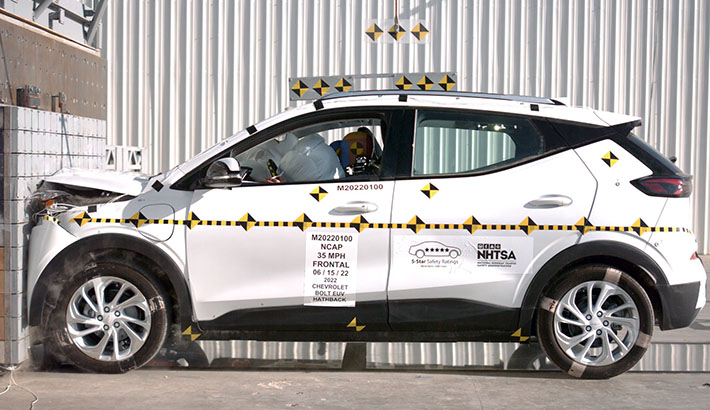
Frontal Crash Test
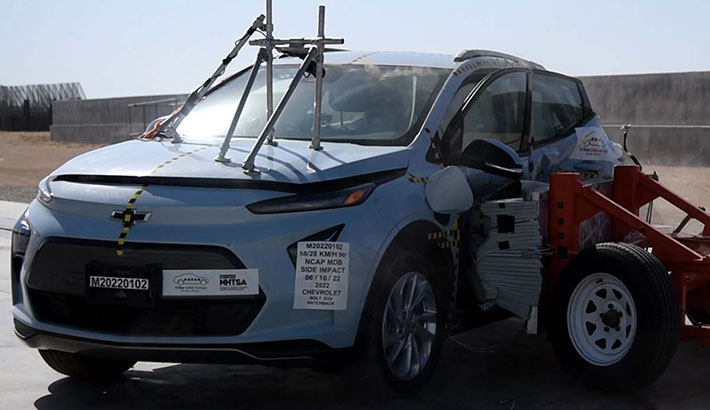
Side Crash Test
Overall Frontal Rating
Driver and Passenger Assessment
Driver Side
Passenger Side
Overall Side Rating
Side Barrier and Side Pole Tests
Driver Side
Passenger Side
Rollover Resistance
10.7% rollover risk in single-vehicle crash
Safety Features
ESC: StandardForward Collision Warning: StandardLane Departure Warning: Standard
Recall Notices
NHTSANHTSA ID: 24V812000October 31, 2024
ELECTRICAL SYSTEM:PROPULSION SYSTEM:TRACTION BATTERY
General Motors, LLC (GM) is recalling certain 2020-2022 Chevrolet Bolt EV and 2022 Bolt EUV vehicles previously repaired under Recall 21V-650. The installation of advanced diagnostic software may have failed. As such, the high voltage battery could catch fire when charged to full or nearly full capacity.
Remedy Status
Owners are advised to take the following interim steps: Set the Target Charge Level feature in their vehicle to limit the charge level to 90%, charge their vehicle more frequently, avoid depleting the battery to 70 miles range remaining, park outside after charging, and do not charge the vehicle indoors overnight. Dealers will reinstall advanced diagnostic software, free of charge. Owner notification letters were mailed December 3, 2024. Owners may contact the Bolt EV Concierge Team at 1-833-382-4389. GM's number for this recall is N242470160.
NHTSA ID: 24V481000June 27, 2024
ELECTRICAL SYSTEM:PROPULSION SYSTEM:TRACTION BATTERY
General Motors, LLC (GM) is recalling certain 2020-2022 Chevrolet Bolt EV and 2022 Chevrolet Bolt EUV vehicles that were previously remedied under recall number 21V-650. The advanced diagnostic software may have been incorrectly installed and fail to detect defective battery modules, possibly resulting in a battery fire.
Remedy Status
Owners are advised to take the following interim steps: Set the Target Charge Level feature in their vehicle to limit the charge level to 90%, charge their vehicle more frequently, avoid depleting the battery to 70 miles range remaining, park outside after charging, and do not charge the vehicle indoors overnight. Dealers will reinstall the advanced diagnostic software, free of charge. Owner notification letters were mailed on August 1, 2024. Owners may contact the Bolt EV Concierge Team at 1-833-382-4389. GM's numbers for this recall are N242443000 and N242443002.
NHTSA ID: 21V650000August 20, 2021
ELECTRICAL SYSTEM:PROPULSION SYSTEM:TRACTION BATTERY
General Motors, LLC (GM) is recalling certain 2020-2022 Chevrolet Bolt EV and 2022 Chevrolet Bolt EUV vehicles. The high voltage battery could catch fire when charged to full or nearly full capacity.
Remedy Status
Owners are advised to take the following interim steps: Set the Target Charge Level feature in their vehicle to limit the charge level to 90%, charge their vehicle more frequently, avoid depleting the battery to 70 miles range remaining, park outside after charging, and do not charge the vehicle indoors overnight. Defective battery modules will be replaced by GM, free of charge. Owner notification letters were mailed on October 1, 2021 and June 23, 2023. Owners may contact the Bolt EV Concierge Team at 1-833-382-4389. This recall is an expansion of NHTSA recall 21V-560. GM's number for this recall is N212345940.
NHTSA ID: 21V517000July 08, 2021
AIR BAGS:FRONTAL
General Motors, LLC. (GM) is recalling certain 2022 Chevrolet Bolt EV and Bolt EUV vehicles. One of the two fasteners that secure the driver's frontal air bag to the steering wheel may be missing or improperly tightened.
Remedy Status
Dealers will inspect and replace as necessary, the driver-side air bag fasteners. If the fasteners cannot be tightened properly, the air bag assembly will be replaced. All repairs will be performed free of charge. Owner notification letters were mailed on July 29, 2021. Owners may contact Chevrolet customer service at 1-800-222-1020. GM's number for this recall is N212340860.
Owner Complaints
21 totalSTEERING
Mar 25, 2026
There's a very common issue with these vehicles where the steering rack breaks and causes a number of issues including a clunking noise when driving over bumps and a rattle in steering wheel when turning left and right. However the most important and dangerous issue is that the s...
Preview excerpt
ELECTRICAL SYSTEM
Feb 27, 2026
The contact owns a 2022 Chevrolet Bolt EUV. The contact stated that while driving at an undisclosed speed, the electrical system became inoperable. The contact stated that the seat belt warning chime failed to function when the seat belt was not fastened. Additionally, the instru...
Preview excerpt
STEERING
Oct 6, 2025
Steering has been become stiff at lower speeds and does not return to center. There is also a knocking noise when making turns. Chevrolet dealer has indicated that the steering rack/gear needs to be replaced. Vehicle is at 115,000 miles, and the problem started happening aroun...
Preview excerpt
VEHICLE SPEED CONTROL,UNKNOWN OR OTHER,ENGINE
Aug 14, 2025
On Thursday, August 14th, while pulling into a parking space my car accellerated speed by itself and the engine sounded like it was reving up loud. I had to slam the brakes to get the car to stop. i narrowly missed hitting two other vehicles.
UNKNOWN OR OTHER
Jul 30, 2025
On Wednesday, July 30, 2025, while driving home from routine shopping errands, I suddenly heard a loud “pop” from above the vehicle. Importantly, there was no collision, no debris, no road hazard, and no indication that anything had struck the vehicle. I was not involved in any i...
Preview excerpt
STEERING
Jul 7, 2025
Steering wheel would bind up when returning to center after turning, requiring sudden additional force to go in the intended direction. Occurred on a regular basis, verified by the dealer and required steering gear replacement. Steering was also generally stiffer than normal.
STEERING
Jun 23, 2025
steering wheel does not return to center after a turn. I have to force center the wheel after a turn. This is a common issue known to bolt euv owners online and should be a recall by the manufacturer due to poor steering rack build.
STEERING
Jun 5, 2025
Steering does not return to center after making turns at slower speeds. Upon reviewing complaints from numerous other Chevrolet Bolt owners it appears to be a faulty steering rack that needs to be replaced.
STEERING
May 27, 2025
The steering does not return to center at lower speeds. This appears to be a very common problem affecting these cars after about 40k miles due to faulty part. Repair can cost $3k. Worried that the steering could lock up and cause an accident. My wife didn't even notice until I d...
Preview excerpt
FORWARD COLLISION AVOIDANCE
May 9, 2025
Three times while using the Adaptive Cruise Control, the car applied the brakes without cause (“phantom braking”.) Two of the times there were cars behind me that could have rear ended me given the unexpected, rapid deceleration. The problem has not been reviewed by the car dea...
Preview excerpt
Showing 10 recent complaints from 21 total
View Full Complaint LogCompare Related Vehicles
Why Compare These Pages
The strongest comparison flow is usually: exact vehicle-year page, then nearby years of the same model, then other 2022 Chevrolet models. That sequence helps separate one-off year spikes from broader make-wide patterns.
More Chevrolet Bolt EUV Years
More 2022 Chevrolet Models
2022 Chevrolet SilveradoAnother 2022 Chevrolet option for same-year comparison.6r507c2022 Chevrolet TahoeAnother 2022 Chevrolet option for same-year comparison.4r165c2022 Chevrolet EquinoxAnother 2022 Chevrolet option for same-year comparison.5r143c2022 Chevrolet SuburbanAnother 2022 Chevrolet option for same-year comparison.4r99c2022 Chevrolet TrailblazerAnother 2022 Chevrolet option for same-year comparison.1r88c2022 Chevrolet TraverseAnother 2022 Chevrolet option for same-year comparison.1r86c
Frequently Asked Questions
How many recalls does the 2022 Chevrolet Bolt EUV have?
The 2022 Chevrolet Bolt EUV has 4 recalls recorded by NHTSA.
How many complaints have been filed for the 2022 Chevrolet Bolt EUV?
NHTSA has received 21 owner-reported complaints for the 2022 Chevrolet Bolt EUV.
What is the NHTSA safety rating for the 2022 Chevrolet Bolt EUV?
The 2022 Chevrolet Bolt EUV received an overall safety rating of 5 out of 5 stars from NHTSA.
What are the most common problems with the 2022 Chevrolet Bolt EUV?
The most commonly reported complaint categories for the 2022 Chevrolet Bolt EUV are steering (8 reports), unknown or other (3 reports), forward collision avoidance (3 reports).
Does the 2022 Chevrolet Bolt EUV have any recalls?
Yes. NHTSA has 4 recalls on record for the 2022 Chevrolet Bolt EUV. Scroll up to review the published recall summaries, consequences, and remedies. To check for unrepaired recalls on your specific vehicle, use your VIN at nhtsa.gov/recalls.
Check Another Vehicle
Look up recalls and complaints for any year, make, and model.
This page summarizes publicly available data from the National Highway Traffic Safety Administration (NHTSA). Complaint counts reflect reports submitted to NHTSA by vehicle owners and do not by themselves prove defect severity or vehicle safety. Safety ratings may not be available for all vehicle-years. This site is not affiliated with NHTSA or any vehicle manufacturer. For official information, visit the official NHTSA page for this vehicle.