Mazda · CX-9 · 2019
2
Recalls
50
Complaints
5/5
Safety Rating
The 2019 Mazda CX-9 has 2 recalls and 50 owner-reported complaints on file with NHTSA. Overall safety rating: 5 out of 5 stars. Most reported issue: engine (14 reports).
Source: NHTSA Public Records · Updated Apr 25, 2026
This page combines three types of NHTSA data: recall campaigns (official manufacturer or government actions), owner complaints (unverified consumer reports), and crash test ratings (where available). A vehicle with many complaints is not necessarily less reliable — complaint volume correlates with sales volume and vehicle age. Recalls indicate identified defects, not overall quality. To compare this model year with others, use the year navigation in the sidebar or return to the model overview page.
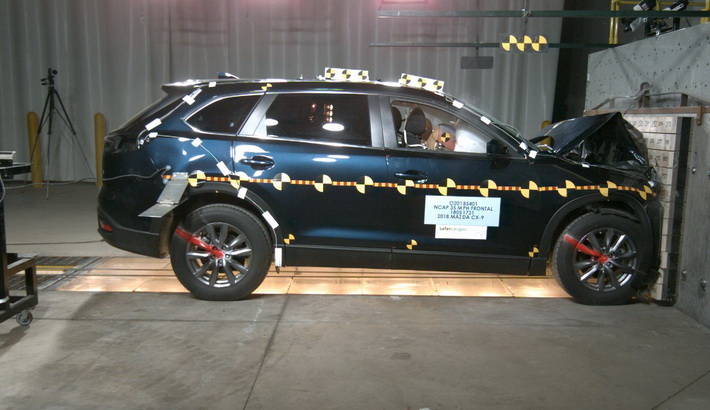
Frontal Crash Test

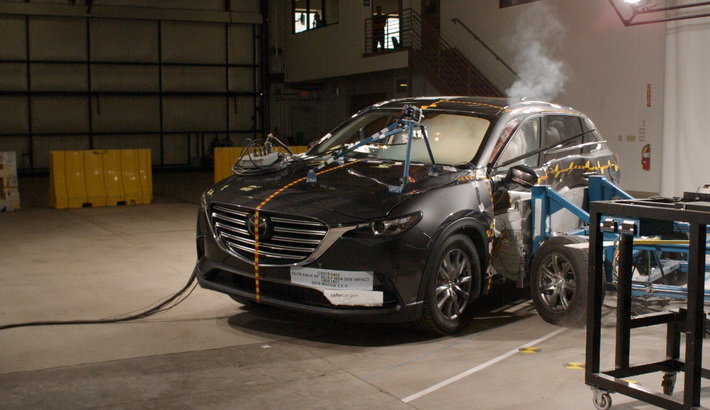
Side Crash Test

Overall Frontal Rating
Driver and Passenger Assessment
Driver Side
Passenger Side
Overall Side Rating
Side Barrier and Side Pole Tests
Driver Side
Passenger Side
Rollover Resistance
15.9% rollover risk in single-vehicle crash
Safety Features
Mazda North American Operations (Mazda) is recalling certain 2018 Mazda3, Mazda6, 2019 CX-3, 2018-2019 MX-5, CX-5, CX-9, and 2019-2020 Mazda2 vehicles. The impeller inside the low-pressure fuel pump may crack and deform, potentially causing the fuel pump to fail.
Remedy Status
Dealers will replace the fuel pumps, free of charge. Owner notification letters were mailed July 18, 2022. Owners may contact Mazda customer service at 1-800-222-5500 Option 4. Mazda's number for this recall is 5321K.
Mazda North American Operations (Mazda) is recalling certain 2019 CX-9 vehicles equipped with Sumitomo Falken ZIEX CT50 A/S tires, size P255/50R20 104V, having date code 1619. An incorrect rubber compound may have been used in the tire's manufacturing, allowing the tread to separate and detach.
Remedy Status
Mazda will notify owners, and dealers will inspect all four tire serial numbers, replacing the tires as necessary, free of charge. The recall began December 4, 2019. Owners may contact Mazda customer service at 1-800-222-5500, Option 4. Mazda's number for this recall is 4019J.
- Coolant leak at cylinder head and turbo at only 63,000 miles. - Safety issue because no warning lamps or messages appeared and potential for car to overheat without coolant circulating in the system. Car could breakdown at worst time and location. Leaking coolant onto exhaust created potential for fire. - Problem has not been confirmed by dealer yet. Appointment is upcoming. - Symptoms of the problem were leaking coolant on ground, low coolant level, heater not working properly. - First appeared 1/29/2026.
Mazda has a current service alert ("SA", SA-001/23) for issues with their Gen 6 Infotainment Center Display, which covers issues (e.g. ghost touch, surface peeling, spider cracks, and white dots) and defects the occur on the primary display of the car. This display provides the driver with essential car operational information. This service alert applies to may of their vehicles in the 2014-2021 range, dependent on model. This VIN provided [XXX] ) is associated with a 2019 CX-9 that within the last month started displaying spider cracks at 2 of the 4 corners of the display. Even though this is a known (manufacturer) issue with other cars that utilize this display, the local Mazda dealership will not cover the replacement for this vehicle as the VIN range has not been included in this SA. The SA does not include CX-9s, but does include Mazda3 (Japan built) with applicable model years 2017-2018 (produced from June 27, 2016 to October 31, 2018). --> This 2019 CX-9 vehicle is Japan built, with a manufacture date of "10/18" (October 2018). Many other people are having this same issue [XXX] ). Please encourage Mazda to expand their Service Alert range for this repair, which should be free (product cost and labor should be both provided at no cost to the consumer) to replace since it's a material issue with the product, not an operator error.... as documented in their SA-001/23. INFORMATION REDACTED PURSUANT TO THE FREEDOM OF INFORMATION ACT (FOIA), 5 U.S.C. 552(B)(6)
1. What component or system failed or malfunctioned, and is it available for inspection upon request? ANSWER: Engine failure due to overheating. 2. safety & indicators: ANSWER: During evening rush hour traffic on a 3 lane highway my car went into a form of engine power saving mode while i had children in the vehicle; this was almost catastrophic form my family and the other vehicles around me. there was NO warning. there were no previous issues with my vehicle, this was unexpected. 3. technician review: this is a known issue with no warning: The technician inspected your vehicle and found a concerning issue with the engine overheating. They scanned the vehicle and found a trouble code P111A, indicating the engine coolant reached a temperature of 251.6 degrees Fahrenheit, forcing the engine into limp mode. Based on their experience, the technician believes the engine likely reached much higher temperatures, potentially causing internal damage to the engine block. After a thorough inspection, they found no external coolant leaks, but upon using a digital borescope, they discovered evidence of coolant entering and being burned off in Cylinder 3. Given the severity of the issue, the technician recommends replacing the entire engine to ensure the long-term reliability and extended life of your vehicle. Services completed: - Scanned vehicle and found trouble code P111A - Inspected engine and found no external coolant leaks - Used digital borescope to inspect cylinders and found coolant entering Cylinder 3 Recommendations: - Replace the entire engine
The contact owns a 2019 Mazda CX-9. The contact stated that a State Inspection was performed on the windshield for cracks. The contact stated that while driving in the rain, the front windshield wipers turned on independently with the switch in the off position. The contact was unable to turn off the windshield wipers. The contact pulled over to the side of the road and turned off the vehicle. When the vehicle was restarted, the front windshield wipers had turned off. The contact stated that the failure persisted and worsened. The contact stated that occasionally the windshield wipers failed to turn off. The vehicle was taken to the dealer; however, no cause for the failure was found. The vehicle was not repaired. The contact purchased and replaced a sensor. Upon investigation, the contact became aware that the on and off switch for the front windshield wipers related to the sensor located on the front windshield. The contact stated that the sensor controlled the on and off switch and failed to function as intended. The contact stated that the OEM windshield provided protection against the sensor malfunctioning; however, if the front windshield was replaced with a non-OEM windshield, the windshield wipers would fail to operate as designed. The manufacturer was not made aware of the failure. The failure mileage was 56,199.
Vehicle jumps while driving. And sometimes stalls.
Failed water pump, blown head gasket, major coolant leak, and warped head causing the vehicle to overheat and die when coming to a stop. Vehicle died when stopped in construction on a highway and we were nearly rear-ended. Vehicle never showed check engine light and temperature gauge never showed that vehicle was overheating but significant damage was caused to the engine from “excessive temperatures.” Failure of warning signals allowed us to continue driving the car with a significant engine issue. Now the entire engine needs replaced at only 83,000 miles. Car was diagnosed by licensed independent repair shop. Additionally, front struts went out at approximately 40,000 miles making the car wobble at higher speeds. Was inspected and replaced by dealership.
Car coolant warning light came on for a short time 5 min after starting car, then would go off. During severely cold days it would come on then go off once the car was warm. On 2/25/25 the coolant warning light appeared and stayed on. The car made loud rickety noise, as it warmed up. After driving 2 miles the car coolant light turned red and began blinking. An alert appeared saying car over heating. The car was stopped and smoke came out of the car. The car leaked blue/greenish fluid. Overnight the car cooled. The next day the car continued making loud rickety noise driving to dealership. Dealership would not honor extended warranty for coolant leaks at the cylinder. The water pump cracked, with coolant leak also causing the cylinder to crack and leak oil. Dealership is suggesting total engine replacement. The car has gone through its normal servicing with no reported issues of coolant leak or depletion. The engine overheated in a span of 2 miles after being parked for 8 hours. The car was
While driving on highway I get a message on my dashboard "High Engine Temperature/Engine Output may be limited" warning message. I pullover and see that the cooland is low. I wait for thee car to cool down and fill with coolant. After 5 minutes of driving, get the same message on dash. I had car towed to Martin Mazda in Delaware. Diagnosis is that I need a new EGR valve and new engine $13,000. How coincidental it has the same symptoms as described in TSB and manifests itself differently and not covered? I even had my vehicle towed to John Kennedy Mazda in Pennsylvania and diagnosis is coolant is leaking into my engine. Too much of a coincidence and I am not the only Mazda owner experiencing this. My car is part of the VIN for the Mazda Powertrain Warranty Extension Technical Service Bulletin 01-002/23 (Feb. 10, 2023). The Mazda Techs are trained to not diagnose as such not to be covered under the warranty due to the enormous economic strain it will put on Mazda corporation. Mazda gets around the class action suits by offering the Warranty Extension but not honoring it. Mazda needs to own up to their mistake and turn this Warranty Extenions TSB into an actual Recall. Will it take an actual stall of the Mazda affected vehicle on the highway causing deaths for some corrective action to be taken?
I am reporting a serious safety issue involving a defective suspension part (lower control arm) manufactured by Dorman and purchased from an online auto parts retailer. On October 7, 2024, I ordered a Dorman lower control arm for my vehicle and had it professionally installed on November 7, 2024 at Johnston and Magwood Wheels & Tires. On November 8, 2024, at approximately 5:40 p.m., while I was driving and made a hard brake, I suddenly lost steering control and my front left wheel collapsed. Fortunately, I was the only one in the car and managed to avoid an accident. My vehicle had to be towed to a nearby shop (Kal Tire) and was later sent back to the original shop for further inspection. On November 12, technicians confirmed that the newly installed lower control arm had failed, which caused serious damage to the suspension. I paid $1,774.10 in repairs in order to make the car safe to drive again. This is extremely dangerous — if I had been driving on a highway or with passengers, it could have resulted in a major accident or injuries. When I contacted the retailer about the warranty, they only offered to refund the part itself and refused to take responsibility for the damages caused by this defective product. I believe this part should be investigated for safety defects. When I searched online, I noticed Dorman has had similar recalls on control arms, which makes me even more concerned. I am reporting this incident to NHTSA in hopes that you will look into this part to protect public safety.
I was backing out of a parking spot while watching the backup camera when I felt a bump as if I hit something but the camera was showing I have enough space to the cars behind me. It turns out the backup camera image was frozen on the display and I had hit a car parked behind my car. Please investigate and make the manufacturer solve problems with the hardware or the software. Make sure the display shows a warning when the camera fails and the vehicle drives backwards. There may be children behind the car. Shifting into park and then into reverse again caused the camera to work correctly.
My 2019 Mazda CX9 when you turn the steering wheel it makes a clicking noise. I brought car to a mechanic and was told there is a loose bolt in steering column. Mazda has a TSB bulletin on this issue TSB# 06-001/24 dated 01/23/2024. When I brought car to Palisades Mazda two other customers on line with me have the same issue. I looked on internet and found alot of people are having the same issue. Mazda is aware of this problem and it is a defect. Mazda is fixing this problem for cars under warranty but charging customers past warranty to replace the complete steering column to fix a loose bolt,
2019 CX-9 GT, 30K miles, in August found coolant leaking under the car. This was 5 months past the warranty (but only 30K miles!). After doing research online, I found this is a massively common issue with all engines from several years encompassing 2019, where the coolant leaks due to a cracked cylinder head. There is a TSB from Mazda, which requires replacement of the engine, once the crack is developed. I immediately called Mazda corporate on 8/15/2024 and opened the case with them. They said they can try to assist, but first I have to take the car to the dealer for diagnosis of the problem. Had to wait 2 weeks, then leave the car, they did a full inspection and confirmed cracked cylinder head. Dealer opened up claim with Mazda (which apparently is separate from the case I made when I called the corporate). I had to go back because Mazda warranty dept. was asking the dealer to prove the engine was overheating, which it hasn't yet, because I kept adding coolant, so the engine never overheated. But the dealer lowered the coolant and had the engine overheat a little bit just to generate the computer code the warranty dept was requiring. This itself was an unnecessary additional potentially damaging scenario, completely unnecessary when the crack in the cylinder head was already found, and the coolant leak is clearly present. After all this, Mazda lowered their original quote from $10K to $6K and expect me to pay this to replace the engine. I called the corporate (customer relations) many times, but they said if the warranty dept. decided this, they cannot change it. And there's no way to talk to warranty dept. directly (not customer facing). We purchased a brand new factory assembled car for well over $40K. Due to a very common, Mazda acknowledged, engine manufacturing defect, the major component of the vehicle, its engine, requires replacement at only 30K miles! This is NOT a reasonable expectancy when purchasing any vehicle.
I have a coolant leak that I have not been able to locate. Despite replacing the radiator, the leak persists. When I contacted the dealer to inquire about estimates for changing the water pump and timing chain, they advised that it would be more cost-effective to replace the entire engine, which would require removing the existing engine at a starting cost of $5,000, with a new engine costing approximately $6,000. They suggested that if I'm already experiencing issues, it might be better to either replace the engine or consider selling the vehicle and purchasing a new one. This response implies that the dealer might be aware of a larger underlying issue and prefers not to address it directly. Experiencing a coolant leak while on the freeway can lead to serious consequences. It can cause the engine to overheat, potentially resulting in significant engine damage and a complete breakdown. This not only poses a safety risk to the driver and passengers but also to other motorists due to the possibility of losing control of the vehicle.
2019 Mazda CX-9 Coolant Leak. 1st warning light just discovered on June 10, 2024. Dealership quoted not under warranty and will cost $14,000 to replace engine. Mazda has an open TSB Technical Service Bulletin for this and many other Mazda's with the same engine- TSB-Coolant Leaks at Cylinder Heads, Bulletin # - 01-013/21 issued 10/15/21 (CRACKED CYLINDER HEADS). Need Mazda to stand by their product and remedy impacted owners.
Started with rough idle then got overheating msg on dashboard. After the diagnostics they found cracked cylinder head and quoted $6000 for replacement. Called Mazda USA and they denied our claim. Car is under 5yrs old & around 74k. While working on the car they noticed the turbo needed it to be rebuilt. Another $2k. There is TSB out for this and it’s a known problem, lot of others having/had same issues. Never had a car that needed an engine replacement even before car is paid off.
In June of 2022, Mazda issued a TSB for an engine flaw that cause coolant to leak in to the engine and significant overheating occurred. This overheating causes the head to warp. The TSB states that the only repair for this is a newer model engine. This happened to my Mazda CX9 and quite a few more. There are class action suits currently ongoing. Mazda never made its owners aware of the TSB. The car can shut down on the highway which is dangerous to all.
Large crack in cylinder head
My car has a 60/40 split adjustable-type second-row seat and the driver side of the 60/40 split-bench second row seat has been sliding forward during braking despite being seemingly locked in place. Apparently, a similar issue was the subject of a safety recall for 2020/2021 Mazda CX-9s (5221I). I have spoken with Mazda and they are not offering to replace the seat as part of the recall since my car is a 2019. While I understand their position, the issue appears to be the exact same one described in the recall of the 2020/2021 models.
I entered my vehicle one day to find what looked to be cracks in the top left hand corner of my center display infotainment screen. However, they appeared to be internal and could not be felt. After doing some research, I came across Service Alert SA-008/18 from Mazda which covered this issue on 2016-2018 CX-9s, among other models. I also found a memo dated May 6, 2020, which detailed an extension of warranty service for these internal display cracks. I took my vehicle to my Mazda dealership who inspected the vehicle and told me they would be filing a claim with Mazda for the repair of the screen since there wasn't a current recall for this issue on my vehicle. Mazda agreed to partially cover the replacement with me being responsible for a $543 copay. I have spoken to Mazda Corporate about this resolution being unacceptable. This issue is a known manufacturing defect on earlier models of the CX-9, and it is obviously still an issue on the 2019 models. I explained to them that this was in no way a fault of my own and I feel that the screen should be replaced at no charge to me, which was the procedure for those affected by this issue with 2016-2018 models. As of right now, the cracks only affect the top left corner of my screen but I have read of many instances where vehicle owners had the cracks continue to spread, which I feel is very distracting to the driver. I strongly feel that Mazda should be performing a goodwill replacement in full for this issue at no cost to me as the consumer, and I am very disappointed that so far they are unwilling to do so.
The contact’s husband owns a 2019 Mazda CX-9. The contact stated that while the vehicle was at the dealer for a diagnostic test, she was informed that the head gasket was cracked, and fluids were leaking into the engine. The vehicle was not repaired due to the cost. Additionally, the message “Excessive Engine Temperature - Engine Output Will be Limited" was displayed. The vehicle was not included in NHTSA Campaign Number: 21V875000 (Fuel System, Gasoline). The manufacturer was made aware of the failure. The failure mileage was approximately 62,756.
Showing 1–20 of 25 complaints
The 2019 Mazda CX-9 has 2 recalls recorded by NHTSA.
NHTSA has received 50 owner-reported complaints for the 2019 Mazda CX-9.
The 2019 Mazda CX-9 received an overall safety rating of 5 out of 5 stars from NHTSA.
The most commonly reported complaint categories for the 2019 Mazda CX-9 are engine (14 reports), unknown or other (6 reports), electrical system (4 reports).
Yes. NHTSA has 2 recalls on record for the 2019 Mazda CX-9. Scroll up to review the published recall summaries, consequences, and remedies. To check for unrepaired recalls on your specific vehicle, use your VIN at nhtsa.gov/recalls.
Look up recalls and complaints for any year, make, and model.
This page summarizes publicly available data from the National Highway Traffic Safety Administration (NHTSA). Complaint counts reflect reports submitted to NHTSA by vehicle owners and do not by themselves prove defect severity or vehicle safety. Safety ratings may not be available for all vehicle-years. This site is not affiliated with NHTSA or any vehicle manufacturer. For official information, visit the official NHTSA page for this vehicle.