Toyota · Avalon · 2019
2019 Toyota Avalon
4
Recalls
64
Complaints
5/5
Safety Rating
The 2019 Toyota Avalon has 4 recalls and 64 owner-reported complaints on file with NHTSA. Overall safety rating: 5 out of 5 stars. Most reported issue: fuel/propulsion system (14 reports).
Source: NHTSA Public Records · Updated Apr 29, 2026
Research Context
The 2019 Toyota Avalon page works best as a research starting point. Complaint totals show how much owner-reported activity exists, while recalls and investigations help show whether any of that activity turned into formal safety action.
Because this is a newer-era vehicle page, it usually helps to compare this year against nearby model years before deciding whether a complaint pattern looks isolated or persistent. On this page, the most prominent complaint area is fuel/propulsion system with 14 reported complaints.
Best Research Moves
- Use the complaint log to understand what owners were actually reporting instead of relying only on the raw complaint total.
- Review the recall section even if the total is smaller, because a limited number of recalls can still point to meaningful safety actions.
- This page is primarily a complaints-and-recalls research surface, so compare nearby model years before treating the complaint total as a standalone verdict.
Key Takeaways
- The 2019 Toyota Avalon currently shows 4 NHTSA recalls listed on this page and 64 owner-reported complaints.
- This page currently shows no linked NHTSA investigations.
- This page reflects complaint volume, recall history, and NHTSA test data, but it does not diagnose causes or rank reliability by itself.
- Safety data currently shows 5/5 overall NHTSA safety rating.
- The most frequently reported complaint categories on this page are fuel/propulsion system (14), electrical system (7), power train (4).
- Vehicle
- 2019 Toyota Avalon
- Recalls
- 4
- Complaints
- 64
- Safety Rating
- 5/5
How to Interpret This Page
This page combines three types of NHTSA data: recall campaigns (official manufacturer or government actions), owner complaints (unverified consumer reports), and crash test ratings (where available). A vehicle with many complaints is not necessarily less reliable — complaint volume correlates with sales volume and vehicle age. Recalls indicate identified defects, not overall quality. To compare this model year with others, use the year navigation in the sidebar or return to the model overview page.
If you are researching a used vehicle, start with the complaint categories, compare them against the recall list, and then check nearby model years to see whether the same issue profile repeats. That usually produces a better buying or research signal than treating the raw complaint total as a standalone safety ranking.
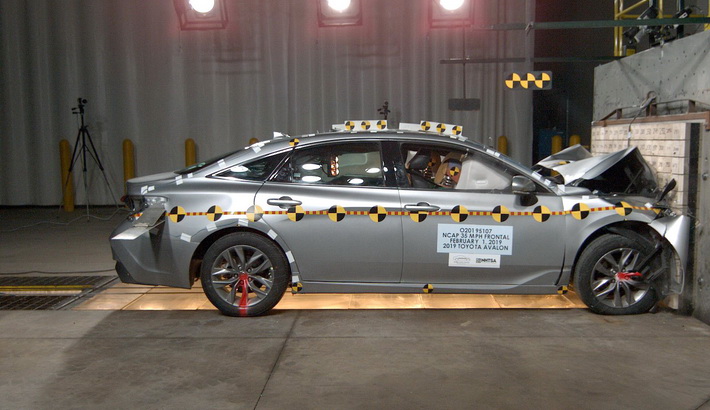
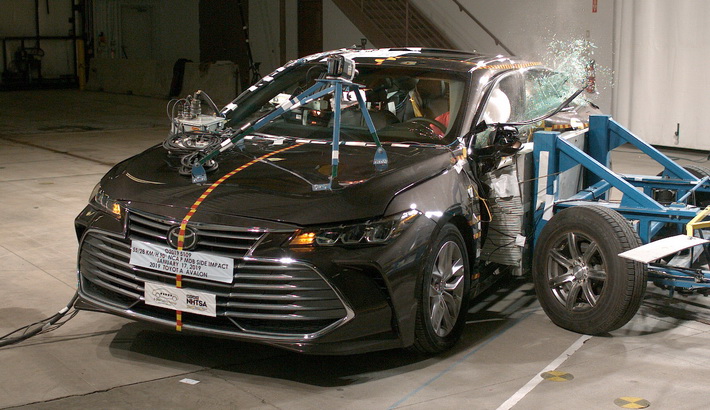
NHTSA Crash Test Performance
Frontal Crash Test
Side Crash Test
Overall Frontal Rating
Driver and Passenger Assessment
Driver Side
Passenger Side
Overall Side Rating
Side Barrier and Side Pole Tests
Driver Side
Passenger Side
Rollover Resistance
10.5% rollover risk in single-vehicle crash
Safety Features
ESC: StandardForward Collision Warning: StandardLane Departure Warning: Standard
Recall Notices
NHTSANHTSA ID: 20V682000November 04, 2020
FUEL SYSTEM, GASOLINE:DELIVERY:FUEL PUMP
Toyota Motor Engineering & Manufacturing (Toyota) is recalling certain 2018-2019 4Runner, 2019-2020 Avalon, 2019 Corolla Hatchback, 2017-2019 Highlander, 2018-2020 Camry, 2020 Corolla, 2018-2019 Land Cruiser, 2017-2020 Tacoma, 2019-2020 RAV4, 2019-2020 Sequoia, 2017-2020 Sienna, 2019-2020 Tundra, 2018-2020 Lexus ES350, 2017 Lexus GS200t, 2017-2019 Lexus GS350, 2019 Lexus GS300, 2018-2020 Lexus LC500h, 2019-2020 Lexus LS500, 2018-2019 Lexus GX460, 2017 Lexus IS200t, 2019 Lexus IS300, 2019 Lexus IS350, 2018-2020 Lexus LC500, 2018 Lexus LS500, 2019 Lexus LS500h, 2018-2019 Lexus LX570, 2017 Lexus RC200t, 2019 Lexus RC300, RC350, 2017 and 2019-2020 Lexus RX350, 2018-2020 RX350L, 2019 Lexus UX200, 2018-2019 Lexus NX300 vehicles. The low-pressure fuel pump inside the fuel tank may fail.
Remedy Status
Toyota will notify owners, and dealers will replace the fuel pump assembly with an improved one, free of charge. Owners of specific models were notified that remedy parts were available starting January 21, 2021. Owners of other models will be notified as remedy parts become available. Remedy parts should be available for all affected vehicles by late March 2021. Owners may contact Toyota customer service at 1-888-270-9371 or Lexus customer service at 1-800-255-3987. Note: This recall is an expansion of recall 20V-012. Toyota's number for this recall is 20TA02. Lexus' number for this recall is 20LA01.
NHTSA ID: 20V012000January 13, 2020
FUEL SYSTEM, GASOLINE:DELIVERY:FUEL PUMP
Toyota Motor Engineering & Manufacturing (Toyota) recalled certain 2018-2019 4Runner, Highlander, Camry, Land Cruiser, Sequoia, Sienna, Tacoma and Tundra, and Lexus RC 300, RC 350, GS 350, GX 460, IS 300, LC 500, LS 500, LX 570, RX 350L, and 2019 Toyota Avalon and Corolla, and certain Lexus NX 300, and ES 350 vehicles on January 13, 2020. On March 4, 2020, Toyota expanded the recall to include certain 2014-2015 Toyota 4Runner and Land Cruiser, 2018 Avalon, Corolla, 2014 FJ Cruiser, 2017 Sienna and Lexus 2018 ES 350, 2018-2019 GS 300, 2013-2014 GS350, 2014-2015 GX 460, IS 350 and LX 570, 2014 IS F, 2018-2019 IS 350, LC 500H and LS 500H, 2013-2015 LS 460, 2015 NX 200T and RC350, 2017 RC 200T and RX 350. Toyota also removed the 2018-2019 Toyota 4Runner and Land Cruiser and 2018-2019 Lexus GX 460 and LX 570 and 2019 NX300 from inclusion in this recall. On March 19, 2020, Toyota expanded the recall to include 2015 Lexus GS350 vehicles. The low-pressure fuel pump inside the fuel tank may fail.
Remedy Status
Toyota will notify owners, and dealers will replace the fuel pump, free of charge. The recall began May 4, 2020. Owners may contact Toyota customer service at 1-888-270-9371 or Lexus customer service at 1-800-255-3987. Toyota's numbers for this recall are 20TB02 and 20TA02 for Toyota vehicles and 20LB01 and 20LA01 for Lexus vehicles.
NHTSA ID: 19V244000March 27, 2019
EQUIPMENT:OTHER:LABELS
Gulf States Toyota (GST) is recalling certain 2019 C-HR, 4Runner, Avalon, Avalon Hybrid, Camry, Camry Hybrid, Highlander, Land Cruiser, Prius, RAV4, Sequoia, Tacoma, Sienna, Tundra and Yaris vehicles. The text on the load capacity label may become illegible. As such, these vehicles fail to comply with the requirements of Federal Motor Vehicle Safety Standard (FMVSS) number 110, "Tire Selection and Rims."
Remedy Status
GST will notify owners, and dealers will provide corrected load carrying capacity modification labels, free of charge. The recall began May 24, 2019. Owners may contact GST customer service at 1-800-444-1074. GST's number for this recall is 19R1.
NHTSA ID: 18V685000October 04, 2018
ELECTRICAL SYSTEM:SOFTWARE
Toyota Motor Engineering & Manufacturing (Toyota) is recalling certain 2018-2019 Toyota Tundra and Sequoia vehicles and 2019 Toyota Avalon and Avalon Hybrid vehicles. The air bag electronic control unit (ECU) may erroneously detect a fault during the vehicle start-up self check. If this occurs, the ECU may not deploy the airbags as intended, in the event of a crash. As such, these vehicles fail to comply with the requirements of Federal Motor Vehicle Safety Standard (FMVSS) number 208, "Occupant Crash Protection," and 214, "Side Impact Protection."
Remedy Status
Toyota will notify owners, and dealers will update the software for the air bag ECU, free of charge. The recall began October 26, 2018. Owners may contact Toyota customer service at 1-888-270-9371. Toyota's number for this recall is J0X. Note: 18V-122 was superseded by this recall. The software remedy also includes the updates to the software for 18V-122.
Owner Complaints
64 totalFUEL/PROPULSION SYSTEM
Mar 6, 2026
Engine does not start or takes longer to start because fuel line does not hold pressure after turning off engine.
BACK OVER PREVENTION
Feb 1, 2026
I am experiencing the same malfunction with my backup camera/parking assist software that a million other VINs were recalled for. I called Toyota and was essentially told that not enough people from my cars' "batch" have complained. The malfunction is inconsistent, sometimes the ...
Preview excerpt
ELECTRICAL SYSTEM
Dec 31, 2025
I am writing to formally report a serious and ongoing safety issue involving the Telematics / Data Communication Module (DCM) installed in Toyota vehicles. This issue presents a clear risk to driver and passenger safety and warrants immediate corrective action. The DCM is respon...
Preview excerpt
ELECTRICAL SYSTEM
Nov 8, 2025
The contact owns a 2019 Toyota Avalon. The contact stated that while driving at an undisclosed speed, several unknown warning lights illuminated, and the engine seized. The contact stated that a good Samaritan attempted to start the vehicle, but the vehicle failed to restart. The...
Preview excerpt
UNKNOWN OR OTHER
Oct 1, 2025
The 12.3 in Bird's Eye system with backup camera produces a "black screen" when in reverse and when viewing the forward camera when parking. When driving in snow or rain, the collision warning system becomes unavailable due to the precipitation. I believe these are two separa...
Preview excerpt
LANE DEPARTURE,BACK OVER PREVENTION
Sep 12, 2025
Recurring issue with blind spot and rear cross traffic malfunction alerts. Toyota had issued a service bulletin for this concern. Dealer had to reprogram the module under part: 39151 T-SB-0034-19. CODE C1AB4 and C1AB5.
POWER TRAIN,ELECTRICAL SYSTEM,FUEL/PROPULSION SYSTEM
Jul 17, 2025
I purchased this Vehicle as a Preowned Used Certified from The Toyota dealership The car has broke down 4 times for the same exact ISSUES All the lights will come on and it will say take to the dealer for Service June 8 2024 purchased the Car. November 2024 in the shop ( sensor )...
Preview excerpt
SERVICE BRAKES,FORWARD COLLISION AVOIDANCE
Jul 2, 2025
After starting to accelerate from a stop light ,the Dashboard had a warning message that the accelerator and brake pedals were pressed simultaneously. The acceleration stopped and the car slowed automatically. After a few seconds the warning indicator went away and the car could ...
Preview excerpt
POWER TRAIN
May 4, 2025
Jerking and grinding noise in the transmission
ELECTRICAL SYSTEM
Mar 8, 2025
When starting the vehicle, an extremely high pitched noise is emitted from the speakers. This high pitch seems like its comes out full volume out the speakers. Ear piercing noise leaves my ears ringing every time.
Showing 10 recent complaints from 64 total
View Full Complaint LogCompare Related Vehicles
Why Compare These Pages
The strongest comparison flow is usually: exact vehicle-year page, then nearby years of the same model, then other 2019 Toyota models. That sequence helps separate one-off year spikes from broader make-wide patterns.
More Toyota Avalon Years
2020 Toyota AvalonCompare this year against 2019 for complaint and recall shifts.3r10c2018 Toyota AvalonCompare this year against 2019 for complaint and recall shifts.2r1i24c2021 Toyota AvalonCompare this year against 2019 for complaint and recall shifts.2r21c2017 Toyota AvalonCompare this year against 2019 for complaint and recall shifts.2r1i14c2022 Toyota AvalonCompare this year against 2019 for complaint and recall shifts.6c2016 Toyota AvalonCompare this year against 2019 for complaint and recall shifts.3r1i23c
More 2019 Toyota Models
2019 Toyota RAV4Another 2019 Toyota option for same-year comparison.7r855c2019 Toyota HighlanderAnother 2019 Toyota option for same-year comparison.3r441c2019 Toyota CamryAnother 2019 Toyota option for same-year comparison.6r365c2019 Toyota TacomaAnother 2019 Toyota option for same-year comparison.4r1i206c2019 Toyota CorollaAnother 2019 Toyota option for same-year comparison.5r1i198c2019 Toyota C-HRAnother 2019 Toyota option for same-year comparison.3r85c
Frequently Asked Questions
How many recalls does the 2019 Toyota Avalon have?
The 2019 Toyota Avalon has 4 recalls recorded by NHTSA.
How many complaints have been filed for the 2019 Toyota Avalon?
NHTSA has received 64 owner-reported complaints for the 2019 Toyota Avalon.
What is the NHTSA safety rating for the 2019 Toyota Avalon?
The 2019 Toyota Avalon received an overall safety rating of 5 out of 5 stars from NHTSA.
What are the most common problems with the 2019 Toyota Avalon?
The most commonly reported complaint categories for the 2019 Toyota Avalon are fuel/propulsion system (14 reports), electrical system (7 reports), power train (4 reports).
Does the 2019 Toyota Avalon have any recalls?
Yes. NHTSA has 4 recalls on record for the 2019 Toyota Avalon. Scroll up to review the published recall summaries, consequences, and remedies. To check for unrepaired recalls on your specific vehicle, use your VIN at nhtsa.gov/recalls.
Check Another Vehicle
Look up recalls and complaints for any year, make, and model.
This page summarizes publicly available data from the National Highway Traffic Safety Administration (NHTSA). Complaint counts reflect reports submitted to NHTSA by vehicle owners and do not by themselves prove defect severity or vehicle safety. Safety ratings may not be available for all vehicle-years. This site is not affiliated with NHTSA or any vehicle manufacturer. For official information, visit the official NHTSA page for this vehicle.