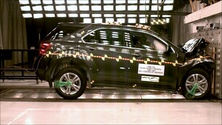
Chevrolet · Equinox · 2017
0
Recalls
268
Complaints
4/5
Safety Rating
The 2017 Chevrolet Equinox has no recalls and 268 owner-reported complaints on file with NHTSA. Overall safety rating: 4 out of 5 stars. Most reported issue: engine (123 reports).
Source: NHTSA Public Records · Updated Apr 22, 2026
This page combines three types of NHTSA data: recall campaigns (official manufacturer or government actions), owner complaints (unverified consumer reports), and crash test ratings (where available). A vehicle with many complaints is not necessarily less reliable — complaint volume correlates with sales volume and vehicle age. Recalls indicate identified defects, not overall quality. To compare this model year with others, use the year navigation in the sidebar or return to the model overview page.
Frontal Crash Test

Side Crash Test

Overall Frontal Rating
Driver and Passenger Assessment
Driver Side
Passenger Side
Overall Side Rating
Side Barrier and Side Pole Tests
Driver Side
Passenger Side
Rollover Resistance
19.1% rollover risk in single-vehicle crash
Safety Features
Odometer Fraud. The contact purchased a 2017 Chevrolet Equinox. The contact discovered a mileage discrepancy after the purchase. The vehicle was a private sale. At the time of purchase, the vehicle mileage was 98,000. The contact found paperwork inside the glove compartment that indicated that the mileage on the Title was 156,300. The contact purchased the Carfax Report and confirmed the mileage. The contact filed a report with the local Police Department.
The contact owns a 2017 Chevrolet Equinox. While the contact’s son was driving at an undisclosed speed, the vehicle unexpectedly started shaking, and the check engine warning light illuminated. The vehicle was towed to an independent mechanic, where it was diagnosed and determined that the rear engine seal had failed and needed to be replaced. The vehicle was not repaired. The dealer was not contacted. The vehicle was not diagnosed or repaired. The manufacturer was made aware of the failure and referred the contact to the NHTSA Hotline for further assistance. The approximate failure mileage was 130,000.
Due to cold temperatures, the main rear seal blew causing engine, coolant and intake systems to fail. Full replacements are now needed.
The contact owns a 2017 Chevrolet Equinox. The contact stated that while driving approximately 55 MPH, the vehicle went into LIMP Mode and the vehicle decelerated to 5 MPH. The contact stated that the message "Vehicle Entering Power Saver Mode" was displayed. The vehicle was pulled over to the side of the road, and the vehicle stalled. The contact stated that when the vehicle was restarted, the message “Engine Oil Level Low – Shut-off Immediately" was displayed, and the vehicle stalled. The vehicle was towed to a dealer, where it was diagnosed and determined that the rear main seal had failed and needed to be replaced. The vehicle was not repaired. The manufacturer was notified of the failure, and a complaint was filed. The failure mileage was approximately 88,000.
On 1/27/26, while driving at highway speeds, I received a "Reduced Engine Power" alert. I was forced to pull over immediately; the vehicle stalled before I could reach a complete stop. This left me stranded in dangerously cold temperatures for an extended period while awaiting a tow. Upon inspection, I was informed that the engine has failed and requires a complete replacement. This is highly distressing for several reasons: * Low Mileage: The vehicle has only 54,000 miles and is well under the expected lifespan of a modern engine. * Meticulous Maintenance: As a loyal customer, I have had every scheduled oil change and service performed at my local Chevrolet dealership. My service history will confirm that this vehicle has been maintained to the highest standards. * Brand Loyalty: I have been a dedicated Chevrolet owner for years, having purchased five brand-new vehicles from your dealerships. I chose Chevrolet based on a reputation for reliability that, in this instance, has not been met. "I am specifically concerned because my vehicle's symptoms align with Special Coverage Adjustment #14882 (PCV Icing). Given that the failure occurred during extreme cold and resulted in immediate engine failure, it appears to be the exact scenario outlined in your technical service bulletins regarding the 2.4L engine. I am requesting that this repair be handled under that special coverage or a similar goodwill extension." My research indicates that this specific engine model has a documented history of similar issues. Given my history with the brand and the premature nature of this failure, I am requesting that Chevrolet review my case for a goodwill repair adjustment or a significant cost-sharing assistance for the engine replacement.
2017 chevrolet Equinox LT with a 2.4L ecotec engine. The PCV system froze due to the cold weather conditions caused the rear main seal to blow futher causing cylinder scoring to the engine. I got it checked out by a local mechanic that actually works with the extended warranty company called Silverrock that's provided from the dealership Drivetime from who I financed the truck from. The mechanic shop name is hoekstra muffler and alignment located at 722 W 151st St, East Chicago, IN 46312. They were the ones to diagnose the problem and provided me with a diagnostic sheet for this issue. The vehicle has not been checked by a chevrolet technician yet. I took the truck in for a regular maintenance oil change on January 8th at Walmart in portage, indiana. My truck was driving fine and suddenly on January 20th my truck seized on the highway on my way to work at 7am. A warning light marking low oil pressure turn off engine was marking on my dashboard. After i was in a safe spot on the side of the expressway, I have Life360 and proceeded to call for a tow truck. When the tow truck driver arrived in order to put the car in neutral he has to jump start my equinox. My truck will only start if it's jumped and keep the cables connected, otherwise it shuts off.
The contact owns a 2017 Chevrolet Equinox. The contact stated that while driving approximately 30 MPH, there was a knocking sound coming from the engine compartment before the vehicle stalled. The vehicle was coasted to the side of the road. The contact attempted to restart the vehicle; however, the vehicle failed to restart with a knocking sound coming from the engine. The vehicle was towed to an independent mechanic, where it was diagnosed, and it was determined that oil had seeped out of the vehicle, a seal was fractured, and the engine had seized. The manufacturer was notified of the failure. The vehicle was not repaired. The failure mileage was unknown.
I have had this car for a little under a year. In January of this year 2026, I was driving on the freeway when I received a. reduce engine power alert. Which caused me to immediately get off of the freeway put the car power down before I can make it another half a mile. After having it looked at several times what was thought to be a rear seal oil leak turned out to be a leak in the transmission. Repairs as of now our thoughts to be needing an entire new transmission. . Repairs as of now our thoughts to be needing a entire new transmission. I don’t understand why there is no recall for this specific situation. Upon my research, I have seen many complaints many concerns of the exact same thing of the exact same making model of these cars. I have not been able to drive the car since January and have been paying for a rental. With cost estimated to be between 1500 and $4000. Surely there’s something that Chevrolet can do for all of the people who are having the same problems with the equinox
There is water my oil and I have a blown head gasket. I get all maintenance done and have oil changes on time
I am submitting this complaint regarding a serious safety defect involving a 2017 Chevrolet Equinox that experienced a sudden and complete loss of engine power while the vehicle was in motion. While traveling approximately 50 mph in active traffic, the engine abruptly shut off and the vehicle immediately lost all ability to accelerate. The loss of propulsion was total and occurred without warning. There were no warning lights, alerts, or indicators of a low oil or engine condition prior to the failure. Moments before the shutdown, the engine began making an abnormal mechanical noise. A video was recorded during the incident while the vehicle was still operating in traffic. The recording captures the engine failure in real time, including the vehicle decelerating from approximately 50 mph to a complete stop as the engine shut down. I was able to coast into a breakdown lane and then into a nearby parking lot, narrowly avoiding a collision. A sudden loss of propulsion at this speed and in these conditions presents a severe and immediate safety risk to vehicle occupants and surrounding traffic. This vehicle has been regularly serviced by authorized Chevrolet dealerships and maintained according to the manufacturer’s recommended schedule. At no point was I advised that the vehicle required frequent manual oil checks between scheduled oil changes, nor did the vehicle provide any warning prior to engine shutdown. I routinely operate this vehicle at highway speeds and regularly transport my child. Had this failure occurred on a highway or in heavier traffic, the risk of serious injury or fatality would have been significant. The exact cause is UNKNOWN at this time. The vehicle is available for inspection, and I can provide maintenance records and video documentation upon request.
The 2.4L engine is experiencing significant issues, including power loss and rapid oil consumption. The power loss has been observed while driving on both expressways and city streets. The oil burning commenced less than a month after an oil change, resulting in an oil level of zero. This situation poses a risk of accidents and endangers the occupants of the vehicle. An independent service center has confirmed the problem. The center determined that a new engine is necessary as the issue cannot be resolved. There have been no inspections by manufacturers, law enforcement, or other relevant authorities. Additionally, there was no warning about the oil being low to the point of being absent from the engine. The code for the power failure, P0303, was obtained from the service center. It is imperative that this issue be addressed promptly. Either the engine should be recalled or the vehicle should be repaired. Otherwise, I will be compelled to purchase a new engine or a new car.
Received a report from local auto repair and they found that the oil main seal is leaking. Issue happened in the highway and car automatically turned off the engine. I was not in an accident as there was no one else on the road and I was able to push it to the side. When the car turned on the wheel was stiff and hardly moved to the right or left. The warning received before the shut off was the service stabilitrack issues and when checked all oil completely depleted from the vehicle.
The contact owned a 2017 Chevrolet Equinox. The contact stated that while driving at approximately 55 MPH, the vehicle collided with a deer. During the crash, the air bags became inoperable and failed to inflate or expose themselves out of the housing, and an “Air Bag Needs Service” warning message was displayed. The contact also noticed a strong fume-like odor following the impact and stated that the air bag system appeared to engage but did not deploy. No injuries were sustained, and no medical attention was required. A police report was filed. The vehicle was not towed, and law enforcement advised the contact that the vehicle could be safely driven home. The dealer was not contacted. The vehicle was not diagnosed or repaired. The vehicle was later deemed a total loss by the contact's insurance agency. The manufacturer was not made aware of the failure. The approximate failure mileage was 104,000.
What component or system failed or malfunctioned, and is it available for inspection upon request? - 2.4L engine failure. PCV system froze Dec 05 2025. Crankcase pressure increased and caused the rear main engine seal to fail, which inturn allowed all the engine oil to leak out. Due to oil starvation the timing chain components failed. Additional internal engine damage is possible, but not yet confirmed. Failed parts will be available for inspection. How was your safety or the safety of others put at risk? Engine failure while driving with no notice. Happened on a day with sub zero wind chill. Stalled vehicle poses a safety risk to occupants and other drivers. Has the problem been reproduced or confirmed by a dealer or independent service center? UNKNOWN Has the vehicle or component been inspected by the manufacturer, police, insurance representatives or others? UNKNOWN Were there any warning lamps, messages or other symptoms of the problem prior to the failure, and when did they first appear? UNKNOWN
Twice the exhaust has leaked into the cabin to the point where it is very noticeable. It causes headaches and breathing problems. GM has known of this issue for several years and it has been reported several times. GM placed a bandaid on it knowing it would fail.
The contact owns a 2017 Chevrolet Equinox. The contact stated that while driving at 10 MPH, there was an abnormal odor entering the cabin of the vehicle while the air conditioning system was activated or turned off. A dealer was contacted. The vehicle was taken to a dealer, where it was diagnosed and determined that there was a leak in the exhaust pipe, and that the exhaust pipe needed to be replaced. The vehicle was not repaired. The manufacturer was notified of the failure but offered no assistance. The failure mileage was unknown.
While driving my 2017 Chevrolet Equinox, the vehicle repeatedly displays diagnostic trouble code P2138 (Throttle/Pedal Position Sensor Voltage Correlation). The vehicle suddenly enters “Reduced Engine Power” mode without warning and loses acceleration while driving. This occurs daily and multiple times per day, both on highways and local roads. When the issue happens, the vehicle will not properly accelerate and loses power unexpectedly. This creates a serious safety hazard, especially in highway traffic, as I am unable to maintain speed or accelerate to avoid other vehicles. I have had to maneuver carefully or move toward the shoulder to avoid potential collisions. The throttle body has already been replaced; however, the problem continues to occur. The defect has not been corrected and remains ongoing and reproducible. I am currently [XXX] pregnant and drive this vehicle daily for work and to transport my [XXX] child to school. The unexpected loss of power places both myself and my child at risk while operating the vehicle in active traffic. This defect presents a significant safety concern due to repeated and sudden loss of engine power while driving. The vehicle is available for inspection upon request. INFORMATION REDACTED PURSUANT TO THE FREEDOM OF INFORMATION ACT (FOIA), 5 U.S.C. 552(B)(6)
Driving on the highway, nothing unusual or out of the ordinary. Within a 30 second span of time, the car started making a horrible rattling sound, followed by a loud snap sound, then smoke, then I was off the road with oil pouring out of the bottom of the car. Towed home, car was dropped off at the Chevrolet dealership mechanic. As far as I can tell, it fits the description that others have had with this car, namely that some apparent oil consumption issue that never came up on warning lamps resulted in the catastrophic engine failure that nearly launched me off the highway. The vehicle is currently awaiting diagnostics from the mechanic, and I have yet to hear back from them over a week later. There were no warning lights of any sort, and the oil life meter said there was 38% oil life remaining before it would need an oil change. If I had known about this issue before I bought the car, there is a 0% chance I would have bought it.
I have the ECOTEC 2.4 engine the engine has gone out and GM is stating car needs a new engine. At 10,000. Two different associates told me to get a new car before they even checked the car.
The contact owns a 2017 Chevrolet Equinox. The contact stated that on several occasions while driving at undisclosed speeds, the vehicle stalled. There were no warning lights illuminated. The contact stated that while accelerating from a stoplight, the engine seized without any warning lights illuminated. The dealer was not contacted. The vehicle was not diagnosed or repaired. The manufacturer was made aware of the failure and referred the contact to the NHTSA Hotline for assistance. The approximate failure mileage was 147,000.
Showing 1–20 of 25 complaints
The 2017 Chevrolet Equinox has 0 recalls recorded by NHTSA.
NHTSA has received 268 owner-reported complaints for the 2017 Chevrolet Equinox.
The 2017 Chevrolet Equinox received an overall safety rating of 4 out of 5 stars from NHTSA.
The most commonly reported complaint categories for the 2017 Chevrolet Equinox are engine (123 reports), unknown or other (12 reports), power train (12 reports).
NHTSA does not currently list any recalls on record for the 2017 Chevrolet Equinox. To verify the status of your specific vehicle, check nhtsa.gov/recalls with your VIN.
Look up recalls and complaints for any year, make, and model.
This page summarizes publicly available data from the National Highway Traffic Safety Administration (NHTSA). Complaint counts reflect reports submitted to NHTSA by vehicle owners and do not by themselves prove defect severity or vehicle safety. Safety ratings may not be available for all vehicle-years. This site is not affiliated with NHTSA or any vehicle manufacturer. For official information, visit the official NHTSA page for this vehicle.