Nissan · Ariya · 2023
2023 Nissan Ariya
4
Recalls
37
Complaints
5/5
Safety Rating
The 2023 Nissan Ariya has 4 recalls and 37 owner-reported complaints on file with NHTSA. Overall safety rating: 5 out of 5 stars. Most reported issue: electrical system (7 reports).
Source: NHTSA Public Records · Updated Apr 28, 2026
Research Context
The 2023 Nissan Ariya page works best as a research starting point. Complaint totals show how much owner-reported activity exists, while recalls and investigations help show whether any of that activity turned into formal safety action.
Because this is a newer-era vehicle page, it usually helps to compare this year against nearby model years before deciding whether a complaint pattern looks isolated or persistent. On this page, the most prominent complaint area is electrical system with 7 reported complaints.
Best Research Moves
- Use the complaint log to understand what owners were actually reporting instead of relying only on the raw complaint total.
- Review the recall section even if the total is smaller, because a limited number of recalls can still point to meaningful safety actions.
- This page is primarily a complaints-and-recalls research surface, so compare nearby model years before treating the complaint total as a standalone verdict.
Key Takeaways
- The 2023 Nissan Ariya currently shows 4 NHTSA recalls listed on this page and 37 owner-reported complaints.
- This page currently shows no linked NHTSA investigations.
- This page reflects complaint volume, recall history, and NHTSA test data, but it does not diagnose causes or rank reliability by itself.
- Safety data currently shows 5/5 overall NHTSA safety rating.
- The most frequently reported complaint categories on this page are electrical system (7), electrical system,engine (3), power train (3).
- Vehicle
- 2023 Nissan Ariya
- Recalls
- 4
- Complaints
- 37
- Safety Rating
- 5/5
How to Interpret This Page
This page combines three types of NHTSA data: recall campaigns (official manufacturer or government actions), owner complaints (unverified consumer reports), and crash test ratings (where available). A vehicle with many complaints is not necessarily less reliable — complaint volume correlates with sales volume and vehicle age. Recalls indicate identified defects, not overall quality. To compare this model year with others, use the year navigation in the sidebar or return to the model overview page.
If you are researching a used vehicle, start with the complaint categories, compare them against the recall list, and then check nearby model years to see whether the same issue profile repeats. That usually produces a better buying or research signal than treating the raw complaint total as a standalone safety ranking.
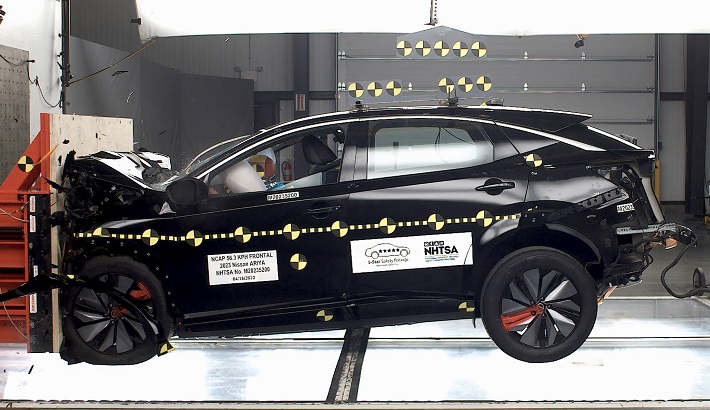
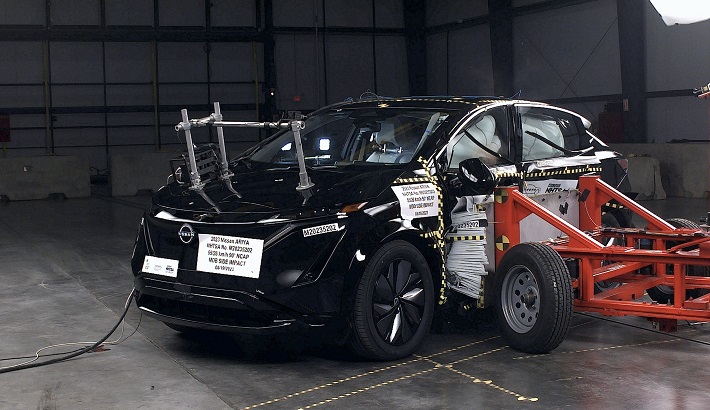
NHTSA Crash Test Performance
Frontal Crash Test
Side Crash Test
Overall Frontal Rating
Driver and Passenger Assessment
Driver Side
Passenger Side
Overall Side Rating
Side Barrier and Side Pole Tests
Driver Side
Passenger Side
Rollover Resistance
10.7% rollover risk in single-vehicle crash
Safety Features
ESC: StandardForward Collision Warning: StandardLane Departure Warning: Standard
Recall Notices
NHTSANHTSA ID: 24V560000July 25, 2024
ELECTRICAL SYSTEM:PROPULSION SYSTEM:INVERTER
Nissan North America, Inc. (Nissan) is recalling certain 2023 Ariya vehicles. The inverter software may misdiagnose an error, which can shut down the EV system, resulting in a loss of drive power.
Remedy Status
Dealers will inspect the vehicle's inverter software version and update the software, if necessary, free of charge. Owner notification letters were mailed September 12, 2024. Owners may contact Nissan's customer service at 1-800-867-7669. Nissan's number for this recall is R24A8.
NHTSA ID: 24V391000June 03, 2024
ELECTRICAL SYSTEM:PROPULSION SYSTEM:TRACTION MOTOR
Nissan North America, Inc. (Nissan) is recalling certain 2023 Ariya vehicles. O-rings inside the electric front traction motor may have been damaged during assembly, which can result in an internal oil leak and an unexpected loss of drive power.
Remedy Status
Dealers will replace the front traction motor assembly, free of charge. Owner notification letters were mailed July 26, 2024. Owners may contact Nissan's customer service at 1-800-867-7669. Nissan's number for this recall is R24A3.
NHTSA ID: 23V657000September 28, 2023
ELECTRICAL SYSTEM:PROPULSION SYSTEM:INVERTER
Nissan North America, Inc. (Nissan) is recalling certain 2023 Ariya vehicles. The inverter software may detect a short circuit and shut down the EV system, resulting in a loss of drive power.
Remedy Status
Dealers will reprogram the inverter software, free of charge. Owner notification letters were mailed October 20, 2023. Owners may contact Nissan's customer service at 1-800-867-7669. Nissan's number for this recall is R23C6.
NHTSA ID: 23V131000February 28, 2023
STEERING:CRITICAL FASTENERS
Nissan North America, Inc. (Nissan) is recalling certain 2023 Ariya vehicles. The steering wheel bolt may have been tightened incorrectly or not installed.
Remedy Status
Owners are advised to contact their dealer for transport and immediate repair if the steering wheel feels loose when gently rocking the wheel forward and back with their hands. Dealers will replace the steering wheel bolt, free of charge. Nissan began notifying owners on March 2, 2023 via phone and will follow up with owner notification letters beginning on March 30, 2023. Owners may contact Nissan's customer service at 1-800-867-7669. Nissan's number for this recall is PC956.
Owner Complaints
37 totalSERVICE BRAKES
Apr 16, 2026
At approximately 18,500 miles, my 2023 Nissan Ariya experienced a brake system failure while driving. The vehicle exhibited abnormal braking behavior and reduced braking performance, creating a serious safety concern. I was able to safely stop the vehicle, but the failure could h...
Preview excerpt
POWER TRAIN
Mar 16, 2026
Recently I been hearing a clicking noise every time I come to a complete stop and when I take off again. It started happening recently. After I hear the click noise coming from the middle of the front of my car, the wheel feels like it’s spinning just a little bit before coming t...
Preview excerpt
ELECTRICAL SYSTEM,FUEL/PROPULSION SYSTEM
Mar 7, 2026
At low speeds after startup, the car automatically shifts from drive into neutral. The car will be locked in neutral, not letting you put it in park, drive, or reverse. To get the car back into drive, you must come to a complete stop, turn the car off, back on, and floor the acce...
Preview excerpt
ELECTRICAL SYSTEM
Feb 22, 2026
The car was unable to move when started up and displayed a warning that said "Service EV system." The car is within the initial 3 year warranty and has under 20,000 miles.
ENGINE
Dec 19, 2025
The contact owns a 2023 Nissan Ariya. The contact stated that while driving approximately 40 MPH, the vehicle unexpectedly lost motive power. The contact became aware of smoke coming from the engine compartment. There was no warning light illuminated. The vehicle was towed to an ...
Preview excerpt
ELECTRICAL SYSTEM
Nov 11, 2025
DEFECTIVE COMPONENT & FAILURE MODE The vehicle suffered a failure in the 12-volt battery system, potentially involving the DC-to-DC Converter or the associated charging logic. This malfunction caused the lead-acid 12V battery to be severely overcharged and boiled while the vehicl...
Preview excerpt
POWER TRAIN
Oct 8, 2025
The contact owns a 2023 Nissan Ariya. The contact stated that while driving at an undisclosed speed, there was a loud thud coming from the vehicle. There was no warning light illuminated. The contact stated that while attempting to inspect the vehicle, the vehicle restarted while...
Preview excerpt
POWER TRAIN,ELECTRICAL SYSTEM
Aug 10, 2025
I had just left the [XXX] on the [XXX] when our Ariya suddenly lost power at highway speeds. It felt like a very dangerous situation, because there are very long distances between exits in this area, and the shoulder is somewhat narrow in spots. The high voltage battery had been ...
Preview excerpt
ELECTRICAL SYSTEM
Jul 4, 2025
my car isnt listed for a current recall but should considering the software update does not match. Recall Reference: P4A30, P4A31 should have included my call as i dont have that update. Update 283C36PA5E is before the one shown in the recall.
POWER TRAIN,VEHICLE SPEED CONTROL,BACK OVER PREVENTION
CRASHMay 13, 2025
The contact owned a 2023 Nissan Ariya. The contact stated that, while pulling out of an end parking space, the driver made a third-point turn. While reversing, the vehicle suddenly stopped. The corner of the vehicle hit a pillar. The driver looked into the camera. There were no o...
Preview excerpt
Showing 10 recent complaints from 37 total
View Full Complaint LogCompare Related Vehicles
Why Compare These Pages
The strongest comparison flow is usually: exact vehicle-year page, then nearby years of the same model, then other 2023 Nissan models. That sequence helps separate one-off year spikes from broader make-wide patterns.
More Nissan Ariya Years
More 2023 Nissan Models
2023 Nissan RogueAnother 2023 Nissan option for same-year comparison.6r594c2023 Nissan PathfinderAnother 2023 Nissan option for same-year comparison.1r92c2023 Nissan FrontierAnother 2023 Nissan option for same-year comparison.1r57c2023 Nissan VersaAnother 2023 Nissan option for same-year comparison.1r37c2023 Nissan AltimaAnother 2023 Nissan option for same-year comparison.26c2023 Nissan KicksAnother 2023 Nissan option for same-year comparison.1r25c
Frequently Asked Questions
How many recalls does the 2023 Nissan Ariya have?
The 2023 Nissan Ariya has 4 recalls recorded by NHTSA.
How many complaints have been filed for the 2023 Nissan Ariya?
NHTSA has received 37 owner-reported complaints for the 2023 Nissan Ariya.
What is the NHTSA safety rating for the 2023 Nissan Ariya?
The 2023 Nissan Ariya received an overall safety rating of 5 out of 5 stars from NHTSA.
What are the most common problems with the 2023 Nissan Ariya?
The most commonly reported complaint categories for the 2023 Nissan Ariya are electrical system (7 reports), electrical system,engine (3 reports), power train (3 reports).
Does the 2023 Nissan Ariya have any recalls?
Yes. NHTSA has 4 recalls on record for the 2023 Nissan Ariya. Scroll up to review the published recall summaries, consequences, and remedies. To check for unrepaired recalls on your specific vehicle, use your VIN at nhtsa.gov/recalls.
Check Another Vehicle
Look up recalls and complaints for any year, make, and model.
This page summarizes publicly available data from the National Highway Traffic Safety Administration (NHTSA). Complaint counts reflect reports submitted to NHTSA by vehicle owners and do not by themselves prove defect severity or vehicle safety. Safety ratings may not be available for all vehicle-years. This site is not affiliated with NHTSA or any vehicle manufacturer. For official information, visit the official NHTSA page for this vehicle.