Honda · Odyssey · 2015
2015 Honda Odyssey
6
Recalls
193
Complaints
5/5
Safety Rating
The 2015 Honda Odyssey has 6 recalls and 193 owner-reported complaints on file with NHTSA. Overall safety rating: 5 out of 5 stars. Most reported issue: engine (26 reports).
Source: NHTSA Public Records · Updated Apr 28, 2026
Research Context
The 2015 Honda Odyssey page works best as a research starting point. Complaint totals show how much owner-reported activity exists, while recalls and investigations help show whether any of that activity turned into formal safety action.
Because this is a newer-era vehicle page, it usually helps to compare this year against nearby model years before deciding whether a complaint pattern looks isolated or persistent. On this page, the most prominent complaint area is engine with 26 reported complaints.
Best Research Moves
- Use the complaint log to understand what owners were actually reporting instead of relying only on the raw complaint total.
- Compare the recall list with the complaint mix to see whether the most reported issues overlap with formal NHTSA safety campaigns.
- This page is primarily a complaints-and-recalls research surface, so compare nearby model years before treating the complaint total as a standalone verdict.
Key Takeaways
- The 2015 Honda Odyssey currently shows 6 NHTSA recalls listed on this page and 193 owner-reported complaints.
- This page currently shows no linked NHTSA investigations.
- This page reflects complaint volume, recall history, and NHTSA test data, but it does not diagnose causes or rank reliability by itself.
- Safety data currently shows 5/5 overall NHTSA safety rating.
- The most frequently reported complaint categories on this page are engine (26), power train (24), unknown or other (16).
- Vehicle
- 2015 Honda Odyssey
- Recalls
- 6
- Complaints
- 193
- Safety Rating
- 5/5
How to Interpret This Page
This page combines three types of NHTSA data: recall campaigns (official manufacturer or government actions), owner complaints (unverified consumer reports), and crash test ratings (where available). A vehicle with many complaints is not necessarily less reliable — complaint volume correlates with sales volume and vehicle age. Recalls indicate identified defects, not overall quality. To compare this model year with others, use the year navigation in the sidebar or return to the model overview page.
If you are researching a used vehicle, start with the complaint categories, compare them against the recall list, and then check nearby model years to see whether the same issue profile repeats. That usually produces a better buying or research signal than treating the raw complaint total as a standalone safety ranking.
NHTSA Crash Test Performance
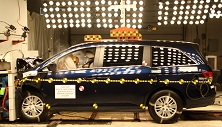
Frontal Crash Test
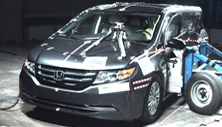
Side Crash Test
Overall Frontal Rating
Driver and Passenger Assessment
Driver Side
Passenger Side
Overall Side Rating
Side Barrier and Side Pole Tests
Driver Side
Passenger Side
Rollover Resistance
12.7% rollover risk in single-vehicle crash
Safety Features
ESC: StandardForward Collision Warning: OptionalLane Departure Warning: Optional
Recall Notices
NHTSANHTSA ID: 25V876000December 17, 2025
EQUIPMENT ADAPTIVE/MOBILITY:WHEELCHAIR RESTRAINTS/SECUREMENT:LATCH/ANCHOR:
Rollx Vans (Rollx) is recalling certain GMC Yukon, Sierra, Chevrolet Express 2500, Ford Transit, E-250, Toyota Sienna, Sienna Hybrid, Honda Odyssey, Chrysler Town and Country, Voyager, Pacifica, Dodge Grand Caravan, and Ram Promaster vehicles equipped with QRT-Deluxe and QRT-Max wheelchair restraints. Please refer to Rollx's recall report for specific model year information. The retractors may not lock, preventing the wheelchair from being properly secured.
Remedy Status
Rollx will work with Q'Straint to inspect and replace the retractors as necessary, free of charge. Owner notification letters were mailed February 5, 2026. Owners may contact Rollx's customer service at 1-800-956-6668.
NHTSA ID: 23V858000December 18, 2023
FUEL SYSTEM, GASOLINE:DELIVERY:FUEL PUMP
Honda (American Honda Motor Co.) is recalling certain 2013-2023 Honda Accord, Civic Coupe, Civic Sedan, Civic Hatchback, Civic Type R, CR-V, HR-V, Ridgeline, Odyssey, Acura ILX, MDX, MDX Hybrid, RDX, RLX, TLX, 2019-2022 Honda Insight, Passport, 2020 Honda CR-V Hybrid, 2018-2019 Honda Clarity PHEV, Fit, and 2015-2020 Honda Accord Hybrid, Pilot, Acura NSX vehicles. The fuel pump inside the fuel tank may fail.
Remedy Status
Dealers will replace the fuel pump module, free of charge. Owner letters were mailed September 6, 2024. Owners may contact Honda customer service at 1-888-234-2138. Honda's numbers for this recall are KGC and KGD. This recall is an expansion of NHTSA recall numbers 21V-215 and 20V-314.
NHTSA ID: 18V170000March 13, 2018
SEATS:MID/REAR ASSEMBLY
Honda (American Honda Motor Co.) is recalling certain 2014-2016 Honda Odyssey vehicles. The second row outboard seats have a lever to fold the seatback and slide the seat forward to access the third row seats. Due to a manufacturing error, if the walk-in release lever is used to fold a fully reclined left outboard seatback forward, the seatback may stay in the unlocked position (free-folding) or unexpectedly unlock without engaging the walk-in or recliner lever.
Remedy Status
Honda will notify owners, and dealers will confirm proper operation of the second row left outboard seatback, and install a support bracket to the seat recliner. If the seatback cannot lock, dealers will replace the seatback frame assembly. These repairs will be performed free of charge. The recall began May 7, 2018. Owners may contact Honda customer service at 1-888-234-2138. Honda's number for this recall is X0R.
NHTSA ID: 17V725000November 17, 2017
SEATS:MID/REAR ASSEMBLY
Honda (American Honda Motor Co.) is recalling certain 2011-2017 Honda Odyssey vehicles. The second row outboard seats can slide sideways to one of two positions. If a seat is placed between either of the two positions when attaching the seat to the vehicle floor, the seat will not latch properly to the seat striker, allowing the seat to tip forward unexpectedly during braking.
Remedy Status
Honda will notify owners, and dealers will install a bracket to the second row outboard floor strikers, free of charge. The recall began April 2, 2018. Owners may contact American Honda Customer Support & Campaign Center at 1-888-234-2138. Honda's number for this recall is S0G.
NHTSA ID: 16V933000December 27, 2016
SEATS:MID/REAR ASSEMBLY
Honda (American Honda Motor Co.) is recalling certain model year 2011-2016 Odyssey vehicles manufactured August 17, 2010, to October 1, 2015. The affected vehicles have second row outboard seats that have a release lever that allows the seats to move for easier access to the third row of seats. This release lever may remain in the unlocked position allowing the seats to move unexpectedly.
Remedy Status
Honda will notify owners, and dealers will install an additional bracket and spring to both second row outboard seats, free of charge. Interim letter has been mailed, and a second notification will be sent . Owners may contact Honda customer service at 1-888-234-2138. Honda's number for this recall is KD5.
NHTSA ID: 16V417000June 09, 2016
FUEL SYSTEM, GASOLINE:STORAGE:TANK ASSEMBLY
Honda (American Honda Motor Co.) is recalling certain model year 2015 Acura MDX 2WD and MDX 4WD vehicles, 2016 Acura MDX 4WD vehicles, 2015-2016 Honda Odyssey vehicles, and 2016 Honda Pilot 2WD and 4WD vehicles. The affected vehicles have fuel tanks that were manufactured with insufficient welds which may separate and allow fuel to leak out.
Remedy Status
Honda will notify owners, and dealers will replace the fuel tanks, free of charge. Owners may contact Honda/Acura customer service at 1-888-234-2138. The recall began on July 29, 2016. Honda's numbers for this recall are KA9 (Honda vehicles) and KB0 (Acura vehicles).
Owner Complaints
193 totalENGINE
Apr 10, 2026
Our 2015 Honda Odyssey van has bad piston rings 1-3. The check engine light and all of the lights are on in the vehicle is not driving and idling poorly.This is the second time it has happened. The first time was under warranty at 112,000 miles, and now the van has 179,000 miles....
Preview excerpt
ENGINE
Apr 1, 2026
In November 2024, the engine of my 2015 Honda Odyssey misfired and I had all spark plugs replaced. The vehicle had 102, 171 miles on it. The issue was resolved at that time. On April 1, 2026 the engine misfire returned, check engine light came on and the repair shop advised that ...
Preview excerpt
POWER TRAIN,ENGINE
Mar 26, 2026
Approximately 7 months ago, my 2015 Honda Odyssey experienced an engine misfire with code P0302 (cylinder 2). All spark plugs were replaced at that time and the issue appeared resolved. However, the misfire has now returned with the check engine light on, again indicating cylinde...
Preview excerpt
UNKNOWN OR OTHER
Feb 15, 2026
The automatic sliding doors are malfunctioning and will not open. We bought this vehicle used from Fred Anderson Kia of Greenville.
ELECTRICAL SYSTEM
Jan 14, 2026
Odometer Fraud. The contact purchased a 2015 Honda Odyssey. It was discovered that there was a discrepancy in mileage. The vehicle was a private sale. At the time of purchase, the mileage was 96,000; however, upon registration, it was discovered that the actual mileage was 222,00...
Preview excerpt
ELECTRICAL SYSTEM,UNKNOWN OR OTHER,SERVICE BRAKES
Dec 31, 2025
On December 31 at approximately 300 p.m., our 2015 Honda Odyssey experienced a sudden and complete loss of motive power while traveling eastbound on the Sam Houston Parkway South just after crossing the Buffalo Bayou Toll Bridge at highway speed. While driving normally, the Check...
Preview excerpt
POWER TRAIN
Dec 14, 2025
The car sporadically does not shift from 1st 2 second and then abruptly shuts cause a loud jerk of engine and car. It is startling and scary when it happens. I’m afraid the car will break down while in the road. Every time we take the car to dealership they “cannot replicate” is...
Preview excerpt
ELECTRICAL SYSTEM
Dec 5, 2025
Odometer Fraud. The contact purchased a 2015 Honda Odyssey. The contact discovered a mileage discrepancy after the purchase. The vehicle was a private sale. At the time of purchase, the vehicle mileage was 7,274. The contact took the vehicle to a Honda dealer to have the vehicle ...
Preview excerpt
STEERING,ELECTRICAL SYSTEM,VEHICLE SPEED CONTROL
Oct 7, 2025
I am submitting this urgent complaint regarding my 2015 Honda Odyssey, equipped with the 3.5L V6 engine referenced in (TSB) 20-023 which acknowledges that the front rocker arm oil control valve (spool valve) gasket may fail and leak engine oil directly onto the alternator located...
Preview excerpt
ENGINE
Oct 3, 2025
American Honda Motor Co, Inc. recently sent a warranty extension due to piston ring deterioration causing misfires. They have improperly denied my claim for reasons that were clearly arbitrary and to get out of reimbursing me for the repair. This is a safety concern because the c...
Preview excerpt
Showing 10 recent complaints from 193 total
View Full Complaint LogCompare Related Vehicles
Why Compare These Pages
The strongest comparison flow is usually: exact vehicle-year page, then nearby years of the same model, then other 2015 Honda models. That sequence helps separate one-off year spikes from broader make-wide patterns.
More Honda Odyssey Years
2016 Honda OdysseyCompare this year against 2015 for complaint and recall shifts.6r251c2014 Honda OdysseyCompare this year against 2015 for complaint and recall shifts.5r305c2017 Honda OdysseyCompare this year against 2015 for complaint and recall shifts.2r36c2013 Honda OdysseyCompare this year against 2015 for complaint and recall shifts.6r209c2018 Honda OdysseyCompare this year against 2015 for complaint and recall shifts.14r4i883c2012 Honda OdysseyCompare this year against 2015 for complaint and recall shifts.5r238c
More 2015 Honda Models
2015 Honda CR-VAnother 2015 Honda option for same-year comparison.3r2i661c2015 Honda AccordAnother 2015 Honda option for same-year comparison.5r2i586c2015 Honda CivicAnother 2015 Honda option for same-year comparison.1r2i374c2015 Honda FitAnother 2015 Honda option for same-year comparison.4r1i276c2015 Honda PilotAnother 2015 Honda option for same-year comparison.4r1i105c2015 Honda Accord HybridAnother 2015 Honda option for same-year comparison.1r1i39c
Frequently Asked Questions
How many recalls does the 2015 Honda Odyssey have?
The 2015 Honda Odyssey has 6 recalls recorded by NHTSA.
How many complaints have been filed for the 2015 Honda Odyssey?
NHTSA has received 193 owner-reported complaints for the 2015 Honda Odyssey.
What is the NHTSA safety rating for the 2015 Honda Odyssey?
The 2015 Honda Odyssey received an overall safety rating of 5 out of 5 stars from NHTSA.
What are the most common problems with the 2015 Honda Odyssey?
The most commonly reported complaint categories for the 2015 Honda Odyssey are engine (26 reports), power train (24 reports), unknown or other (16 reports).
Does the 2015 Honda Odyssey have any recalls?
Yes. NHTSA has 6 recalls on record for the 2015 Honda Odyssey. Scroll up to review the published recall summaries, consequences, and remedies. To check for unrepaired recalls on your specific vehicle, use your VIN at nhtsa.gov/recalls.
Check Another Vehicle
Look up recalls and complaints for any year, make, and model.
This page summarizes publicly available data from the National Highway Traffic Safety Administration (NHTSA). Complaint counts reflect reports submitted to NHTSA by vehicle owners and do not by themselves prove defect severity or vehicle safety. Safety ratings may not be available for all vehicle-years. This site is not affiliated with NHTSA or any vehicle manufacturer. For official information, visit the official NHTSA page for this vehicle.