Honda · Fit · 2015
2015 Honda Fit
4
Recalls
276
Complaints
5/5
Safety Rating
The 2015 Honda Fit has 4 recalls and 276 owner-reported complaints on file with NHTSA. Overall safety rating: 5 out of 5 stars. Most reported issue: electrical system (80 reports).
Source: NHTSA Public Records · Updated Apr 28, 2026
Research Context
The 2015 Honda Fit page works best as a research starting point. Complaint totals show how much owner-reported activity exists, while recalls and investigations help show whether any of that activity turned into formal safety action.
Because this is a newer-era vehicle page, it usually helps to compare this year against nearby model years before deciding whether a complaint pattern looks isolated or persistent. On this page, the most prominent complaint area is electrical system with 80 reported complaints.
Best Research Moves
- Use the complaint log to see whether the 2015 Honda Fit reports cluster around one repeated symptom or spread across multiple systems.
- Review the recall section even if the total is smaller, because a limited number of recalls can still point to meaningful safety actions.
- Check the linked investigations for extra ODI context if you want to see whether owner complaints escalated into formal defect review.
Key Takeaways
- The 2015 Honda Fit currently shows 4 NHTSA recalls listed on this page and 276 owner-reported complaints.
- This page currently shows 1 NHTSA investigation linked to this page.
- This page reflects complaint volume, recall history, and NHTSA test data, but it does not diagnose causes or rank reliability by itself.
- Safety data currently shows 5/5 overall NHTSA safety rating.
- The most frequently reported complaint categories on this page are electrical system (80), power train (28), unknown or other (22).
- Vehicle
- 2015 Honda Fit
- Recalls
- 4
- Complaints
- 276
- Safety Rating
- 5/5
How to Interpret This Page
This page combines three types of NHTSA data: recall campaigns (official manufacturer or government actions), owner complaints (unverified consumer reports), and crash test ratings (where available). A vehicle with many complaints is not necessarily less reliable — complaint volume correlates with sales volume and vehicle age. Recalls indicate identified defects, not overall quality. To compare this model year with others, use the year navigation in the sidebar or return to the model overview page.
If you are researching a used vehicle, start with the complaint categories, compare them against the recall list, and then check nearby model years to see whether the same issue profile repeats. That usually produces a better buying or research signal than treating the raw complaint total as a standalone safety ranking.
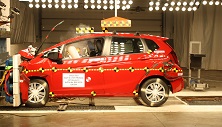
NHTSA Crash Test Performance
Frontal Crash Test
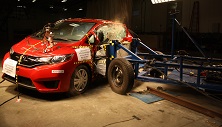
Side Crash Test
Overall Frontal Rating
Driver and Passenger Assessment
Driver Side
Passenger Side
Overall Side Rating
Side Barrier and Side Pole Tests
Driver Side
Passenger Side
Rollover Resistance
14.7% rollover risk in single-vehicle crash
Safety Features
ESC: StandardForward Collision Warning: NoLane Departure Warning: No
Recall Notices
NHTSANHTSA ID: 15V697000October 23, 2015
STRUCTURE
Honda (American Honda Motor Co.) is recalling certain model year 2015-2016 Fit LX-trim vehicles manufactured April 11, 2014, to July 02, 2015 and not equipped with a sunroof. In the affected vehicles, the rear grab handle brackets were not manufactured properly, and as a result, the brackets may puncture the side curtain air bags upon their deployment. As such, these vehicles fail to comply with Federal Motor Vehicle Safety Standard (FMVSS) number 214, "Side Impact Protection" and number 226, "Ejection Mitigation".
Remedy Status
Honda will notify owners, and dealers will replace the rear grab handle bracket, free of charge. The recall began on December 18, 2015. Owners may contact Honda customer service at 1-888-234-2138. Honda's number for this recall is JV8.
NHTSA ID: 15V574000September 15, 2015
POWER TRAIN:AUTOMATIC TRANSMISSION:CONTROL MODULE (TCM/PCM/TECM)
Honda (American Honda Motor Co.) is recalling certain model year 2014-2015 Civic vehicles manufactured January 16, 2014, to November 6, 2014 and 2015 Fit vehicles manufactured March 12, 2014, to May 12, 2015. The software settings that control the transmission operation may result in damage to the transmission drive pulley shaft.
Remedy Status
Honda will notify owners, and dealers will update the software for the transmission, free of charge. The recall is expected to begin October 30, 2015. Owners may contact Honda customer service at 1-888-234-2138. Honda's numbers for this recall are JU2 (Civic) and JU3(Fit).
NHTSA ID: 15V559000September 03, 2015
ELECTRICAL SYSTEM:IGNITION
Honda (American Honda Motor Co.) is recalling certain model year 2015 Fit vehicles manufactured December 6, 2013, to August 28, 2014. The affected vehicles may experience damage to the wires inside the Plug Top Ignition Coils (PTC) due to improper protection against electrical noise.
Remedy Status
Honda will notify owners, and dealers will replace the Plug Top Ignition Coils with new design, free of charge. The recall began on October 9, 2015. Owners may contact Honda Automobile Customer Service at 1-888-234-2138. Honda's number for this recall is JT9.
NHTSA ID: 14V563000July 30, 2014
AIR BAGS:SIDE/WINDOW
American Honda Motor Co. (Honda) is recalling certain model year 2015 Honda Fit vehicles manufactured April 11, 2014, to June 9, 2014. The affected vehicles may have been assembled with an A-pillar interior cover designed for vehicles without side curtain air bags.
Remedy Status
Honda will notify owners, and dealers will inspect the A-pillar interior cover and install the correct A-pillar cover, as necessary, free of charge. The recall is expected to begin on September 25, 2014. Owners may contact Honda customer service at 1-800-999-1009. Honda's number for this recall is JF9.
Investigations
1 totalEAClosed
The Office of Defects Investigation (ODI) opened this investigation to determine if the failure of airbags to deploy during severe crashes, in certain vehicles, was the result of a safety related defect. During the investigation a complex failure was studied that can result in non-deployment of subject vehicle air bags and other restraint system devices in severe crash events. The subject vehicles may be equipped with an airbag control unit (ACU) for the supplemental restraint system (SRS) Electronic Control Unit (ECU) manufactured by ZF-TRW. The ECU receives signals from crash sensors mounted in the vehicle and deploys the vehicle air bags and seat belt pretensioners in accordance with manufacturer design specifications. The ECU in the subject vehicles contains a model DS84 application-specific integrated circuit (ASIC) which controls the communication of the crash sensor signal, firing commands (i.e., when to deploy the airbag(s) and/or pretensioners), and fault information (e.g., diagnostic trouble codes). In September 2016, FCA announced recall 16V-668 for certain model year (MY) 2010 to 2014 Chrysler, Dodge and Jeep products manufactured with the subject ZF-TRW ACU. In this recall, FCA discussed an EOS condition that resulted in a failure of the subject DS84 ASIC, which caused air bag non-deployment. FCA noted that the defect condition had only been observed in vehicles equipped with sensor harnessing routed across the front of the vehicle. Other FCA vehicles that also used the subject ACU, but were not equipped with cross-car harnessing, had not experienced EOS failures, despite similar time in service. During the course of this investigation, ODI sent two separate Information Request (IR) letters to six vehicle manufactures (including FCA, Hyundai, Honda, Kia, Mitsubishi, and Toyota) and one IR letter to ZF-TRW. These IR letters resulted in ODI receiving comprehensive data from these manufacturers and suppliers. Studies of this data found that the DS84 ASIC does not have sufficient protection against negative electrical transients or electrical overstress (“EOS”) that can be generated in certain severe crashes. An electrical transient occurs when the electrical power supplied to a circuit changes momentarily over a short duration of time. In these severe crash cases, the crash sensors and other powered wiring can be damaged and short circuited so as to create a negative electrical transient of sufficient intensity and duration (that are outside the vehicle manufacturer's specification) to damage the ASIC before the restraint device deployment signal is received by the SRS ECU. This damaged signal can lead to incomplete or nondeployment of the air bags and/or pretensioners. Airbag non-deployment and/or lack of pretensioner operation can increase the risk or severity of injury in a crash.A total of 8 fatalities and 14 injuries were associated with known EOS events. The common element in all investigated manufacturers vehicles is the SRS ECU containing a DS84 ASIC manufactured by ZF-TRW. The risk associated with the ASIC is equally shared among all OEMS involved in the investigation. The actual real-world risk can be mitigated by other factors which were assessed by ODI during this investigation. The first mitigating factor involves protections built into the ACU design which protect the DS84 ASIC from damage. There are multiple strategies and levels of protection employed by different OEMs that provide effective EOS mitigation. The two most common strategies at the ACU level are circuit protection diodes on the remote senor signal lines, and current limiting resistors that protect critical components. The second mitigating factor is found at the vehicle level and involves the location and routing of the wires leading from the crash sensors to the SRS ECU. If the wires are well protected in a crash and are not routed with other power wires carrying large currents, the risk for an EOS event is significantly reduced or eliminated. These design specific factors combine to produce a spectrum of risk for the vehicles equipped with ACUs using the DS84 ASIC. Given the many of years of field exposure, it is possible to divide the subject population into two groups; vehicles which have experienced EOS events, and vehicles which have not experienced EOS field events. Four of the six OEMs involved in this investigation have experienced EOS field events on at least one of their models equipped with a DS84 ASIC. All vehicle models (including the Toyota models identified in the Failure Report Summary of the opening resume for this investigation) with field events have been recalled. In an abundance of caution, ODI kept this investigation open five years to monitor field performance and did not identify any field events on vehicles not included in existing safety recalls. Given the spectrum of risk identified in this investigation and that all vehicles with a demonstrated unreasonable risk have been recalled, ODI is closing this investigation. ODI is closing this investigation with the following manufacturer safety recalls: 16V-668, 18E-043, 18V-137, 18V-363, and 20V-024. With the recall actions taken by the subject vehicle and equipment manufacturers, this investigation is closed. The closing of this investigation does not constitute a finding by NHTSA that a safety-related defect does not exists on other model or model year vehicles outside of the recall scopes. The agency reserves the right to take further action if warranted by the circumstances.
Component: AIR BAGS: AIR BAG/RESTRAINT CONTROL MODULEOpened: Apr 19, 2019Closed: Sep 19, 2024Related recall: 20V024
Owner Complaints
276 totalELECTRICAL SYSTEM
Mar 25, 2026
The info display that reports millage, fuel levels etc has been intermittent. When the car starts in cold and/or wet weather The display Is "blued out" or it's digitized and unreadable. [XXX] [XXX] INFORMATION REDACTED PURSUANT TO THE FREEDOM OF INFORMATION ACT (FOIA), 5 U.S....
Preview excerpt
ELECTRICAL SYSTEM
Feb 25, 2026
Odometer screen, which includes mileage, fuel gauge, time and any check engine information, will regularly blink, appear blank, show unreadable characters or a combination of the three on mornings with an external temperature of 60 F or below. Reading up on Honda Fit forums, it a...
Preview excerpt
POWER TRAIN,ELECTRICAL SYSTEM
Feb 5, 2026
The contact owns a 2015 Honda Fit. The contact stated that while driving 45-50 MPH, several unknown warning lights illuminated, with the gear shift indicator light in neutral(N), and the vehicle stalled. The vehicle was towed to an independent mechanic, where it was diagnosed wit...
Preview excerpt
ELECTRICAL SYSTEM,FUEL/PROPULSION SYSTEM
Dec 24, 2025
The fuel gauge and mileage display became inoperable. Fuel level could not be determined.
ELECTRICAL SYSTEM,EXTERIOR LIGHTING,FUEL/PROPULSION SYSTEM
Sep 11, 2025
The fuel gauge in the gauge cluster turns on and off unexpectedly and without reason for extended periods of time. The gauge will also do what I like to call hieroglyphic numbers, essentially unreadable lettering clearly due to an electrical malfunction. This is very distracting ...
Preview excerpt
POWER TRAIN
Sep 10, 2025
Vehicle started to jerk and stall when running and selected to reverse from drive, progressively getting worse and has since stalled in traffic from a stop at a light to acceleration fwd , and frequently stalling more from park to reverse
UNKNOWN OR OTHER
Jun 5, 2025
The fuel gauge, which is digital, has a soldering point which is apparently a known failure spot due to the type of solder used. This causes the display to fail, which makes the fuel gauge unreadable. Not only is this a distraction for drivers, but it can lead to running out of g...
Preview excerpt
UNKNOWN OR OTHER
Jun 3, 2025
The fuel gauge, which is digital, has a soldering point which is apparently a known failure spot due to the type of solder used. This causes the display to fail, which makes the fuel gauge unreadable. Not only is this a distraction for drivers, but it can lead to running out of g...
Preview excerpt
UNKNOWN OR OTHER
May 1, 2025
The fuel gauge, which is digital, has a soldering point which is apparently a known failure spot due to the type of solder used. This causes the display to fail, which makes the fuel gauge unreadable. Not only is this a distraction for drivers, but it can lead to running out of g...
Preview excerpt
POWER TRAIN
Apr 29, 2025
The contact owns a 2015 Honda Fit. The contact stated that while operating the vehicle, the transmission warning light started flashing and the vehicle failed to properly accelerate. The vehicle was taken to the local AAMCO Transmission Service Center who diagnosed that the trans...
Preview excerpt
Showing 10 recent complaints from 276 total
View Full Complaint LogCompare Related Vehicles
Why Compare These Pages
The strongest comparison flow is usually: exact vehicle-year page, then nearby years of the same model, then other 2015 Honda models. That sequence helps separate one-off year spikes from broader make-wide patterns.
More Honda Fit Years
2016 Honda FitCompare this year against 2015 for complaint and recall shifts.1r1i116c2014 Honda FitCompare this year against 2015 for complaint and recall shifts.1i0c2017 Honda FitCompare this year against 2015 for complaint and recall shifts.1i42c2013 Honda FitCompare this year against 2015 for complaint and recall shifts.10r1i173c2018 Honda FitCompare this year against 2015 for complaint and recall shifts.3r109c2012 Honda FitCompare this year against 2015 for complaint and recall shifts.11r1i113c
More 2015 Honda Models
2015 Honda CR-VAnother 2015 Honda option for same-year comparison.3r2i661c2015 Honda AccordAnother 2015 Honda option for same-year comparison.5r2i586c2015 Honda CivicAnother 2015 Honda option for same-year comparison.1r2i374c2015 Honda OdysseyAnother 2015 Honda option for same-year comparison.6r193c2015 Honda PilotAnother 2015 Honda option for same-year comparison.4r1i105c2015 Honda Accord HybridAnother 2015 Honda option for same-year comparison.1r1i39c
Frequently Asked Questions
How many recalls does the 2015 Honda Fit have?
The 2015 Honda Fit has 4 recalls recorded by NHTSA.
How many complaints have been filed for the 2015 Honda Fit?
NHTSA has received 276 owner-reported complaints for the 2015 Honda Fit.
What is the NHTSA safety rating for the 2015 Honda Fit?
The 2015 Honda Fit received an overall safety rating of 5 out of 5 stars from NHTSA.
What are the most common problems with the 2015 Honda Fit?
The most commonly reported complaint categories for the 2015 Honda Fit are electrical system (80 reports), power train (28 reports), unknown or other (22 reports).
Does the 2015 Honda Fit have any recalls?
Yes. NHTSA has 4 recalls on record for the 2015 Honda Fit. Scroll up to review the published recall summaries, consequences, and remedies. To check for unrepaired recalls on your specific vehicle, use your VIN at nhtsa.gov/recalls.
Check Another Vehicle
Look up recalls and complaints for any year, make, and model.
This page summarizes publicly available data from the National Highway Traffic Safety Administration (NHTSA). Complaint counts reflect reports submitted to NHTSA by vehicle owners and do not by themselves prove defect severity or vehicle safety. Safety ratings may not be available for all vehicle-years. This site is not affiliated with NHTSA or any vehicle manufacturer. For official information, visit the official NHTSA page for this vehicle.