Hyundai · Elantra · 2016
2016 Hyundai Elantra
1
Recall
280
Complaints
5/5
Safety Rating
The 2016 Hyundai Elantra has 1 recall and 280 owner-reported complaints on file with NHTSA. Overall safety rating: 5 out of 5 stars. Most reported issue: engine (69 reports).
Source: NHTSA Public Records · Updated Apr 28, 2026
Research Context
The 2016 Hyundai Elantra page works best as a research starting point. Complaint totals show how much owner-reported activity exists, while recalls and investigations help show whether any of that activity turned into formal safety action.
Because this is a newer-era vehicle page, it usually helps to compare this year against nearby model years before deciding whether a complaint pattern looks isolated or persistent. On this page, the most prominent complaint area is engine with 69 reported complaints.
Best Research Moves
- Use the complaint log to see whether the 2016 Hyundai Elantra reports cluster around one repeated symptom or spread across multiple systems.
- Review the recall section even if the total is smaller, because a limited number of recalls can still point to meaningful safety actions.
- This page is primarily a complaints-and-recalls research surface, so compare nearby model years before treating the complaint total as a standalone verdict.
Key Takeaways
- The 2016 Hyundai Elantra currently shows 1 NHTSA recall listed on this page and 280 owner-reported complaints.
- This page currently shows no linked NHTSA investigations.
- This page reflects complaint volume, recall history, and NHTSA test data, but it does not diagnose causes or rank reliability by itself.
- Safety data currently shows 5/5 overall NHTSA safety rating.
- The most frequently reported complaint categories on this page are engine (69), unknown or other (33), air bags (17).
- Vehicle
- 2016 Hyundai Elantra
- Recalls
- 1
- Complaints
- 280
- Safety Rating
- 5/5
How to Interpret This Page
This page combines three types of NHTSA data: recall campaigns (official manufacturer or government actions), owner complaints (unverified consumer reports), and crash test ratings (where available). A vehicle with many complaints is not necessarily less reliable — complaint volume correlates with sales volume and vehicle age. Recalls indicate identified defects, not overall quality. To compare this model year with others, use the year navigation in the sidebar or return to the model overview page.
If you are researching a used vehicle, start with the complaint categories, compare them against the recall list, and then check nearby model years to see whether the same issue profile repeats. That usually produces a better buying or research signal than treating the raw complaint total as a standalone safety ranking.
NHTSA Crash Test Performance
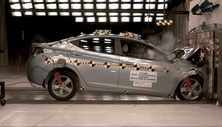
Frontal Crash Test
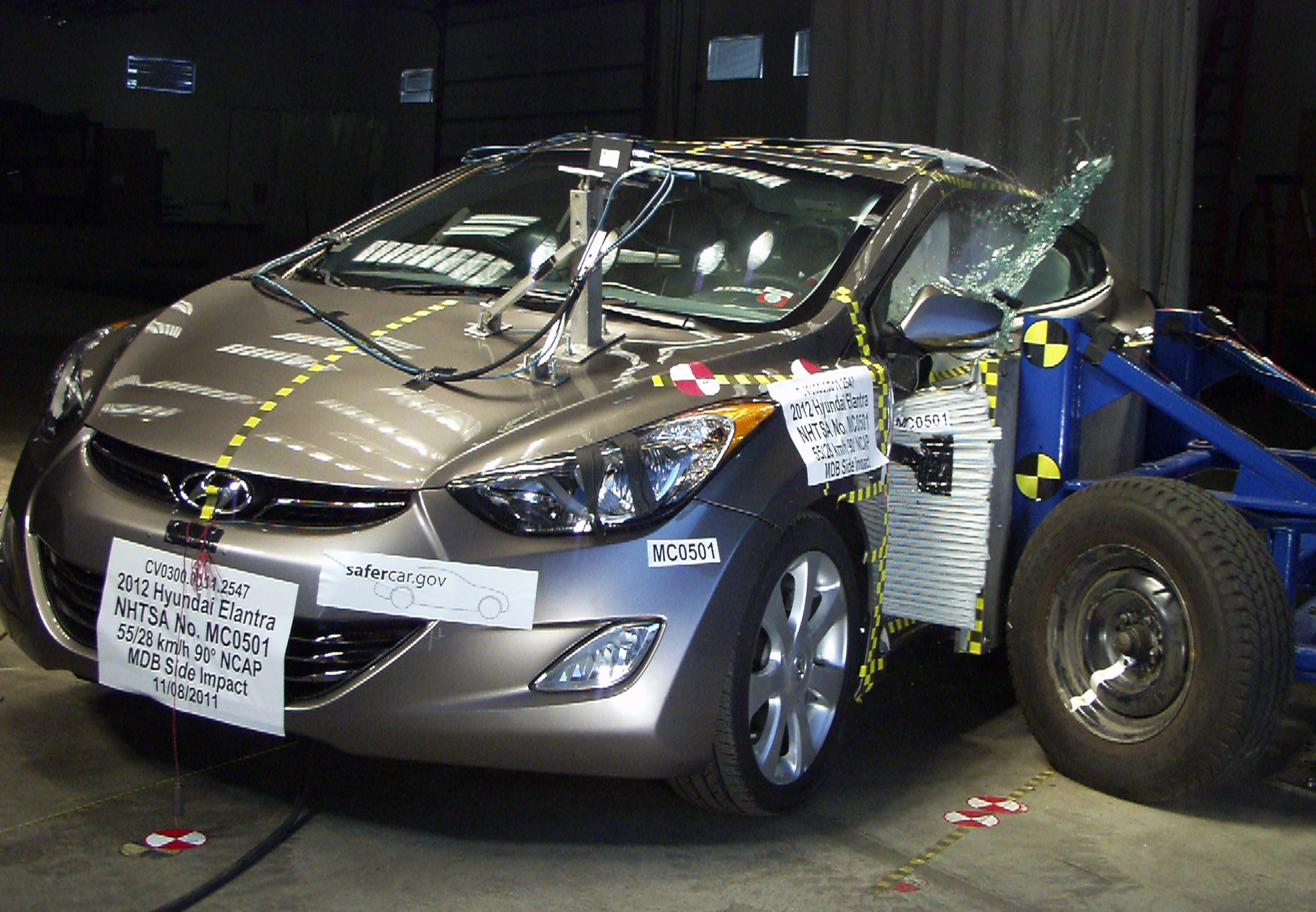
Side Crash Test
Overall Frontal Rating
Driver and Passenger Assessment
Driver Side
Passenger Side
Overall Side Rating
Side Barrier and Side Pole Tests
Driver Side
Passenger Side
Rollover Resistance
10.9% rollover risk in single-vehicle crash
Safety Features
ESC: StandardForward Collision Warning: NoLane Departure Warning: No
Recall Notices
NHTSANHTSA ID: 24V146000February 23, 2024
LATCHES/LOCKS/LINKAGES:TRUNK LID:LATCH
Hyundai Motor America (Hyundai) is recalling certain 2015-2016 Elantra vehicles. The trunk latch may become damaged, preventing the opening of the trunk from the inside. As such, these vehicles fail to comply with the requirements of Federal Motor Vehicle Safety Standard number 401, "Internal Trunk Release."
Remedy Status
Dealers will replace the trunk latch base sub-assembly, free of charge. Owner notification letters were mailed April 5, 2024. Owners may contact Hyundai customer service at 1-855-371-9460. Hyundai's number for this recall is 256.
Owner Complaints
280 totalUNKNOWN OR OTHER
Mar 15, 2026
Car just turns off randomly. This has happened at least 6 times within a month. Once on a highway. Last time it turned off a strange sound was coming out of the car also.
ENGINE
Feb 3, 2026
So I have a suspicion oh a connecting rod, might be a bearing but it’s making a tik tik noise, no other issue than that, no engine light no nothing, been doing it for a while but car still goes great
UNKNOWN OR OTHER
Feb 1, 2026
My car turned off while it was in drive. The oil pressure light flashed on for a second then disappeared. The car did not have anything else seem like it is wrong. I was put in dangers way because it turned off right before I was about to turn onto a very busy street and if it ha...
Preview excerpt
ELECTRICAL SYSTEM,SERVICE BRAKES,FORWARD COLLISION AVOIDANCE
Jan 17, 2026
No accident has occurred as of yet (for my case). Ongoing issues with Hyundai left brake bulb and center brake bulb burning out due to over-amperage. These two are on their own 10A circuit separate from the 5A circuit for the right brakelight bulb. It appears that these two bulb...
Preview excerpt
AIR BAGS
Jan 12, 2026
The contact owns a 2016 Hyundai Elantra. The contact stated that while operating the vehicle, the air bag warning light remained illuminated. The vehicle was taken to the local mechanic, who informed the contact of a Manufacturer's Extended Warranty Coverage for the failure and r...
Preview excerpt
ENGINE,FUEL/PROPULSION SYSTEM
Dec 22, 2025
I received confirmation from my local Hyundai dealership that my 2016 Hyundai Elantra GT is consuming over 1.8 quarts of oil every 1000 miles. The mileage is currently 70k miles. This is not the result of lack of maintenance or neglect but because of Hyundais engine design. I was...
Preview excerpt
AIR BAGS
1 injuryNov 20, 2025
The contact owns a 2016 Hyundai Elantra. The contact stated that while her daughter attempted to adjust the front driver's side seat while the vehicle was turned off, the front Driver-side air bag had independently deployed. No warning light illuminated. In addition, the contact'...
Preview excerpt
UNKNOWN OR OTHER
Oct 21, 2025
The trunk latch was recalled. I supposedly got it fixed in July 2024. It was functioning at the time it was supposedly fixed. It Does say it’s a safety issue.Now it is not working, exactly the symptoms of the recall, not open from the inside. There isn’t a key hole to open it. My...
Preview excerpt
UNKNOWN OR OTHER,ENGINE
Oct 13, 2025
The coolant system is failing after it was fully replaced in November of 2024 and i got The car of may 2025 with only two previous owners. Coolant system failing after me only have the car for 6 months when the car sat for 5 months.
POWER TRAIN
Oct 10, 2025
Vehicle started to violently lurch when shifted into drive. A week later loud clunking sound also started when shifting into drive. Sometimes would not go into drive and had to use manual 1st, 2nd, etc. Reverse was fine, no issues. No dash lights ever came on. Auto parts store ha...
Preview excerpt
Showing 10 recent complaints from 280 total
View Full Complaint LogCompare Related Vehicles
Why Compare These Pages
The strongest comparison flow is usually: exact vehicle-year page, then nearby years of the same model, then other 2016 Hyundai models. That sequence helps separate one-off year spikes from broader make-wide patterns.
More Hyundai Elantra Years
2017 Hyundai ElantraCompare this year against 2016 for complaint and recall shifts.4r753c2015 Hyundai ElantraCompare this year against 2016 for complaint and recall shifts.2r257c2018 Hyundai ElantraCompare this year against 2016 for complaint and recall shifts.265c2014 Hyundai ElantraCompare this year against 2016 for complaint and recall shifts.2r377c2019 Hyundai ElantraCompare this year against 2016 for complaint and recall shifts.1r235c2013 Hyundai ElantraCompare this year against 2016 for complaint and recall shifts.4r1,317c
More 2016 Hyundai Models
2016 Hyundai TucsonAnother 2016 Hyundai option for same-year comparison.5r1,595c2016 Hyundai SonataAnother 2016 Hyundai option for same-year comparison.6r706c2016 Hyundai Santa FeAnother 2016 Hyundai option for same-year comparison.3r232c2016 Hyundai VelosterAnother 2016 Hyundai option for same-year comparison.1r215c2016 Hyundai AccentAnother 2016 Hyundai option for same-year comparison.99c2016 Hyundai AzeraAnother 2016 Hyundai option for same-year comparison.1r13c
Frequently Asked Questions
How many recalls does the 2016 Hyundai Elantra have?
The 2016 Hyundai Elantra has 1 recall recorded by NHTSA.
How many complaints have been filed for the 2016 Hyundai Elantra?
NHTSA has received 280 owner-reported complaints for the 2016 Hyundai Elantra.
What is the NHTSA safety rating for the 2016 Hyundai Elantra?
The 2016 Hyundai Elantra received an overall safety rating of 5 out of 5 stars from NHTSA.
What are the most common problems with the 2016 Hyundai Elantra?
The most commonly reported complaint categories for the 2016 Hyundai Elantra are engine (69 reports), unknown or other (33 reports), air bags (17 reports).
Does the 2016 Hyundai Elantra have any recalls?
Yes. NHTSA has 1 recall on record for the 2016 Hyundai Elantra. Scroll up to review the published recall summaries, consequences, and remedies. To check for unrepaired recalls on your specific vehicle, use your VIN at nhtsa.gov/recalls.
Check Another Vehicle
Look up recalls and complaints for any year, make, and model.
This page summarizes publicly available data from the National Highway Traffic Safety Administration (NHTSA). Complaint counts reflect reports submitted to NHTSA by vehicle owners and do not by themselves prove defect severity or vehicle safety. Safety ratings may not be available for all vehicle-years. This site is not affiliated with NHTSA or any vehicle manufacturer. For official information, visit the official NHTSA page for this vehicle.