Hyundai · Elantra · 2017
2017 Hyundai Elantra
4
Recalls
753
Complaints
4/5
Safety Rating
The 2017 Hyundai Elantra has 4 recalls and 753 owner-reported complaints on file with NHTSA. Overall safety rating: 4 out of 5 stars. Most reported issue: engine (162 reports).
Source: NHTSA Public Records · Updated Apr 28, 2026
Research Context
The 2017 Hyundai Elantra page works best as a research starting point. Complaint totals show how much owner-reported activity exists, while recalls and investigations help show whether any of that activity turned into formal safety action.
Because this is a newer-era vehicle page, it usually helps to compare this year against nearby model years before deciding whether a complaint pattern looks isolated or persistent. On this page, the most prominent complaint area is engine with 162 reported complaints.
Best Research Moves
- Use the complaint log to see whether the 2017 Hyundai Elantra reports cluster around one repeated symptom or spread across multiple systems.
- Review the recall section even if the total is smaller, because a limited number of recalls can still point to meaningful safety actions.
- This page is primarily a complaints-and-recalls research surface, so compare nearby model years before treating the complaint total as a standalone verdict.
Key Takeaways
- The 2017 Hyundai Elantra currently shows 4 NHTSA recalls listed on this page and 753 owner-reported complaints.
- This page currently shows no linked NHTSA investigations.
- This page reflects complaint volume, recall history, and NHTSA test data, but it does not diagnose causes or rank reliability by itself.
- Safety data currently shows 4/5 overall NHTSA safety rating.
- The most frequently reported complaint categories on this page are engine (162), structure (104), unknown or other (68).
- Vehicle
- 2017 Hyundai Elantra
- Recalls
- 4
- Complaints
- 753
- Safety Rating
- 4/5
How to Interpret This Page
This page combines three types of NHTSA data: recall campaigns (official manufacturer or government actions), owner complaints (unverified consumer reports), and crash test ratings (where available). A vehicle with many complaints is not necessarily less reliable — complaint volume correlates with sales volume and vehicle age. Recalls indicate identified defects, not overall quality. To compare this model year with others, use the year navigation in the sidebar or return to the model overview page.
If you are researching a used vehicle, start with the complaint categories, compare them against the recall list, and then check nearby model years to see whether the same issue profile repeats. That usually produces a better buying or research signal than treating the raw complaint total as a standalone safety ranking.
NHTSA Crash Test Performance
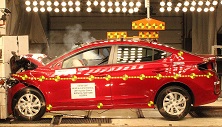
Frontal Crash Test
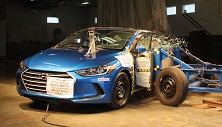
Side Crash Test
Overall Frontal Rating
Driver and Passenger Assessment
Driver Side
Passenger Side
Overall Side Rating
Side Barrier and Side Pole Tests
Driver Side
Passenger Side
Rollover Resistance
10.7% rollover risk in single-vehicle crash
Safety Features
ESC: StandardForward Collision Warning: OptionalLane Departure Warning: Optional
Recall Notices
NHTSANHTSA ID: 17V213000March 28, 2017
STEERING:ELECTRIC POWER ASSIST SYSTEM
Hyundai Motor America (Hyundai) is recalling certain 2017 Elantra vehicles. The affected vehicles may have a damaged Electronic Power Steering (MDPS) connector resulting in a loss of electric power steering assistance.
Remedy Status
Hyundai will notify owners, and dealers will replace the EPS motor, free of charge. The recall is expected to begin April 28, 2017. Owners may contact Hyundai customer service at 1-800-243-7766. Hyundai's number for this recall 161.
NHTSA ID: 17V063000January 26, 2017
SERVICE BRAKES, HYDRAULIC:POWER ASSIST:HYDRAULIC
Hyundai Motor Company (Hyundai) is recalling certain 2017 Elantra vehicles. In the affected vehicles, the brake booster may fail, resulting in a loss of power brake assist.
Remedy Status
Hyundai has notified owners, and dealers will replace the brake system booster assembly, free of charge. The recall began on February 6, 2017. Owners may contact Hyundai customer service at 1-800-633-5151. Hyundai's number for this recall is 157.
NHTSA ID: 16V956000December 30, 2016
AIR BAGS:FRONTAL:DRIVER SIDE:INFLATOR MODULE
Hyundai Motor Company (Hyundai) is recalling certain model year 2017 Hyundai Elantra vehicles manufactured April 15, 2016, to September 13, 2016, and Sonata vehicles manufactured May 27, 2016 to September 16, 2016. In these vehicles, the end seal for the driver's frontal air bag inflator may not have been properly installed, possibly resulting in reduced inflation of the frontal air bag in the event of a crash.
Remedy Status
Hyundai will notify owners, and dealers will replace the driver's frontal air bag module, free of charge. The recall began February 13, 2017. Owners may contact Hyundai customer service at 1-855-371-9460. Hyundai's number for this recall is 156.
NHTSA ID: 16V232000April 21, 2016
AIR BAGS:FRONTAL
Hyundai Motor Company (Hyundai) is recalling certain model year 2015-2016 Sonata vehicles manufactured May 29, 2014 to February 11, 2016, 2017 Elantra vehicles manufactured January 12, 2016 to February 22, 2016, and one 2016 Sonata Hybrid vehicle manufactured October 15, 2015. In these vehicles, the driver's frontal air bag may be missing a chemical enhancer required for the second stage air bag deployment, resulting in the second stage not deploying in certain crashes. The primary stage will deploy as intended.
Remedy Status
Hyundai will notify owners, and dealers will replace the driver's frontal air bag module, free of charge. The recall began on May 5,2016. Owners may contact Hyundai customer service at 1-855-371-9460. Hyundai's number for this recall is 144.
Owner Complaints
753 totalELECTRICAL SYSTEM,VEHICLE SPEED CONTROL,ENGINE
Apr 22, 2026
I own a Hyundai Elantra with approximately 103,000 miles. The vehicle has developed an intermittent issue where the engine will suddenly stall while driving. This most often occurs when I am decelerating and turning, such as when entering or navigating roundabouts. At the time o...
Preview excerpt
ENGINE
Apr 21, 2026
Car is burning oil. Replaced timing chain and it continues to burn oil.
UNKNOWN OR OTHER
Feb 18, 2026
Subject: Escalation of Unresolved Case – Request for NHTSA Assistance Dear NHTSA, For several months, I have been dealing with an unresolved issue regarding my Hyundai vehicle. On February 18th, I was told the supervisor of my case manager at Hyundai Motor America would contact...
Preview excerpt
ELECTRICAL SYSTEM
Feb 9, 2026
There was a recall Electronic Power Steering (EPS) motor connector that was being done for 2017 hyundai elantras and my car is affected by it. Hyundai is saying my car is not affected by the recall that they put out for this issue.
ENGINE
Feb 4, 2026
After no previous issues, car stalled out multiple times on short drive to work. No warning lights and no subsequent diagnostic codes were reported. Upon final restart, engine started knocking severely. Upon investigation, the oil stick showed no oil in the pan. Vehicle was towe...
Preview excerpt
ENGINE
Feb 1, 2026
With no 'low oil' warning, the car's engine started may a knocking noise. Then, all kinds of warning lights started. Parked the vehicle and checked the oil the next day and there was NO OIL in the engine. This should not have been the case considering this car gets regular oil ch...
Preview excerpt
ENGINE
FIREJan 13, 2026
Driving on the highway in the far left lane. Check engine light came on, car stopped accelerating. Car came to a stop, car shut off. Smoke was coming out from under the hood and flames were seen underneath the car. Police and fire department arrived. Report states an electrical f...
Preview excerpt
ELECTRICAL SYSTEM,EXTERIOR LIGHTING
Jan 8, 2026
1: Driver’s window: don't go up or down, it doesn't respond to control. 2: Headlight warning lights is on all the time because bulbs are burn out so soon after replacement .
UNKNOWN OR OTHER
Dec 12, 2025
PROBLEM: DEALER CREATES FINANCIAL BARRIERS TO RECALL COMPLETION I am reporting systematic barriers to recall completion created by Hyundai's authorized dealer that forced me to incur $834.60 in transportation costs for what should be a "no charge" recall repair, potentially disco...
Preview excerpt
UNKNOWN OR OTHER
Dec 12, 2025
I have been having this issue for several months. First, it was the steering wheel being locked. I believe at one point and time on the past they updated the computer on that vehicle. But this time the dealer told me there is nothing they can do. As of today, the car won’t sta...
Preview excerpt
Showing 10 recent complaints from 753 total
View Full Complaint LogCompare Related Vehicles
Why Compare These Pages
The strongest comparison flow is usually: exact vehicle-year page, then nearby years of the same model, then other 2017 Hyundai models. That sequence helps separate one-off year spikes from broader make-wide patterns.
More Hyundai Elantra Years
2018 Hyundai ElantraCompare this year against 2017 for complaint and recall shifts.265c2016 Hyundai ElantraCompare this year against 2017 for complaint and recall shifts.1r280c2019 Hyundai ElantraCompare this year against 2017 for complaint and recall shifts.1r235c2015 Hyundai ElantraCompare this year against 2017 for complaint and recall shifts.2r257c2020 Hyundai ElantraCompare this year against 2017 for complaint and recall shifts.3r226c2014 Hyundai ElantraCompare this year against 2017 for complaint and recall shifts.2r377c
More 2017 Hyundai Models
2017 Hyundai TucsonAnother 2017 Hyundai option for same-year comparison.3r1,060c2017 Hyundai Santa FeAnother 2017 Hyundai option for same-year comparison.6r910c2017 Hyundai SonataAnother 2017 Hyundai option for same-year comparison.3r743c2017 Hyundai AccentAnother 2017 Hyundai option for same-year comparison.66c2017 Hyundai VelosterAnother 2017 Hyundai option for same-year comparison.48c2017 Hyundai AzeraAnother 2017 Hyundai option for same-year comparison.1r12c
Frequently Asked Questions
How many recalls does the 2017 Hyundai Elantra have?
The 2017 Hyundai Elantra has 4 recalls recorded by NHTSA.
How many complaints have been filed for the 2017 Hyundai Elantra?
NHTSA has received 753 owner-reported complaints for the 2017 Hyundai Elantra.
What is the NHTSA safety rating for the 2017 Hyundai Elantra?
The 2017 Hyundai Elantra received an overall safety rating of 4 out of 5 stars from NHTSA.
What are the most common problems with the 2017 Hyundai Elantra?
The most commonly reported complaint categories for the 2017 Hyundai Elantra are engine (162 reports), structure (104 reports), unknown or other (68 reports).
Does the 2017 Hyundai Elantra have any recalls?
Yes. NHTSA has 4 recalls on record for the 2017 Hyundai Elantra. Scroll up to review the published recall summaries, consequences, and remedies. To check for unrepaired recalls on your specific vehicle, use your VIN at nhtsa.gov/recalls.
Check Another Vehicle
Look up recalls and complaints for any year, make, and model.
This page summarizes publicly available data from the National Highway Traffic Safety Administration (NHTSA). Complaint counts reflect reports submitted to NHTSA by vehicle owners and do not by themselves prove defect severity or vehicle safety. Safety ratings may not be available for all vehicle-years. This site is not affiliated with NHTSA or any vehicle manufacturer. For official information, visit the official NHTSA page for this vehicle.