Hyundai · Elantra · 2013
2013 Hyundai Elantra
4
Recalls
1,317
Complaints
5/5
Safety Rating
The 2013 Hyundai Elantra has 4 recalls and 1,317 owner-reported complaints on file with NHTSA. Overall safety rating: 5 out of 5 stars. Most reported issue: steering (181 reports).
Source: NHTSA Public Records · Updated Apr 28, 2026
Research Context
The 2013 Hyundai Elantra page works best as a research starting point. Complaint totals show how much owner-reported activity exists, while recalls and investigations help show whether any of that activity turned into formal safety action.
Because this is a newer-era vehicle page, it usually helps to compare this year against nearby model years before deciding whether a complaint pattern looks isolated or persistent. On this page, the most prominent complaint area is steering with 181 reported complaints.
Best Research Moves
- Use the complaint log to see whether the 2013 Hyundai Elantra reports cluster around one repeated symptom or spread across multiple systems.
- Review the recall section even if the total is smaller, because a limited number of recalls can still point to meaningful safety actions.
- This page is primarily a complaints-and-recalls research surface, so compare nearby model years before treating the complaint total as a standalone verdict.
Key Takeaways
- The 2013 Hyundai Elantra currently shows 4 NHTSA recalls listed on this page and 1,317 owner-reported complaints.
- This page currently shows no linked NHTSA investigations.
- This page reflects complaint volume, recall history, and NHTSA test data, but it does not diagnose causes or rank reliability by itself.
- Safety data currently shows 5/5 overall NHTSA safety rating.
- The most frequently reported complaint categories on this page are steering (181), engine (125), service brakes, hydraulic (104).
- Vehicle
- 2013 Hyundai Elantra
- Recalls
- 4
- Complaints
- 1317
- Safety Rating
- 5/5
How to Interpret This Page
This page combines three types of NHTSA data: recall campaigns (official manufacturer or government actions), owner complaints (unverified consumer reports), and crash test ratings (where available). A vehicle with many complaints is not necessarily less reliable — complaint volume correlates with sales volume and vehicle age. Recalls indicate identified defects, not overall quality. To compare this model year with others, use the year navigation in the sidebar or return to the model overview page.
If you are researching a used vehicle, start with the complaint categories, compare them against the recall list, and then check nearby model years to see whether the same issue profile repeats. That usually produces a better buying or research signal than treating the raw complaint total as a standalone safety ranking.
NHTSA Crash Test Performance
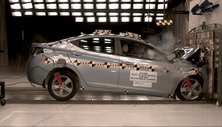
Frontal Crash Test
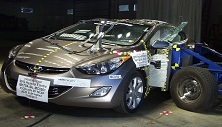
Side Crash Test
Overall Frontal Rating
Driver and Passenger Assessment
Driver Side
Passenger Side
Overall Side Rating
Side Barrier and Side Pole Tests
Driver Side
Passenger Side
Rollover Resistance
10.9% rollover risk in single-vehicle crash
Safety Features
ESC: StandardForward Collision Warning: NoLane Departure Warning: No
Recall Notices
NHTSANHTSA ID: 23V651000September 22, 2023
SERVICE BRAKES, HYDRAULIC:ANTILOCK/TRACTION CONTROL/ELECTRONIC LIMITED SLIP:CONTROL UNIT/MODULE
Hyundai Motor America (Hyundai) is recalling certain 2011-2015 Elantra, Genesis Coupe, Sonata Hybrid, 2012-2015 Accent, Azera, Veloster, 2013-2015 Elantra Coupe, Santa Fe, 2014-2015 Equus, 2010-2012 Veracruz, 2010-2013 Tucson, 2015 Tucson Fuel Cell, and 2013 Santa Fe Sport vehicles. The Anti-Lock Brake System (ABS) module may leak brake fluid internally and cause an electrical short, which can result in an engine compartment fire while parked or driving.
Remedy Status
Owners are advised to park outside and away from structures until the recall repair is complete. Dealers will replace the ABS fuse, free of charge. Owner notification letters were mailed April 10, 2024 through October 11, 2024. Owners may contact Hyundai customer service at 1-855-371-9460. Hyundai's number for this recall is 251.
NHTSA ID: 17V769000November 30, 2017
SERVICE BRAKES, HYDRAULIC:PEDALS AND LINKAGES
Hyundai Motor Company (Hyundai) is recalling certain 2013-2014 Elantra sedan, coupe and GT vehicles. The brake pedal stopper pad can deteriorate allowing the brake light switch plunger to remain extended when the brake pedal is released. This will allow the brake lights to remain illuminated continuously. It can also allow the shift lever to be moved without depressing the brake pedal, or activate the engine management brake pedal override feature.
Remedy Status
Hyundai will notify owners, and dealers will replace the brake pedal stopper pad, free of charge. The recall is expected to begin February 8, 2018. Owners may contact Hyundai customer service at 1-800-633-5151. Hyundai's number for this recall is 170. This campaign expands recall 16V574.
NHTSA ID: 16V574000August 02, 2016
EXTERIOR LIGHTING:BRAKE LIGHTS:SWITCH
Hyundai Motor America (Hyundai) is recalling certain model 2013 Elantra vehicles manufactured December 1, 2012, to April 30, 2013. The brake pedal stopper pad can deteriorate allowing the brake light switch plunger to remain extended when the brake pedal is released.
Remedy Status
Hyundai will notify owners, and dealers will replace the brake pedal stopper pad with an improved part, free of charge. The recall is expected to begin on September 30, 2016. Owners may contact Hyundai customer service at 1-855-371-9460. Hyundai's number for this recall is 146.
NHTSA ID: 13V115000April 01, 2013
AIR BAGS:SIDE/WINDOW
Hyundai Motor Company is recalling certain model year 2011-2013 Elantra vehicles manufactured from November 12, 2010, through March 5, 2013. A support bracket attached to the headliner may become displaced during a side curtain airbag deployment.
Remedy Status
Hyundai will notify owners, and dealers will apply adhesive strips to the headliner, free of charge. The safety recall began during April 2013. Owners may contact Hyundai at 1-800-633-5151. Hyundai's recall campaign number is 109.
Owner Complaints
1317 totalELECTRICAL SYSTEM,UNKNOWN OR OTHER,ENGINE
FIREApr 7, 2026
My mother's vehicle caught fire while in park and it’s listed under a fire-risk recall. Another car got damage with the fire. I want to open a claim.
ENGINE
Apr 6, 2026
My vehicle has a piston slap ticking issue and Hyundai will not help me fix this because it’s a common issue by Hyundai.
STRUCTURE
Apr 3, 2026
Front (engine) subframe rusted out in 2026 after recall work was completed in 2023 for the known issue. Here is the service campaign information: "Service Campaign 984 2011-2016MY ELANTRA (MD/UD) UNDERBODY CORROSION PREVENTATIVE SERVICE"
ENGINE
Mar 12, 2026
While driving on an interstate on March 12, 2026, the engine stopped working requiring that the car be pulled over to the side of the road. There were no indications of issues as oil had been regularly changed, and the battery and tires were replaced in fall of 2025. The check en...
Preview excerpt
POWER TRAIN,ENGINE,FUEL/PROPULSION SYSTEM
Mar 3, 2026
A significant engine failure occurred while driving, presenting as loud knocking from the engine. The issue developed without prior warning lights or messages. The vehicle was inspected by a dealership and the problem was confirmed as internal engine failure (piston slap/engine ...
Preview excerpt
ENGINE
Feb 10, 2026
A system in the Engine that allows for oil to sit and burn. UNKOWN A Mechanic shop that I go to regularly stated that this has been a known issue that has been going on for the past 12 years. Along side when I bought the car I was told that the engine is usually louder then mos...
Preview excerpt
ENGINE
Feb 9, 2026
The vehicle has developed a pronounced knocking noise that was diagnosed by your authorized dealership as “piston slap.” I was informed by dealership staff that this is a known issue with this vehicle. However, because the vehicle is outside of warranty by time and mileage, I was...
Preview excerpt
ELECTRICAL SYSTEM,SERVICE BRAKES,ENGINE
Feb 2, 2026
[XXX] is subject to Safety Recall 20V-755 Hyundai Recall 251 for a defective ABS module that may leak brake fluid, cause an electrical short, and increase the risk of an engine compartment fire. The recall remains open and has not been performed. On Feb 2, I brought the vehicle ...
Preview excerpt
POWER TRAIN
CRASHJan 29, 2026
2013 Hyundai Sonata has a loud knocking noise from engine. Purchases 8/5/25 at 43K miles, currently at 44K miles. There is a Technical Service Bulletin, # 22-EM-009H dated June 2022 about an extended warranty but its time limit is questionable. Unknown and undocumented when pur...
Preview excerpt
UNKNOWN OR OTHER
FIREDec 30, 2025
The car caught fire all the sudden while parked and burnt almost completely (~80%)
Showing 10 recent complaints from 1,317 total
View Full Complaint LogCompare Related Vehicles
Why Compare These Pages
The strongest comparison flow is usually: exact vehicle-year page, then nearby years of the same model, then other 2013 Hyundai models. That sequence helps separate one-off year spikes from broader make-wide patterns.
More Hyundai Elantra Years
2014 Hyundai ElantraCompare this year against 2013 for complaint and recall shifts.2r377c2012 Hyundai ElantraCompare this year against 2013 for complaint and recall shifts.4r668c2015 Hyundai ElantraCompare this year against 2013 for complaint and recall shifts.2r257c2011 Hyundai ElantraCompare this year against 2013 for complaint and recall shifts.5r460c2016 Hyundai ElantraCompare this year against 2013 for complaint and recall shifts.1r280c2010 Hyundai ElantraCompare this year against 2013 for complaint and recall shifts.3r447c
More 2013 Hyundai Models
2013 Hyundai SonataAnother 2013 Hyundai option for same-year comparison.9r1,875c2013 Hyundai Santa FeAnother 2013 Hyundai option for same-year comparison.3r604c2013 Hyundai VelosterAnother 2013 Hyundai option for same-year comparison.3r418c2013 Hyundai TucsonAnother 2013 Hyundai option for same-year comparison.3r263c2013 Hyundai AccentAnother 2013 Hyundai option for same-year comparison.1r138c2013 Hyundai AzeraAnother 2013 Hyundai option for same-year comparison.2r112c
Frequently Asked Questions
How many recalls does the 2013 Hyundai Elantra have?
The 2013 Hyundai Elantra has 4 recalls recorded by NHTSA.
How many complaints have been filed for the 2013 Hyundai Elantra?
NHTSA has received 1,317 owner-reported complaints for the 2013 Hyundai Elantra.
What is the NHTSA safety rating for the 2013 Hyundai Elantra?
The 2013 Hyundai Elantra received an overall safety rating of 5 out of 5 stars from NHTSA.
What are the most common problems with the 2013 Hyundai Elantra?
The most commonly reported complaint categories for the 2013 Hyundai Elantra are steering (181 reports), engine (125 reports), service brakes, hydraulic (104 reports).
Does the 2013 Hyundai Elantra have any recalls?
Yes. NHTSA has 4 recalls on record for the 2013 Hyundai Elantra. Scroll up to review the published recall summaries, consequences, and remedies. To check for unrepaired recalls on your specific vehicle, use your VIN at nhtsa.gov/recalls.
Check Another Vehicle
Look up recalls and complaints for any year, make, and model.
This page summarizes publicly available data from the National Highway Traffic Safety Administration (NHTSA). Complaint counts reflect reports submitted to NHTSA by vehicle owners and do not by themselves prove defect severity or vehicle safety. Safety ratings may not be available for all vehicle-years. This site is not affiliated with NHTSA or any vehicle manufacturer. For official information, visit the official NHTSA page for this vehicle.