Hyundai · Tucson · 2024
2024 Hyundai Tucson
4
Recalls
73
Complaints
5/5
Safety Rating
The 2024 Hyundai Tucson has 4 recalls and 73 owner-reported complaints on file with NHTSA. Overall safety rating: 5 out of 5 stars. Most reported issue: unknown or other (9 reports).
Source: NHTSA Public Records · Updated Apr 28, 2026
Research Context
The 2024 Hyundai Tucson page works best as a research starting point. Complaint totals show how much owner-reported activity exists, while recalls and investigations help show whether any of that activity turned into formal safety action.
Because this is a newer-era vehicle page, it usually helps to compare this year against nearby model years before deciding whether a complaint pattern looks isolated or persistent. On this page, the most prominent complaint area is unknown or other with 9 reported complaints.
Best Research Moves
- Use the complaint log to understand what owners were actually reporting instead of relying only on the raw complaint total.
- Review the recall section even if the total is smaller, because a limited number of recalls can still point to meaningful safety actions.
- This page is primarily a complaints-and-recalls research surface, so compare nearby model years before treating the complaint total as a standalone verdict.
Key Takeaways
- The 2024 Hyundai Tucson currently shows 4 NHTSA recalls listed on this page and 73 owner-reported complaints.
- This page currently shows no linked NHTSA investigations.
- This page reflects complaint volume, recall history, and NHTSA test data, but it does not diagnose causes or rank reliability by itself.
- Safety data currently shows 5/5 overall NHTSA safety rating.
- The most frequently reported complaint categories on this page are unknown or other (9), service brakes,forward collision avoidance (8), forward collision avoidance (5).
- Vehicle
- 2024 Hyundai Tucson
- Recalls
- 4
- Complaints
- 73
- Safety Rating
- 5/5
How to Interpret This Page
This page combines three types of NHTSA data: recall campaigns (official manufacturer or government actions), owner complaints (unverified consumer reports), and crash test ratings (where available). A vehicle with many complaints is not necessarily less reliable — complaint volume correlates with sales volume and vehicle age. Recalls indicate identified defects, not overall quality. To compare this model year with others, use the year navigation in the sidebar or return to the model overview page.
If you are researching a used vehicle, start with the complaint categories, compare them against the recall list, and then check nearby model years to see whether the same issue profile repeats. That usually produces a better buying or research signal than treating the raw complaint total as a standalone safety ranking.
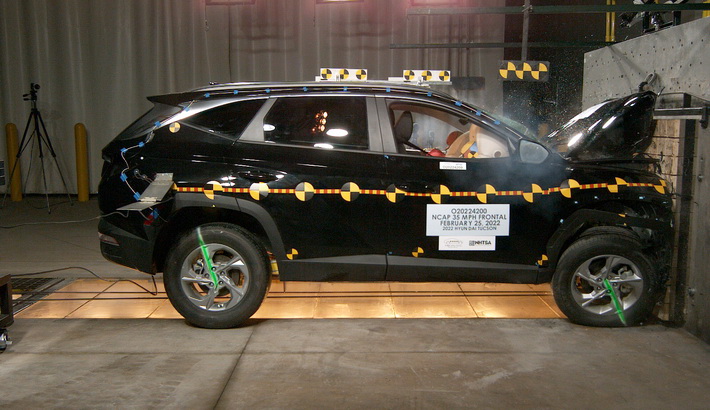
NHTSA Crash Test Performance
Frontal Crash Test
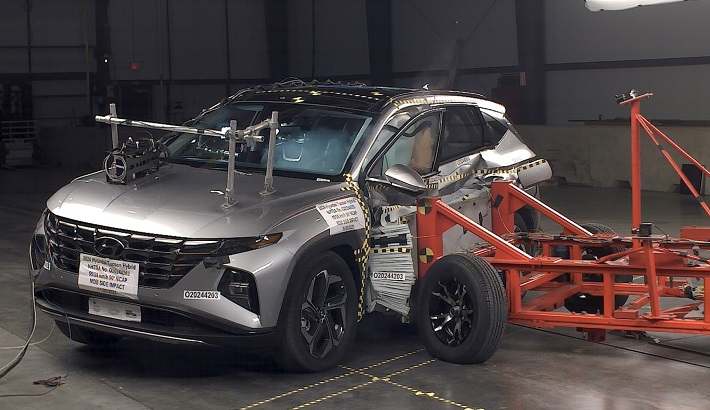
Side Crash Test
Overall Frontal Rating
Driver and Passenger Assessment
Driver Side
Passenger Side
Overall Side Rating
Side Barrier and Side Pole Tests
Driver Side
Passenger Side
Rollover Resistance
15.9% rollover risk in single-vehicle crash
Safety Features
ESC: StandardForward Collision Warning: StandardLane Departure Warning: Standard
Recall Notices
NHTSANHTSA ID: 25V893000December 19, 2025
TRAILER HITCHES
Hyundai Motor America (Hyundai) is recalling certain 2022-2024 Tucson vehicles equipped with an optional Mobis tow hitch wiring harness. The wiring harness may have been installed incorrectly, allowing water into the control module. Moisture accumulation may cause the trailer lighting to fail or an electrical short circuit.
Remedy Status
Owners are advised to park outside and away from structures until the recall repair is complete. Dealers will install a cap of the wiring, free of charge. Interim notification letters, notifying owners of the safety risk, were mailed February 13, 2026. Additional letters will be sent once the final remedy is available, anticipated July 2026. Owners may contact Hyundai customer service at 1-855-371-9460. Hyundai's number for this recall is 290. Vehicle Identification Numbers (VINs) involved in this recall became searchable on NHTSA.gov on December 20, 2025.
NHTSA ID: 24V412000June 05, 2024
STEERING:ELECTRIC POWER ASSIST SYSTEM
Hyundai Motor America (Hyundai) is recalling certain 2024 Tucson and Santa Cruz vehicles. The circuit board in the motor-driven power steering assembly may short circuit, resulting in a loss of power steering assist.
Remedy Status
Dealers will replace the motor-driven power steering electric power pack, free of charge. Owner notification letters were mailed July 11, 2024. Owners may contact Hyundai customer service at 1-855-371-9460. Hyundai's number for this recall is 261.
NHTSA ID: 23V556000August 04, 2023
EQUIPMENT:OTHER:LABELS
Hyundai Motor America (Hyundai) is recalling certain 2024 Tucson vehicles. The tire and loading information label may incorrectly indicate information about a spare tire. As such, these vehicles fail to comply with the requirements of Federal Motor Vehicle Safety Standard number 110, "Tire Selection and Rims."
Remedy Status
Dealers will inspect and replace the tire and loading information label, as necessary, free of charge. Owner notification letters were mailed September 5, 2023. Owners may contact Hyundai customer service at 1-855-371-9460. Hyundai's number for this recall is 247.
NHTSA ID: 23V526000July 27, 2023
POWER TRAIN:AUTOMATIC TRANSMISSION:FLUID/LUBRICANT:PUMP
Hyundai Motor America (Hyundai) is recalling certain 2023-2024 Palisade Tucson, 2023 Sonata, Elantra, and Kona vehicles. The electronic controller for the Idle Stop & Go oil pump assembly may contain damaged electrical components that can cause the pump controller to overheat.
Remedy Status
Owners are advised to park outside and away from structures until the recall repair is complete. Dealers will inspect and replace the electric oil pump controller, as necessary, free of charge. Owner notification letters were mailed starting September 7, 2023. Owners may contact Hyundai customer service at 1-855-371-9460. Hyundai's number for this recall is 246.
Owner Complaints
73 totalTRAILER HITCHES
Apr 9, 2026
The contact owns a 2024 Hyundai Tucson. The contact received notification of NHTSA Campaign Number: 25V893000 (Trailer Hitches). The local dealer was contacted and confirmed that parts were on back order. The vehicle was not diagnosed or repaired. The manufacturer was not contact...
Preview excerpt
ELECTRICAL SYSTEM,SERVICE BRAKES
Mar 31, 2026
There has been an urgent safety recall with no fix for 4 months. I need the issue to be resolved so that my vehicle is no longer a safety hazard, but both the dealership I purchased it from and the manufacturer have stated that it's not a big deal.
TRAILER HITCHES
Mar 18, 2026
The contact owns a 2024 Hyundai Tucson. The contact was informed by the Turo App that the VIN was associated with NHTSA Campaign Number: 25V893000 (Trailer Hitches); however, the part to do the recall repair was not yet available. The dealer was contacted and confirmed that parts...
Preview excerpt
SERVICE BRAKES
Mar 16, 2026
I am reporting a repeated brake system issue on my 2024 Hyundai Tucson involving premature rotor warping and brake failure at very low mileage. On April 30, 2025 (11,007 miles), I first noticed significant vibration and shaking when braking. On May 29, 2025, Colonial Hyundai di...
Preview excerpt
POWER TRAIN,ENGINE,FUEL/PROPULSION SYSTEM
Mar 3, 2026
While driving at approximately 70 mph on a highway under normal conditions, the vehicle experienced a sudden loss of engine power. A check engine light illuminated at the time of the failure, and the vehicle was unable to maintain normal acceleration or consistent speed. The los...
Preview excerpt
ENGINE
Mar 3, 2026
I am submitting a vehicle safety complaint regarding my 2024 Hyundai Tucson Hybrid. The vehicle has a recurring engine warning issue (code P0471) that has not been resolved despite multiple repair attempts by an authorized Hyundai dealership. Additionally, there is a concerning...
Preview excerpt
UNKNOWN OR OTHER,VISIBILITY/WIPER
Feb 25, 2026
My car was parked, without any trees or other objects that could possibly damage my car near by, and the glass on my front windshield cracked for absolutely no reason. It starts where the glass attached to the car and spreads to the middle of my windshield. I believe there is an ...
Preview excerpt
ELECTRICAL SYSTEM,UNKNOWN OR OTHER
Feb 25, 2026
The problem first appeared after I bought my car to the dealership to replace an amplifier. Since then, my car has been there twice and they have not been able to identify the problem. I’m going back-and-forth with the dealership and hyundai corporation. after numerous incidents...
Preview excerpt
SERVICE BRAKES,FORWARD COLLISION AVOIDANCE
Feb 17, 2026
Driving to work, going into a turn with no obstructions my car frequently alerts to a "collision warning" that is not there. Additionally, I have been driving on the highway, with no obstructions in front of me and my car emergency brake despite an emergency not being present. ...
Preview excerpt
ELECTRICAL SYSTEM,UNKNOWN OR OTHER,ENGINE
Feb 13, 2026
I am submitting this complaint regarding Hyundai Safety Recall #290 (NHTSA Recall No. 25V893) as it applies to my vehicle, VIN [XXX] . I received the official recall notice by mail on February 13, 2026. The recall identifies a defect involving the tow hitch wiring harness control...
Preview excerpt
Showing 10 recent complaints from 73 total
View Full Complaint LogCompare Related Vehicles
Why Compare These Pages
The strongest comparison flow is usually: exact vehicle-year page, then nearby years of the same model, then other 2024 Hyundai models. That sequence helps separate one-off year spikes from broader make-wide patterns.
More Hyundai Tucson Years
2025 Hyundai TucsonCompare this year against 2024 for complaint and recall shifts.4r214c2023 Hyundai TucsonCompare this year against 2024 for complaint and recall shifts.2r110c2026 Hyundai TucsonCompare this year against 2024 for complaint and recall shifts.3r19c2022 Hyundai TucsonCompare this year against 2024 for complaint and recall shifts.3r344c2021 Hyundai TucsonCompare this year against 2024 for complaint and recall shifts.1r63c2020 Hyundai TucsonCompare this year against 2024 for complaint and recall shifts.1r160c
More 2024 Hyundai Models
2024 Hyundai PalisadeAnother 2024 Hyundai option for same-year comparison.5r343c2024 Hyundai Ioniq 5Another 2024 Hyundai option for same-year comparison.2r202c2024 Hyundai Santa FeAnother 2024 Hyundai option for same-year comparison.7r104c2024 Hyundai ElantraAnother 2024 Hyundai option for same-year comparison.1r48c2024 Hyundai KonaAnother 2024 Hyundai option for same-year comparison.3r38c2024 Hyundai SonataAnother 2024 Hyundai option for same-year comparison.1r36c
Frequently Asked Questions
How many recalls does the 2024 Hyundai Tucson have?
The 2024 Hyundai Tucson has 4 recalls recorded by NHTSA.
How many complaints have been filed for the 2024 Hyundai Tucson?
NHTSA has received 73 owner-reported complaints for the 2024 Hyundai Tucson.
What is the NHTSA safety rating for the 2024 Hyundai Tucson?
The 2024 Hyundai Tucson received an overall safety rating of 5 out of 5 stars from NHTSA.
What are the most common problems with the 2024 Hyundai Tucson?
The most commonly reported complaint categories for the 2024 Hyundai Tucson are unknown or other (9 reports), service brakes,forward collision avoidance (8 reports), forward collision avoidance (5 reports).
Does the 2024 Hyundai Tucson have any recalls?
Yes. NHTSA has 4 recalls on record for the 2024 Hyundai Tucson. Scroll up to review the published recall summaries, consequences, and remedies. To check for unrepaired recalls on your specific vehicle, use your VIN at nhtsa.gov/recalls.
Check Another Vehicle
Look up recalls and complaints for any year, make, and model.
This page summarizes publicly available data from the National Highway Traffic Safety Administration (NHTSA). Complaint counts reflect reports submitted to NHTSA by vehicle owners and do not by themselves prove defect severity or vehicle safety. Safety ratings may not be available for all vehicle-years. This site is not affiliated with NHTSA or any vehicle manufacturer. For official information, visit the official NHTSA page for this vehicle.