Hyundai · Tucson · 2017
2017 Hyundai Tucson
3
Recalls
1,060
Complaints
5/5
Safety Rating
The 2017 Hyundai Tucson has 3 recalls and 1,060 owner-reported complaints on file with NHTSA. Overall safety rating: 5 out of 5 stars. Most reported issue: engine (394 reports).
Source: NHTSA Public Records · Updated Apr 28, 2026
Research Context
The 2017 Hyundai Tucson page works best as a research starting point. Complaint totals show how much owner-reported activity exists, while recalls and investigations help show whether any of that activity turned into formal safety action.
Because this is a newer-era vehicle page, it usually helps to compare this year against nearby model years before deciding whether a complaint pattern looks isolated or persistent. On this page, the most prominent complaint area is engine with 394 reported complaints.
Best Research Moves
- Use the complaint log to see whether the 2017 Hyundai Tucson reports cluster around one repeated symptom or spread across multiple systems.
- Review the recall section even if the total is smaller, because a limited number of recalls can still point to meaningful safety actions.
- This page is primarily a complaints-and-recalls research surface, so compare nearby model years before treating the complaint total as a standalone verdict.
Key Takeaways
- The 2017 Hyundai Tucson currently shows 3 NHTSA recalls listed on this page and 1,060 owner-reported complaints.
- This page currently shows no linked NHTSA investigations.
- This page reflects complaint volume, recall history, and NHTSA test data, but it does not diagnose causes or rank reliability by itself.
- Safety data currently shows 5/5 overall NHTSA safety rating.
- The most frequently reported complaint categories on this page are engine (394), power train (163), unknown or other (70).
- Vehicle
- 2017 Hyundai Tucson
- Recalls
- 3
- Complaints
- 1060
- Safety Rating
- 5/5
How to Interpret This Page
This page combines three types of NHTSA data: recall campaigns (official manufacturer or government actions), owner complaints (unverified consumer reports), and crash test ratings (where available). A vehicle with many complaints is not necessarily less reliable — complaint volume correlates with sales volume and vehicle age. Recalls indicate identified defects, not overall quality. To compare this model year with others, use the year navigation in the sidebar or return to the model overview page.
If you are researching a used vehicle, start with the complaint categories, compare them against the recall list, and then check nearby model years to see whether the same issue profile repeats. That usually produces a better buying or research signal than treating the raw complaint total as a standalone safety ranking.
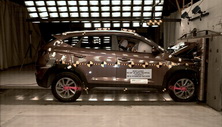
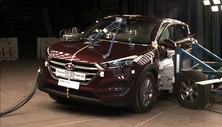
NHTSA Crash Test Performance
Frontal Crash Test
Side Crash Test
Overall Frontal Rating
Driver and Passenger Assessment
Driver Side
Passenger Side
Overall Side Rating
Side Barrier and Side Pole Tests
Driver Side
Passenger Side
Rollover Resistance
15.5% rollover risk in single-vehicle crash
Safety Features
ESC: StandardForward Collision Warning: OptionalLane Departure Warning: Optional
Recall Notices
NHTSANHTSA ID: 21V727000September 17, 2021
ENGINE
Hyundai Motor America (Hyundai) is recalling certain 2017 Tucson and Sonata Hybrid vehicles. The connecting rod bearings inside the engine may wear prematurely, which can result in engine damage.
Remedy Status
Dealers will inspect the engine. If bearing damage is found, the engine will be replaced. Dealers will also install a software update containing a new Knock Sensor Detection System (KSDS). Repairs will be performed free of charge. Owners were notified of the defect on November 16, 2021. Owner notification letters were mailed January 15, 2022. Owners may contact Hyundai customer service at 1-855-371-9460. Hyundai's number for this recall is 209.
NHTSA ID: 20V543000September 04, 2020
SERVICE BRAKES, HYDRAULIC:ANTILOCK/TRACTION CONTROL/ELECTRONIC LIMITED SLIP:CONTROL UNIT/MODULE
Hyundai Motor America (Hyundai) recalled certain 2019-2021 Tucson vehicles on September 4, 2020. On December 30, 2020, Hyundai expanded the recall population, and added certain 2016-2018 Tucson vehicles. The Anti-lock Brake Hydraulic Electronic Control Unit (HECU) could corrode internally and cause an electrical short, possibly resulting in an engine compartment fire.
Remedy Status
Hyundai will notify owners, and dealers will replace the HECU fuse. For 2019-2021 model years, the Electronic Stability Control (ESC) software will also be updated. Recall repairs will be performed free of charge. Owners are advised to park outside and away from structures as a precaution until the recall repair is complete. The recall began November 2, 2020. Owners may contact Hyundai customer service at 1-855-371-9460. Hyundai's number for this recall is 195.
NHTSA ID: 16V842000November 21, 2016
ELECTRICAL SYSTEM:WIRING
Hyundai Motor America (Hyundai) is recalling certain model year 2016-2017 Tucson vehicles manufactured May 19, 2015, to November 14, 2016, and 2017 Santa Fe vehicles manufactured November 28, 2015, to November 14, 2016. The affected vehicles may be equipped with an accessory trailer hitch wiring harness that, due to a malfunction of the tow hitch module, may result, in the trailer brake lights being constantly illuminated. As such, these vehicles fail to comply with the requirements of Federal Motor Vehicle Safety Standard (FMVSS) number 108, " Lamps, Reflective Devices, and Associated Equipment."
Remedy Status
Hyundai will notify owners, and dealers will replace the affected accessory trailer hitch wiring harnesses, free of charge. The recall is expected to begin January 13, 2017. Owners may contact Hyundai customer service at 1-800-633-5151. Hyundai's number for this recall is 153.
Owner Complaints
1060 totalENGINE
Apr 20, 2026
My Hundai Tuscon 2017 was making a whurring sound on the highway, at which time my RPM's were not going over 3. As I was looking for places to pull over on the highway, I heard a loud 'pop' and then my engine started smoking and an intense rattling ensued to where I could hear a ...
Preview excerpt
ENGINE
Apr 6, 2026
Knocking noise in motor and metal flakes in the oil. Called local dealership. They report no recalls for this issue.
ENGINE
Apr 1, 2026
The contact owns a 2017 Hyundai Tucson. The contact stated that while driving at an undisclosed speed, the engine made a ticking sound. No warning light was illuminated. The vehicle was taken to the dealer and was repaired under NHTSA Campaign Numbers: 20V543000 (Service Brakes, ...
Preview excerpt
ENGINE
Mar 24, 2026
The contact owns a 2017 Hyundai Tucson. The contact stated that while starting the vehicle and driving at an undisclosed speed, there was an abnormally loud grumbling sound coming from the engine. There was no warning light illuminated. The contact stated that the vehicle unexpec...
Preview excerpt
STRUCTURE
Mar 24, 2026
the door latches are no longer opening the doors from the inside of the vehicle. This started with the passenger rear and now is effecting the drivers door. The only way to get out of the vehicle is to crawl over the seat to get to a door that is still operational. No warni...
Preview excerpt
ENGINE
Mar 14, 2026
While driving my vehicle, the engine RPM suddenly revved very high, and the vehicle hesitated to accelerate. A warning messaged appeared stating "Transmission too hot stop safely." I was driving up a hill when this happened. I pulled over and turned the vehicle off for about two ...
Preview excerpt
ENGINE
Mar 10, 2026
On March 10, 2026, my 2017 Hyundai Tucson entered 'Limp Home Mode' while driving, a known safety defect that causes a sudden loss of engine power. Diagnostic testing confirmed error code P1326 (Knock Sensor Detection System - KSDS). Despite this vehicle being covered under the Th...
Preview excerpt
SUSPENSION
Mar 9, 2026
On my 2017 Hyundai Tucson, my steering wheel light is illuminated. I took it to the dealership and they said I need a new steering wheel collar. My Hyundai has about 98,000 miles.
ELECTRICAL SYSTEM,ENGINE
Mar 7, 2026
The vehicle has a difficult time turning over when cranking, the RPMs are sticking and the car periodically shuts off at red lights. Several warning lights pop up when it won't crank and then other warnings when the car just completely shuts off at red lights. I drive the interst...
Preview excerpt
ENGINE,FUEL/PROPULSION SYSTEM
Mar 4, 2026
This car has major oil consumption that affects the engine and catalytic converter. This can cause engine damage and stalls in driving that affect safety on the roads because the car doesn't accelerate properly. There were no warning signals to indicate this being a problem with ...
Preview excerpt
Showing 10 recent complaints from 1,060 total
View Full Complaint LogCompare Related Vehicles
Why Compare These Pages
The strongest comparison flow is usually: exact vehicle-year page, then nearby years of the same model, then other 2017 Hyundai models. That sequence helps separate one-off year spikes from broader make-wide patterns.
More Hyundai Tucson Years
2018 Hyundai TucsonCompare this year against 2017 for complaint and recall shifts.1r373c2016 Hyundai TucsonCompare this year against 2017 for complaint and recall shifts.5r1,595c2019 Hyundai TucsonCompare this year against 2017 for complaint and recall shifts.1r359c2015 Hyundai TucsonCompare this year against 2017 for complaint and recall shifts.1r223c2020 Hyundai TucsonCompare this year against 2017 for complaint and recall shifts.1r160c2014 Hyundai TucsonCompare this year against 2017 for complaint and recall shifts.2r200c
More 2017 Hyundai Models
2017 Hyundai Santa FeAnother 2017 Hyundai option for same-year comparison.6r910c2017 Hyundai ElantraAnother 2017 Hyundai option for same-year comparison.4r753c2017 Hyundai SonataAnother 2017 Hyundai option for same-year comparison.3r743c2017 Hyundai AccentAnother 2017 Hyundai option for same-year comparison.66c2017 Hyundai VelosterAnother 2017 Hyundai option for same-year comparison.48c2017 Hyundai AzeraAnother 2017 Hyundai option for same-year comparison.1r12c
Frequently Asked Questions
How many recalls does the 2017 Hyundai Tucson have?
The 2017 Hyundai Tucson has 3 recalls recorded by NHTSA.
How many complaints have been filed for the 2017 Hyundai Tucson?
NHTSA has received 1,060 owner-reported complaints for the 2017 Hyundai Tucson.
What is the NHTSA safety rating for the 2017 Hyundai Tucson?
The 2017 Hyundai Tucson received an overall safety rating of 5 out of 5 stars from NHTSA.
What are the most common problems with the 2017 Hyundai Tucson?
The most commonly reported complaint categories for the 2017 Hyundai Tucson are engine (394 reports), power train (163 reports), unknown or other (70 reports).
Does the 2017 Hyundai Tucson have any recalls?
Yes. NHTSA has 3 recalls on record for the 2017 Hyundai Tucson. Scroll up to review the published recall summaries, consequences, and remedies. To check for unrepaired recalls on your specific vehicle, use your VIN at nhtsa.gov/recalls.
Check Another Vehicle
Look up recalls and complaints for any year, make, and model.
This page summarizes publicly available data from the National Highway Traffic Safety Administration (NHTSA). Complaint counts reflect reports submitted to NHTSA by vehicle owners and do not by themselves prove defect severity or vehicle safety. Safety ratings may not be available for all vehicle-years. This site is not affiliated with NHTSA or any vehicle manufacturer. For official information, visit the official NHTSA page for this vehicle.