Toyota · 4Runner · 2017
2017 Toyota 4Runner
5
Recalls
35
Complaints
4/5
Safety Rating
The 2017 Toyota 4Runner has 5 recalls and 35 owner-reported complaints on file with NHTSA. Overall safety rating: 4 out of 5 stars. Most reported issue: unknown or other (9 reports).
Source: NHTSA Public Records · Updated Apr 29, 2026
Research Context
The 2017 Toyota 4Runner page works best as a research starting point. Complaint totals show how much owner-reported activity exists, while recalls and investigations help show whether any of that activity turned into formal safety action.
Because this is a newer-era vehicle page, it usually helps to compare this year against nearby model years before deciding whether a complaint pattern looks isolated or persistent. On this page, the most prominent complaint area is unknown or other with 9 reported complaints.
Best Research Moves
- Use the complaint log to understand what owners were actually reporting instead of relying only on the raw complaint total.
- Compare the recall list with the complaint mix to see whether the most reported issues overlap with formal NHTSA safety campaigns.
- Check the linked investigations for extra ODI context if you want to see whether owner complaints escalated into formal defect review.
Key Takeaways
- The 2017 Toyota 4Runner currently shows 5 NHTSA recalls listed on this page and 35 owner-reported complaints.
- This page currently shows 1 NHTSA investigation linked to this page.
- This page reflects complaint volume, recall history, and NHTSA test data, but it does not diagnose causes or rank reliability by itself.
- Safety data currently shows 4/5 overall NHTSA safety rating.
- The most frequently reported complaint categories on this page are unknown or other (9), service brakes (9), electrical system (3).
- Vehicle
- 2017 Toyota 4Runner
- Recalls
- 5
- Complaints
- 35
- Safety Rating
- 4/5
How to Interpret This Page
This page combines three types of NHTSA data: recall campaigns (official manufacturer or government actions), owner complaints (unverified consumer reports), and crash test ratings (where available). A vehicle with many complaints is not necessarily less reliable — complaint volume correlates with sales volume and vehicle age. Recalls indicate identified defects, not overall quality. To compare this model year with others, use the year navigation in the sidebar or return to the model overview page.
If you are researching a used vehicle, start with the complaint categories, compare them against the recall list, and then check nearby model years to see whether the same issue profile repeats. That usually produces a better buying or research signal than treating the raw complaint total as a standalone safety ranking.
NHTSA Crash Test Performance
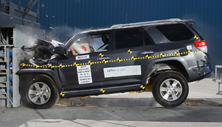
Frontal Crash Test
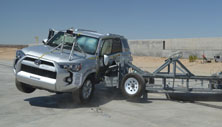
Side Crash Test
Overall Frontal Rating
Driver and Passenger Assessment
Driver Side
Passenger Side
Overall Side Rating
Side Barrier and Side Pole Tests
Driver Side
Passenger Side
Rollover Resistance
24.6% rollover risk in single-vehicle crash
Safety Features
ESC: StandardForward Collision Warning: NoLane Departure Warning: No
Recall Notices
NHTSANHTSA ID: 18V753000October 25, 2018
EQUIPMENT:OTHER:LABELS
Southeast Toyota Distributors, LLC (SET) is recalling certain 2017-2019 Toyota 4Runner vehicles that SET modified to be equipped with a TRD wheel package. The Gross Vehicle Weight Rating (GVWR) on the certification label may be incorrect, possibly resulting in the vehicle being overloaded. As such, these vehicles fail to comply with the requirements of Federal Motor Vehicle Safety Standard (FMVSS) number 110, "Tire Selection and Rims."
Remedy Status
SET will notify owners and mail them corrected certification labels, free of charge. The recall began November 28, 2018. Owners may contact SET customer service at 1-866-405-4226. SET's number for this recall is SET18A.
NHTSA ID: 17V831000December 20, 2017
EQUIPMENT:OTHER:LABELS
Toyota Motor Engineering & Manufacturing (Toyota) is recalling certain 2017-2018 Toyota 4Runner and Tundra, 2018 Toyota Highlander, RAV4 and Lexus GX460 and 2017 Toyota Sienna and Tacoma vehicles. These vehicles may have incorrect load carrying capacity modification labels. As such, these vehicles fail to comply with the requirements of Federal Motor Vehicle Safety Standard (FMVSS) number 110, "Tire Selection and Rims."
Remedy Status
Toyota will notify owners and provide them with corrected labels, free of charge. The recall began on January 23, 2018. Owners may contact Toyota customer service at 1-800-331-4331. Toyota's numbers for this recall are H0Z for Toyota vehicles, and HLF for Lexus vehicles.
NHTSA ID: 17V763000November 29, 2017
STRUCTURE:BODY:HOOD
Southeast Toyota Distributors, LLC (SET) is recalling certain 2015-2018 Toyota 4Runner vehicles equipped with an accessory Billet Grille Overlay installed by SET or provided by SET and installed by SET dealers. The U-nut that secures the overlay grille may fracture, allowing the Billet Grille Overlay to detach from the vehicle.
Remedy Status
SET will notify owners, and dealers will replace the securing U-nuts with upgraded hardware, free of charge. The recall is expected to begin January 26, 2018. Owners may contact SET customer service at 1-866-405-4226. SET's number for this recall is SET17C.
NHTSA ID: 17V295000May 02, 2017
TIRES:TEMPORARY/EMERGENCY SPARE TIRE
Gulf States Toyota, Inc. (Gulf States) is recalling certain 2017 4Runner , 86, Avalon, Camry, Camry Hybrid, Corolla, Corolla iM, Highlander, Highlander Hybrid, Prius, Prius C, RAV4, RAV4 Hybrid, Sienna and Yaris vehicles. The spare tire air pressure was not adjusted to the proper pressure as stated on the Tire Pressure Label.
Remedy Status
Gulf States will notify owners, and dealers will inspect the spare tires, adjusting their pressure as necessary, free of charge. The recall began June 15, 2017. Owners may contact Gulf States customer service at 1-800-444-1074. Toyota's number for this recall is 17R2.
NHTSA ID: 17V291000May 01, 2017
EQUIPMENT
Gulf States Toyota, Inc (Gulf States) is recalling certain 2016-2017 4Runner vehicles equipped with the TFORCE accessory package. The fasteners for the aftermarket roof rack may have been improperly tightened.
Remedy Status
Gulf States will notify owners, and dealers will inspect and, as necessary, tighten the roof rack fasteners, free of charge. The recall began June 15, 2017. Owners may contact Gulf States customer service at 1-800-444-1074. Gulf States' number for this recall is 17R1.
Investigations
1 totalFrom 2000 through 2017, Takata produced millions of air bag inflators using two types of phase-stabilized ammonium nitrate ("PSAN") propellant -- propellant 2004 and propellant 2004L. After prolonged exposure to high temperature cycles and humidity, inflators using propellant 2004 can degrade, causing the propellant to burn too quickly when ignited. The rapid burning can cause the inflator to rupture during deployment, potentially causing serious or even fatal injury to vehicle occupants. See 2016 Blomquist Report at www.nhtsa.gov/sites/nhtsa.gov/files/documents/expert_report-hrblomquist.pdf.Consequently, all frontal inflators using propellant 2004 that do not contain a "desiccant" (a substance that traps and holds moisture) in US vehicles are under recall. These "non-desiccated" inflators either have been or are required to be replaced.In some cases, the remedy part for these recalled inflators was, or will be, an inflator using either propellant 2004 or 2004L that does contain a desiccant. None of these "desiccated" remedy parts (which were installed in older model year vehicles) are currently under recall for a degradation concern. Certain subsets of desiccated PSAN inflators using propellant 2004 for use as original equipment, however, have been recalled for a degradation concern. All Takata inflators produced with propellant 2004L contain desiccant, and none of these desiccated inflators using propellant 2004L are under recall for a degradation concern. There have been no reported field ruptures in any non-recalled desiccated PSAN inflators.It is understood that desiccants fully saturate at some threshold, at which point any additional moisture will not be captured. This means the degradation process observed in non-desiccated inflators using propellant 2004 may also occur in non-recalled desiccated inflators using propellant 2004, assuming additional moisture enters the inflator and high temperature cycling occurs. Based on available information, desiccant saturation can occur within the first five years in the worst environments, and the time required for full saturation is affected by multiple factors. While no present safety risk has been identified, further work is needed to evaluate the future risk of non-recalled desiccated inflators using propellant 2004.Three entities -- Takata (now known as TK Global), the Independent Testing Coalition, and Exponent -- have been studying the long-term behavior of Takata desiccated PSAN inflators using propellant 2004L (as well as 2004) in the presence of moisture and temperature cycling. The research efforts, which include development of predictive modeling techniques and field sample analysis, are ongoing. To date, none of the researchers have identified field evidence showing that propellant 2004L is undergoing a degradation process that leads to aggressive deployment and potential rupture. However, the time in service of such inflators remains short compared to that of the inflators using propellant 2004. Further study is needed to assess the long-term safety of desiccated inflators using propellant 2004L.The Office of Defects Investigation is opening this investigation to examine whether a safety defect related to propellant degradation exists in non-recalled desiccated PSAN frontal inflators manufactured by Takata. This investigation will require extensive information on Takata production processes and surveys of inflators in the field. Lists of recall actions that may have used desiccated PSAN inflators as remedy parts, as well as the makes and models originally manufactured with them, is available with the downloadable version of this document (see nhtsa.gov/recalls?nhtsaId=EA21002 -- note this information is subject to change/revision as the investigation proceeds). This investigation does not supersede EA15-001, which remains open.
Component: AIR BAGS:FRONTAL:DRIVER SIDE:INFLATOR MODULEOpened: Sep 17, 2021
Owner Complaints
35 totalELECTRICAL SYSTEM
Feb 26, 2026
For the 2nd time in 5 weeks, the main wiring harness and knock sensor have been eaten and destroyed by rodents. This has caused thousands of dollars worth of damage, and it's due to the soy based wiring used in the wiring harness. I cannot keep this vehicle outside for any period...
Preview excerpt
UNKNOWN OR OTHER
Aug 29, 2025
I was driving on the highway with no one around me. Temperature was around 60 degrees at 7:15am. My sunroof glass shattered as if it was a gunshot and the glass was pointed outward. It terrified my special needs child and myself and took a while for her to calm down. I drove it h...
Preview excerpt
FUEL/PROPULSION SYSTEM
May 25, 2025
2017 Toyota 4 runner SR5 While driving on the highway the vehicle stopped apparently the fuel pump stopped working and could not get going anymore. I had a mechanic come to the house with a PC and test it. He told me that’s a change that will need to take place in a garage. Lucki...
Preview excerpt
ENGINE,FUEL/PROPULSION SYSTEM
Mar 19, 2025
Throttle has a lag when depressing gas pedal (occasionally a dead petal symptom) research indicates a TSB T-SB-0166-10 exist that relates to this issue. Lack of Toyota dealer assistance with this issue when contacted (Toyota of Round Rock Texas 78664) This issues is a safety c...
Preview excerpt
STEERING,SUSPENSION,POWER TRAIN
Dec 2, 2024
Front struts are leaking which are causing the vehicle to drive inconsistently. The struts should not have to be replaced this soon when the vehicle is being used on normal condition roads. After researching, it appears this is a manufacturer, Toyota, issue, that is known, and To...
Preview excerpt
UNKNOWN OR OTHER
Dec 12, 2022
Car Theft Brentwood
VEHICLE SPEED CONTROL
Apr 19, 2022
Text sent to Toyota. Copy to NHTSA. Hello, my name is [XXX]. I am writing to both Toyota and NHTSA with what I perceive as a safety problem. I have owned three Toyotas including a 2017 4runner. I have been pleased with them except for one characteristic they all shared. Th...
Preview excerpt
SERVICE BRAKES
Feb 17, 2022
Failed brake master cylinder, this is still a rather new vehicle and the mechanics said this is unlikely in a new low mileage vehicle. I did research and this has only happened a few times, seems like a safety recall should be put in place.
SERVICE BRAKES
Sep 27, 2021
While driving at full speed on the freeway, another vehicle stopped suddenly in front of me. My brake pedal was soft and went down almost to the floor. Rapid pulsing of brakes, as would be expected with the ABS (antilock brake system), did not occur. I pulled around to the shoul...
Preview excerpt
SUSPENSION,VEHICLE SPEED CONTROL,WHEELS
Jul 1, 2020
TRUCK SHIMMY'S WHENEVER I DRIVE OVER 50MPH. FRONT TIRES ARE DAMAGED FROM CUPPING. MAINTENANCE HAS BEEN DONE AS WELL AS TIRE ALIGNMENT AND ROTATION. DEALERSHIP KEEPS SAYING NOTHING IS WRONG WITH IT.
Showing 10 recent complaints from 35 total
View Full Complaint LogCompare Related Vehicles
Why Compare These Pages
The strongest comparison flow is usually: exact vehicle-year page, then nearby years of the same model, then other 2017 Toyota models. That sequence helps separate one-off year spikes from broader make-wide patterns.
More Toyota 4Runner Years
2018 Toyota 4RunnerCompare this year against 2017 for complaint and recall shifts.5r57c2016 Toyota 4RunnerCompare this year against 2017 for complaint and recall shifts.8r1i75c2019 Toyota 4RunnerCompare this year against 2017 for complaint and recall shifts.4r62c2015 Toyota 4RunnerCompare this year against 2017 for complaint and recall shifts.9r1i86c2020 Toyota 4RunnerCompare this year against 2017 for complaint and recall shifts.1r31c2014 Toyota 4RunnerCompare this year against 2017 for complaint and recall shifts.7r1i76c
More 2017 Toyota Models
2017 Toyota RAV4Another 2017 Toyota option for same-year comparison.3r1i300c2017 Toyota HighlanderAnother 2017 Toyota option for same-year comparison.4r252c2017 Toyota TacomaAnother 2017 Toyota option for same-year comparison.5r1i229c2017 Toyota CorollaAnother 2017 Toyota option for same-year comparison.3r2i186c2017 Toyota CamryAnother 2017 Toyota option for same-year comparison.3r145c2017 Toyota SiennaAnother 2017 Toyota option for same-year comparison.10r143c
Frequently Asked Questions
How many recalls does the 2017 Toyota 4Runner have?
The 2017 Toyota 4Runner has 5 recalls recorded by NHTSA.
How many complaints have been filed for the 2017 Toyota 4Runner?
NHTSA has received 35 owner-reported complaints for the 2017 Toyota 4Runner.
What is the NHTSA safety rating for the 2017 Toyota 4Runner?
The 2017 Toyota 4Runner received an overall safety rating of 4 out of 5 stars from NHTSA.
What are the most common problems with the 2017 Toyota 4Runner?
The most commonly reported complaint categories for the 2017 Toyota 4Runner are unknown or other (9 reports), service brakes (9 reports), electrical system (3 reports).
Does the 2017 Toyota 4Runner have any recalls?
Yes. NHTSA has 5 recalls on record for the 2017 Toyota 4Runner. Scroll up to review the published recall summaries, consequences, and remedies. To check for unrepaired recalls on your specific vehicle, use your VIN at nhtsa.gov/recalls.
Check Another Vehicle
Look up recalls and complaints for any year, make, and model.
This page summarizes publicly available data from the National Highway Traffic Safety Administration (NHTSA). Complaint counts reflect reports submitted to NHTSA by vehicle owners and do not by themselves prove defect severity or vehicle safety. Safety ratings may not be available for all vehicle-years. This site is not affiliated with NHTSA or any vehicle manufacturer. For official information, visit the official NHTSA page for this vehicle.