Toyota · 4Runner · 2013
2013 Toyota 4Runner
6
Recalls
35
Complaints
4/5
Safety Rating
The 2013 Toyota 4Runner has 6 recalls and 35 owner-reported complaints on file with NHTSA. Overall safety rating: 4 out of 5 stars. Most reported issue: air bags (8 reports).
Source: NHTSA Public Records · Updated Apr 29, 2026
Research Context
The 2013 Toyota 4Runner page works best as a research starting point. Complaint totals show how much owner-reported activity exists, while recalls and investigations help show whether any of that activity turned into formal safety action.
Because this is a newer-era vehicle page, it usually helps to compare this year against nearby model years before deciding whether a complaint pattern looks isolated or persistent. On this page, the most prominent complaint area is air bags with 8 reported complaints.
Best Research Moves
- Use the complaint log to understand what owners were actually reporting instead of relying only on the raw complaint total.
- Compare the recall list with the complaint mix to see whether the most reported issues overlap with formal NHTSA safety campaigns.
- Check the linked investigations for extra ODI context if you want to see whether owner complaints escalated into formal defect review.
Key Takeaways
- The 2013 Toyota 4Runner currently shows 6 NHTSA recalls listed on this page and 35 owner-reported complaints.
- This page currently shows 1 NHTSA investigation linked to this page.
- This page reflects complaint volume, recall history, and NHTSA test data, but it does not diagnose causes or rank reliability by itself.
- Safety data currently shows 4/5 overall NHTSA safety rating.
- The most frequently reported complaint categories on this page are air bags (8), unknown or other (5), service brakes (4).
- Vehicle
- 2013 Toyota 4Runner
- Recalls
- 6
- Complaints
- 35
- Safety Rating
- 4/5
How to Interpret This Page
This page combines three types of NHTSA data: recall campaigns (official manufacturer or government actions), owner complaints (unverified consumer reports), and crash test ratings (where available). A vehicle with many complaints is not necessarily less reliable — complaint volume correlates with sales volume and vehicle age. Recalls indicate identified defects, not overall quality. To compare this model year with others, use the year navigation in the sidebar or return to the model overview page.
If you are researching a used vehicle, start with the complaint categories, compare them against the recall list, and then check nearby model years to see whether the same issue profile repeats. That usually produces a better buying or research signal than treating the raw complaint total as a standalone safety ranking.
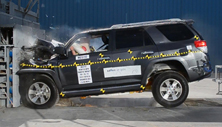
NHTSA Crash Test Performance
Frontal Crash Test
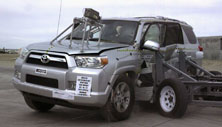
Side Crash Test
Overall Frontal Rating
Driver and Passenger Assessment
Driver Side
Passenger Side
Overall Side Rating
Side Barrier and Side Pole Tests
Driver Side
Passenger Side
Rollover Resistance
24.6% rollover risk in single-vehicle crash
Safety Features
ESC: StandardForward Collision Warning: NoLane Departure Warning: No
Recall Notices
NHTSANHTSA ID: 19V741000October 17, 2019
AIR BAGS:FRONTAL:PASSENGER SIDE:INFLATOR MODULE
Toyota Motor Engineering & Manufacturing (Toyota) is recalling certain 2010-2016 4Runner, 2003-2006 Tundra, 2003-2013 Corolla, 2009-2010 Corolla Matrix, 2004-2005 RAV4, 2002-2007 Sequoia, 2011-2013 Sienna, 2008-2012 Scion xB, 2008-2009 Lexus IS-F, 2007-2012 Yaris and Lexus ES350, 2010-2017 Lexus GX460, 2002-2010 Lexus SC430, 2006-2012 Lexus IS250 and IS350 and 2010-2015 Lexus IS250C and IS350C vehicles. These vehicles had their driver or passenger frontal air bag inflators previously replaced under a prior recall using inflators of the same design. The inflators may explode due to propellant degradation occurring after long-term exposure to high absolute humidity, temperature and temperature cycling.
Remedy Status
Toyota will notify owners. Depending on the vehicle model, dealers will replace the front driver inflator, front passenger airbag inflator, the airbag assembly, or the front passenger airbag sub-assembly and inflator. The recall began November 20, 2019. Owners may contact Toyota customer service at 1-888-270-9371 or Lexus customer service at 1-800-255-3987. Toyota's numbers for this recall are J0A, J0B, and J0C. Lexus' numbers for this recall are JLI, JLJ, and JLK.
NHTSA ID: 19V005000January 09, 2019
AIR BAGS:FRONTAL:PASSENGER SIDE:INFLATOR MODULE
Toyota Motor Engineering & Manufacturing (Toyota) is recalling certain 2014-2016 Toyota 4Runner, 2014-2015 Scion xB, Lexus IS350C, IS250C, 2014 Toyota Sienna, Lexus IS-F, and 2014-2017 Lexus GX460 vehicles sold, or ever registered in the states of Alabama, California, Florida, Georgia, Hawaii, Louisiana, Mississippi, South Carolina, Texas, Puerto Rico, American Samoa, Guam, the Northern Mariana Islands (Saipan), and the U.S. Virgin Islands or "Zone A." Toyota is also recalling certain 2011-2013 Toyota Corolla, Corolla Matrix, Lexus IS250, IS350, 2011-2016 4Runner, 2011-2015 Scion xB, Lexus IS350C, IS250C, 2011-2014 Toyota Sienna, Lexus IS-F, 2011-2017 Lexus GX460, and 2011-2012 Lexus ES350 vehicles ever registered in the states of Arizona, Arkansas, Delaware, District of Columbia, Illinois, Indiana, Kansas, Kentucky, Maryland, Missouri, Nebraska, Nevada, New Jersey, New Mexico, North Carolina, Ohio, Oklahoma, Pennsylvania, Tennessee, Virginia, and West Virginia or "Zone B." Toyota is also recalling certain 2010-2013 Toyota Corolla, Corolla Matrix, Lexus IS350, 2010-2016 4Runner, 2010-2013 Lexus IS250, 2010-2015 Scion xB, Lexus IS350C, IS250C, 2010-2017 Lexus GX460, 2010-2014 Lexus IS-F, and 2010-2012 Lexus ES350 vehicles ever registered in the states of Alaska, Colorado, Connecticut, Idaho, Iowa, Maine, Massachusetts, Michigan, Minnesota, Montana, New Hampshire, New York, North Dakota, Oregon, Rhode Island, South Dakota, Utah, Vermont, Washington, Wisconsin, and Wyoming or "Zone C." These vehicles are equipped with air bag inflators assembled as part of the passenger frontal air bag modules, used as original equipment or replacement equipment (such as after a vehicle crash necessitating replacement of the original air bags), that may explode due to propellant degradation occurring after long-term exposure to high absolute humidity, temperature and temperature cycling.
Remedy Status
Toyota will notify owners. Depending on the vehicle model, dealers will replace the front passenger air bag inflator, or replace the air bag assembly. The recall began February 15, 2019. Owners may contact Toyota customer service at 1-800-331-4331. Toyota's numbers for this recall are "Zone A" Toyota: G0P, Lexus: GLG; "Zone B" Toyota: G0R, Lexus GLH; "Zone C" Toyota: H0A, and Lexus: HLA.
NHTSA ID: 18V024000January 09, 2018
AIR BAGS:FRONTAL:PASSENGER SIDE:INFLATOR MODULE
Toyota Motor Engineering & Manufacturing (Toyota) is recalling certain 2013 Scion xB, Toyota Corolla, Corolla Matrix, Sienna, 4Runner, Lexus IS250, IS350, IS250C, IS350C, IS-F, and GX460 vehicles sold, ever registered, in the states of AL, CA, FL, GA, HI, LA, MS, SC, TX, PR, AS, GU, the MP (Saipan), and the U.S. VI or "Zone A." Toyota is also recalling certain 2010 Scion xB, Toyota Corolla, Corolla Matrix, Yaris, 4Runner, Lexus IS250, IS350, IS250C, IS350C, ES350, IS-F, GX460, and Pontiac Vibe vehicles sold, ever registered, in the states of AZ, AR, DE, DC, IL, IN, KS, KY, MD, MO, NE, NV, NJ, NM, NC, OH, OK, PA, TN, VA, and WV or "Zone B." Toyota is also recalling certain 2009 Scion xB, Toyota Corolla, Corolla Matrix, Yaris, Lexus IS250, IS350, ES350, IS-F, and Pontiac Vibe vehicles ever registered in the states of AK, CO, CT, ID, IA, ME, MA, MI, MN, MT, NH, NY, ND, OR, RI, SD, UT, VT, WA, WI, and WY or "Zone C." These vehicles are equipped with certain air bag inflators assembled as part of the passenger frontal air bag modules used as original equipment or replacement equipment. In the event of a crash necessitating deployment of the passenger frontal air bag, these inflators may explode due to propellant degradation occurring after long-term exposure to absolute humidity and temperature cycling.
Remedy Status
Toyota will notify the Toyota, Scion and Lexus owners. General Motors will contact the Pontiac owners. Depending on the vehicle model, dealers will replace the front passenger air bag inflator, or replace the air bag assembly. The recall began on January 29, 2018. Owners may contact Toyota customer service at 1-800-331-4331, or Pontiac customer service at 1-800-762-2737. Toyota's numbers for this recall are "Zone A" Toyota: G0P, Lexus: GLG; "Zone B" Toyota: G0R, Lexus GLH; "Zone C" Toyota: H0A, and Lexus: HLA.
NHTSA ID: 17V425000July 03, 2017
STRUCTURE:BODY:HOOD:HINGE AND ATTACHMENTS
Southeast Toyota Distributors, LLC (SET) is recalling certain 2011-2016 Toyota Tacoma and 4Runner vehicles equipped with accessory hood scoops installed by SET or SET dealers. The adhesive attaching the hood scoop may weaken, allowing the hood scoop to detach from the vehicle.
Remedy Status
SET will notify owners, and dealers will mechanically fasten the scoop to the hood, free of charge. The recall began on September 1, 2017. Owners may contact SET customer service at 1-954-429-2000. SET's number for this recall is SET17B.
NHTSA ID: 16V577000August 03, 2016
ENGINE AND ENGINE COOLING:EXHAUST SYSTEM:MANIFOLD/HEADER/MUFFLER/TAIL PIPE
Southeast Toyota Distributors, LLC (SET) is recalling certain model year 2010-2015 Toyota 4Runner vehicles manufactured September 3, 2009, to December 1, 2014. The affected vehicles may be equipped with accessory exhaust tips installed by SET or SET dealers that may contact people and possibly burn them while they are standing behind the vehicle.
Remedy Status
SET will notify owners, and dealers will install a re-designed exhaust tip that is smaller in diameter and is more recessed behind the bumper, free of charge. The recall began September 15, 2016. Owners may contact SET customer service at 1-866-405-4226. SET's number for this recall is SET16D.
NHTSA ID: 15V515000August 13, 2015
ENGINE AND ENGINE COOLING:EXHAUST SYSTEM:MANIFOLD/HEADER/MUFFLER/TAIL PIPE
Southeast Toyota Distributors, LLC (SET) is recalling certain model year 2010-2015 Toyota 4Runner vehicles manufactured March 29, 2010, to July 30, 2015. The affected vehicles may be equipped with accessory exhaust tips installed by SET or SET dealers that may contact people and possibly burn them while they are standing behind the vehicle.
Remedy Status
SET will notify owners, and dealers will install a re-designed exhaust tip that is smaller in diameter and is more recessed behind the bumper, free of charge. The recall began on September 22, 2015. Owners may contact SET customer service at 1-866-405-4226. SET's number for the recall is SET15D.
Investigations
1 totalFrom 2000 through 2017, Takata produced millions of air bag inflators using two types of phase-stabilized ammonium nitrate ("PSAN") propellant -- propellant 2004 and propellant 2004L. After prolonged exposure to high temperature cycles and humidity, inflators using propellant 2004 can degrade, causing the propellant to burn too quickly when ignited. The rapid burning can cause the inflator to rupture during deployment, potentially causing serious or even fatal injury to vehicle occupants. See 2016 Blomquist Report at www.nhtsa.gov/sites/nhtsa.gov/files/documents/expert_report-hrblomquist.pdf.Consequently, all frontal inflators using propellant 2004 that do not contain a "desiccant" (a substance that traps and holds moisture) in US vehicles are under recall. These "non-desiccated" inflators either have been or are required to be replaced.In some cases, the remedy part for these recalled inflators was, or will be, an inflator using either propellant 2004 or 2004L that does contain a desiccant. None of these "desiccated" remedy parts (which were installed in older model year vehicles) are currently under recall for a degradation concern. Certain subsets of desiccated PSAN inflators using propellant 2004 for use as original equipment, however, have been recalled for a degradation concern. All Takata inflators produced with propellant 2004L contain desiccant, and none of these desiccated inflators using propellant 2004L are under recall for a degradation concern. There have been no reported field ruptures in any non-recalled desiccated PSAN inflators.It is understood that desiccants fully saturate at some threshold, at which point any additional moisture will not be captured. This means the degradation process observed in non-desiccated inflators using propellant 2004 may also occur in non-recalled desiccated inflators using propellant 2004, assuming additional moisture enters the inflator and high temperature cycling occurs. Based on available information, desiccant saturation can occur within the first five years in the worst environments, and the time required for full saturation is affected by multiple factors. While no present safety risk has been identified, further work is needed to evaluate the future risk of non-recalled desiccated inflators using propellant 2004.Three entities -- Takata (now known as TK Global), the Independent Testing Coalition, and Exponent -- have been studying the long-term behavior of Takata desiccated PSAN inflators using propellant 2004L (as well as 2004) in the presence of moisture and temperature cycling. The research efforts, which include development of predictive modeling techniques and field sample analysis, are ongoing. To date, none of the researchers have identified field evidence showing that propellant 2004L is undergoing a degradation process that leads to aggressive deployment and potential rupture. However, the time in service of such inflators remains short compared to that of the inflators using propellant 2004. Further study is needed to assess the long-term safety of desiccated inflators using propellant 2004L.The Office of Defects Investigation is opening this investigation to examine whether a safety defect related to propellant degradation exists in non-recalled desiccated PSAN frontal inflators manufactured by Takata. This investigation will require extensive information on Takata production processes and surveys of inflators in the field. Lists of recall actions that may have used desiccated PSAN inflators as remedy parts, as well as the makes and models originally manufactured with them, is available with the downloadable version of this document (see nhtsa.gov/recalls?nhtsaId=EA21002 -- note this information is subject to change/revision as the investigation proceeds). This investigation does not supersede EA15-001, which remains open.
Component: AIR BAGS:FRONTAL:DRIVER SIDE:INFLATOR MODULEOpened: Sep 17, 2021
Owner Complaints
35 totalELECTRICAL SYSTEM,ENGINE,FUEL/PROPULSION SYSTEM
Jul 3, 2024
TOYOTA 4RUNNER 2013 VIN# [XXX] LP# XXX The gas needle will be above the half (middle line), and the fuel range on top of the dash would read anywhere from 160-213 miles, going 45 mph up a hill or 70 mph on the freeway, all of a sudden starts to stall and completely shut off whi...
Preview excerpt
TIRES
Apr 10, 2024
I was traveling on [XXX] returning home and felt the steering wheel pulling strongly to the right so I immediately pulled off to the side of the road and noted the right front passenger tire was deflated. This tire is a 245/60 R20 107HSL BSW Procontrol Cooper tire. The tire at t...
Preview excerpt
AIR BAGS
Jul 12, 2023
The component that failed is the air back clock spring. It’s preventing the horn form functioning properly. In turn can result in an accident from lack of warning other drivers and/or air bag might not go off. It seems to be a known problem on the 13 model year of the 4Runners. I...
Preview excerpt
UNKNOWN OR OTHER
Feb 1, 2023
1) The failed component is the door locks. Or more precisely, the motor for the electrical operation of the door locks. When failed, the door remains locked even when pulling on the interior handle to open the door or when trying to unlock the door using the interior latch. You ...
Preview excerpt
STRUCTURE
Aug 17, 2021
Rust appeared on the hatch of my 4Runner approximately 2 years after I purchased it new. My complaints to 2 different dealerships were ignored and left undocumented. I was told this wasn't covered under warranty. In 2019, the rust was finally documented by Toyota and I was told t...
Preview excerpt
FUEL/PROPULSION SYSTEM
Apr 9, 2021
OUR FUEL PUMP AND A GASKET WENT OUT AT SAME TIME. NO WARNING IT WAS GOING TO HAPPEN, LUNGED FORWARD 5 FEET AND THEN DIED. GOING TO COST $1,000 TO FIX. IT LOOKS LIKE TOYOTA HAS RECALLS ON FUEL PUMPS BUT IT DOESN'T COVER OUR YEAR YET.
AIR BAGS
CRASH1 injuryAug 7, 2020
DURING AN ACCIDENT, BOTH SIDE AIRBAGS DEPLOYED (FRONT AIRBAGS DID NOT DEPLOY). FRONT RIGHT PASSENGER INJURED BY SIDE AIRBAG -- BLEEDING PUNCTURE WOUNDS (APPROX 3) ON UPPER RIGHT WRIST, SEVERE RAISED GOUGES (BELOW THE SKIN) FROM THAT POINT UP THE ENTIRE LENGTH OF THE ARM (MORE SE...
Preview excerpt
ENGINE
Jun 12, 2020
Make: Toyota Model: 4Runner Year: 2013 Mileage: 76,200 Description of Incident While driving on [XXX] at night, the vehicle experienced a sudden and catastrophic engine failure, leaving it immobilized in the middle of the highway. This presented an immediate and severe safety ri...
Preview excerpt
VEHICLE SPEED CONTROL
Mar 12, 2020
THIS HAS HAPPENED 4 TIMES. ONCE AT STOP SIGN, TWICE ON HIGHWAY SLOWING DOWN FOR RED LIGHT AND ONCE IN A DRIVE THRU. ALL WAS IN MOTION. HAVEN'T HAD TO DEALER YET BECAUSE OF CORONAVIRUS SCARE. DATE BELOW IS ESTIMATE OF LAST TIME IT HAPPENED. NOTHING TO BACK THIS PROBLEM UP BUT MY...
Preview excerpt
FUEL/PROPULSION SYSTEM
Feb 15, 2020
THE VEHICLE HAS STALLED ON THE HIGHWAY THREE TIMES IN THE LAST SIX MONTHS MOST RECENTLY ON 2/15/2020. EACH TIME THE GAS GAUGE WAS SHOWING APPROXIMATELY A QUARTER TANK OF GAS. IN NONE OF THE CASES WAS THE LOW FUEL LIGHT ON.
Showing 10 recent complaints from 35 total
View Full Complaint LogCompare Related Vehicles
Why Compare These Pages
The strongest comparison flow is usually: exact vehicle-year page, then nearby years of the same model, then other 2013 Toyota models. That sequence helps separate one-off year spikes from broader make-wide patterns.
More Toyota 4Runner Years
2014 Toyota 4RunnerCompare this year against 2013 for complaint and recall shifts.7r1i76c2012 Toyota 4RunnerCompare this year against 2013 for complaint and recall shifts.8r1i96c2015 Toyota 4RunnerCompare this year against 2013 for complaint and recall shifts.9r1i86c2011 Toyota 4RunnerCompare this year against 2013 for complaint and recall shifts.10r1i162c2016 Toyota 4RunnerCompare this year against 2013 for complaint and recall shifts.8r1i75c2010 Toyota 4RunnerCompare this year against 2013 for complaint and recall shifts.12r1i145c
More 2013 Toyota Models
2013 Toyota PriusAnother 2013 Toyota option for same-year comparison.3r3i389c2013 Toyota CamryAnother 2013 Toyota option for same-year comparison.2r301c2013 Toyota RAV4Another 2013 Toyota option for same-year comparison.2r1i253c2013 Toyota HighlanderAnother 2013 Toyota option for same-year comparison.3r2i208c2013 Toyota CorollaAnother 2013 Toyota option for same-year comparison.5r2i201c2013 Toyota SiennaAnother 2013 Toyota option for same-year comparison.6r1i179c
Frequently Asked Questions
How many recalls does the 2013 Toyota 4Runner have?
The 2013 Toyota 4Runner has 6 recalls recorded by NHTSA.
How many complaints have been filed for the 2013 Toyota 4Runner?
NHTSA has received 35 owner-reported complaints for the 2013 Toyota 4Runner.
What is the NHTSA safety rating for the 2013 Toyota 4Runner?
The 2013 Toyota 4Runner received an overall safety rating of 4 out of 5 stars from NHTSA.
What are the most common problems with the 2013 Toyota 4Runner?
The most commonly reported complaint categories for the 2013 Toyota 4Runner are air bags (8 reports), unknown or other (5 reports), service brakes (4 reports).
Does the 2013 Toyota 4Runner have any recalls?
Yes. NHTSA has 6 recalls on record for the 2013 Toyota 4Runner. Scroll up to review the published recall summaries, consequences, and remedies. To check for unrepaired recalls on your specific vehicle, use your VIN at nhtsa.gov/recalls.
Check Another Vehicle
Look up recalls and complaints for any year, make, and model.
This page summarizes publicly available data from the National Highway Traffic Safety Administration (NHTSA). Complaint counts reflect reports submitted to NHTSA by vehicle owners and do not by themselves prove defect severity or vehicle safety. Safety ratings may not be available for all vehicle-years. This site is not affiliated with NHTSA or any vehicle manufacturer. For official information, visit the official NHTSA page for this vehicle.