Toyota · Highlander · 2013
2013 Toyota Highlander
3
Recalls
208
Complaints
4/5
Safety Rating
The 2013 Toyota Highlander has 3 recalls and 208 owner-reported complaints on file with NHTSA. Overall safety rating: 4 out of 5 stars. Most reported issue: steering (40 reports).
Source: NHTSA Public Records · Updated Apr 29, 2026
Research Context
The 2013 Toyota Highlander page works best as a research starting point. Complaint totals show how much owner-reported activity exists, while recalls and investigations help show whether any of that activity turned into formal safety action.
Because this is a newer-era vehicle page, it usually helps to compare this year against nearby model years before deciding whether a complaint pattern looks isolated or persistent. On this page, the most prominent complaint area is steering with 40 reported complaints.
Best Research Moves
- Use the complaint log to understand what owners were actually reporting instead of relying only on the raw complaint total.
- Review the recall section even if the total is smaller, because a limited number of recalls can still point to meaningful safety actions.
- Check the linked investigations for extra ODI context if you want to see whether owner complaints escalated into formal defect review.
Key Takeaways
- The 2013 Toyota Highlander currently shows 3 NHTSA recalls listed on this page and 208 owner-reported complaints.
- This page currently shows 2 NHTSA investigations linked to this page.
- This page reflects complaint volume, recall history, and NHTSA test data, but it does not diagnose causes or rank reliability by itself.
- Safety data currently shows 4/5 overall NHTSA safety rating.
- The most frequently reported complaint categories on this page are steering (40), unknown or other (15), vehicle speed control (13).
- Vehicle
- 2013 Toyota Highlander
- Recalls
- 3
- Complaints
- 208
- Safety Rating
- 4/5
How to Interpret This Page
This page combines three types of NHTSA data: recall campaigns (official manufacturer or government actions), owner complaints (unverified consumer reports), and crash test ratings (where available). A vehicle with many complaints is not necessarily less reliable — complaint volume correlates with sales volume and vehicle age. Recalls indicate identified defects, not overall quality. To compare this model year with others, use the year navigation in the sidebar or return to the model overview page.
If you are researching a used vehicle, start with the complaint categories, compare them against the recall list, and then check nearby model years to see whether the same issue profile repeats. That usually produces a better buying or research signal than treating the raw complaint total as a standalone safety ranking.
NHTSA Crash Test Performance
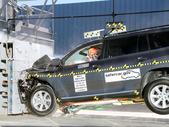
Frontal Crash Test
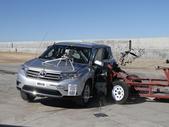
Side Crash Test
Overall Frontal Rating
Driver and Passenger Assessment
Driver Side
Passenger Side
Overall Side Rating
Side Barrier and Side Pole Tests
Driver Side
Passenger Side
Rollover Resistance
17.4% rollover risk in single-vehicle crash
Safety Features
ESC: StandardForward Collision Warning: NoLane Departure Warning: No
Recall Notices
NHTSANHTSA ID: 14V148000March 27, 2014
SEATS
Toyota is recalling certain model year 2013 Highlander vehicles manufactured March 13, 2013, through August 6, 2013. In the affected vehicles, the second row left hand seat may not lock in place when positioned in the forward front or second adjusting position. As such, the vehicles do not conform to Federal Motor Vehicle Safety Standard (FMVSS) number 207, "Seating Systems."
Remedy Status
Toyota will notify owners, and dealers will modify the second row left hand seat so that it will lock into the seat track, free of charge. The recall began on May 21, 2014. Owners may contact Toyota at 1-800-331-4331.
NHTSA ID: 13V123000April 09, 2013
EQUIPMENT:OTHER:LABELS
Southeast Toyota is recalling certain model year 2008 and 2010-2013 Toyota Tundra, 2010-2012 Rav4, 2012 Toyota Sequoia, 2010-2011 Toyota Corolla, 2010-2011 Toyota Camry and Camry Hybrid, 2010-2013 Toyota Highlander and Highlander Hybrid, 2010-2013 Toyota FJ Cruiser, 2011 Toyota Land Cruiser, 2010-2013 Toyota Venza, 2010-2011 Toyota 4Runner, 2010-2013 Toyota Tacoma, 2011-2012 Toyota Sienna, 2012 Toyota Prius, 2013 Scion FR-S, 2011 Scion XD, 2011 Scion XB, and 2012 Scion TC vehicles. These vehicles were sold with labels that were outside the allowable one percent of accuracy of actual weight added. Thus, these vehicles fail to comply with the requirements of Federal Motor Vehicle Safety Standard (FMVSS) Number 110, "Tire Selection and Rims."
Remedy Status
Southeast Toyota will notify owners and provide a corrected label with instructions concerning its installation. A small group of the affected vehicles will need additonal remedies which are still being developed. The recall began on May 28, 2013. Owners may contact Southeast Toyota at 1-800-301-6859.
NHTSA ID: 13V014000January 16, 2013
AIR BAGS:FRONTAL:SENSOR/CONTROL MODULE-INACTIVE
Southeast Toyota Distributors, LLC (SET) is recalling certain models interspersed through model years 2009 through 2013 as follows: model year 2009-2012 Tacoma, 4Runner, Camry, Camry Hybrid, Prius, and RAV4; model year 2009-2010 Avalon, FJ Cruiser, and Highlander Hybrid; model year 2010-2013 model year Corolla, Sienna and Tundra; model year 2009-2013 Highlander and Venza; model year 2012 Prius V; and model year 2010-2012 Sequoia. During modification by SET to include accessories such as leather seat covers, seat heaters or headrest DVD systems, these vehicles may not have had the passenger seat occupant sensing system calibration tested. Without passing the calibration test, the occupant sensing system may not operate as designed.
Remedy Status
Southeast Toyota will notify owners, and dealers will test the sensitivity of the occupant detection sensors, and recalibrate them as necessary. The recall began on March 21, 2013. Owners may contact Southeast Toyota at 1-800-301-6859.
Investigations
2 totalOn November 16, 2018, the Office of Defects Investigation (ODI) opened an Engineering Analysis (EA18-006) as an upgrade to a Preliminary Evaluation (PE18-005). The investigation focused on allegations of steering wheel separation from the lower steering column after using the tilt and/or telescoping mechanism. Given the separation occurring when operating the tilt and/or telescoping function and failure of both shear capsules to maintain the lower steering column mounting position, potential for shear capsule damage in the known failures due to collisions, the overall low rate of occurrence, and the updated manufacturer documentation, this investigation is closed. The closing of this investigation does not constitute a finding by NHTSA that no safety-related defect exists. The agency reserves right to take further action if warranted by the circumstances. A detailed summary of the investigation is attached to this closing resume. To review the ODI reports cited in the Closing Resume ODI Report Identification Number document, go to NHTSA.gov.
Component: STEERING:COLUMNOpened: Nov 16, 2018Closed: Apr 2, 2024
On May 4, 2018, the Office of Defects Investigation (ODI) opened Preliminary Evaluation PE18-005 to investigate three allegations of steering column separation for Model Year (MY) 2008 through 2013 Toyota Highlander vehicles. Two (2) of the 3 complaints were received by ODI in April 2018 and occurred while the vehicle was in motion. Since opening PE18-005, one (1) additional VOQ involving steering column separation has been received. This incident occurred while the vehicle was stationary.As part of PE18-005, ODI examined the field data, warranty data, and relevant technical information submitted by Toyota in response to the PE18-005 information request letter. Ten (10) additional incidents of steering column separation were identified. Four (4) of these instances occurred while driving. During PE18-005, ODI confirmed that the steering columns in the subject vehicles are equipped with breakaway capsules that are designed to collapse/shear during certain types of vehicle collisions. This design feature aims to reduce driver injury severity from impact with the steering wheel in frontal vehicle collisions. There is no direct method for detecting when the capsules in the subject vehicles have sheared. If the driver operates the tilt/telescoping feature after the breakaway capsules have separated, the steering column may drop out of position and could subsequently detach entirely from the rest of the steering assembly. Loss of steering while driving may cause a loss of vehicle control, which could lead to a vehicle crash.To date, ODI has identified 14 incidents involving complete steering column separation, 6 of which occurred while driving. One of these incidents involved a minor crash. Additionally, there have been 16 events where the steering column dropped from the dashboard mounting brackets, but column separation did not occur. Four of these incidents happened while driving. Of these 30 total separation/drop incidents, 5 of the vehicles have evidence of minor collision repairs months or years prior to the steering column failure.This investigation has been upgraded an to Engineering Analysis (EA18-006) in order to 1) conduct a more detailed analysis of the conditions that may cause the steering column breakaway capsules to separate and 2) assess factors that may contribute to the problem of failing to detect and repair breakaway capsules after they have separated. Toyota has recently revised their repair manual and issued a Collision Repair Information Bulletin to help address the second concern.The VOQs associated with this investigation can be viewed at www.NHTSA.gov under the following ODI complaint numbers: 11141761, 11083623, 11083280, 10888043.
Component: STEERING:COLUMNOpened: May 4, 2018Closed: Nov 20, 2018
Owner Complaints
208 totalFUEL/PROPULSION SYSTEM
Jul 27, 2025
A persistent smell of fuel occurred while in slow moving traffic and after vehicle was parked after use. Upon close inspection, the fuel injector fuel rail end cap exhibited a slow fuel leak. This component caused a recall for year model highlanders for 2014 production year descr...
Preview excerpt
UNKNOWN OR OTHER
Jun 21, 2025
I own a Toyota and have always been a strong supporter of the brand — I truly believe Toyota’s reliability and build quality are unmatched. That’s why I was shocked and disappointed to discover that the paint on the roof of my car, especially near the sunroof, had started peeling...
Preview excerpt
AIR BAGS,SEAT BELTS
Apr 15, 2025
Driver side airbags (curtain and left seat) spontaneously deployed while I was parking the car. I did not hit anything. I was not injured but my safety was put at risk because I likely would have crashed if it had happened while I was driving. I contacted Toyota and they sent...
Preview excerpt
AIR BAGS
Feb 10, 2025
The contact owns a 2013 Toyota Highlander. The contact stated that while driving in negative 10-degree weather at 75 MPH, the driver's and passenger’s side curtain air bags deployed without warning or impact. The local dealer was contacted, but the vehicle was not diagnosed or re...
Preview excerpt
STRUCTURE
Nov 5, 2024
The contact owns a 2013 Toyota Highlander. The contact stated while the vehicle was parked, the contact discovered that the paint on the top of the vehicle was peeling. The contact did research and was made aware of the Customer Support Program: ZKG however, the VIN was not inclu...
Preview excerpt
SERVICE BRAKES
Sep 30, 2024
Multiple ABS related(ABS, TRACTION, BRAKES) warning lights/messages making driving my Highlander dangerous to me and others. Warning lights appeared 9/30/2024. No symptoms or warning lights appeared prior. Vehicle was then inspected by Toyota of Plano. Code 1391indicating an inte...
Preview excerpt
ENGINE,FUEL/PROPULSION SYSTEM
Feb 11, 2024
I purchased the car in 2020 with 73K miles on it. It has sporadically had incidents of unintended acceleration. I happens when I slow for a stop sign, red light, or crosswalk. My foot is on the brake when this occurs, the engine then goes into high gear and no amount of pressu...
Preview excerpt
ENGINE
Jan 3, 2024
The issue started when the car was over 84,000 miles. The engine burns excessive oil. I have to add oil every 2200 miles. When I press on the gas pedal to rev the car, oil come out of the tail pipe. When I went to the dealer that they are aware of the issue but they did not make ...
Preview excerpt
ENGINE
Jul 18, 2023
I am known by Toyota experts and my local mechanics as someone who takes excellent care of my vehicle, but unfortunately I am completely blown away when I was driving my car and suddenly it stopped and couldn’t start, after I tolled it to my mechanic, he told me the engine seized...
Preview excerpt
ENGINE
Jan 14, 2023
Engine is burning/consuming oil excessively; no leaks or any other unusual symptoms found. I was on an interstate highway and all of a sudden engine sound changed and excessive knocking started. No OIL LOW LEVEL or CHECK ENGINE light turned on. Yes the problem is persistent now a...
Preview excerpt
Showing 10 recent complaints from 208 total
View Full Complaint LogCompare Related Vehicles
Why Compare These Pages
The strongest comparison flow is usually: exact vehicle-year page, then nearby years of the same model, then other 2013 Toyota models. That sequence helps separate one-off year spikes from broader make-wide patterns.
More Toyota Highlander Years
2014 Toyota HighlanderCompare this year against 2013 for complaint and recall shifts.5r131c2012 Toyota HighlanderCompare this year against 2013 for complaint and recall shifts.2r2i190c2015 Toyota HighlanderCompare this year against 2013 for complaint and recall shifts.2r184c2011 Toyota HighlanderCompare this year against 2013 for complaint and recall shifts.5r2i185c2016 Toyota HighlanderCompare this year against 2013 for complaint and recall shifts.3r109c2010 Toyota HighlanderCompare this year against 2013 for complaint and recall shifts.10r2i237c
More 2013 Toyota Models
2013 Toyota PriusAnother 2013 Toyota option for same-year comparison.3r3i389c2013 Toyota CamryAnother 2013 Toyota option for same-year comparison.2r301c2013 Toyota RAV4Another 2013 Toyota option for same-year comparison.2r1i253c2013 Toyota CorollaAnother 2013 Toyota option for same-year comparison.5r2i201c2013 Toyota SiennaAnother 2013 Toyota option for same-year comparison.6r1i179c2013 Toyota AvalonAnother 2013 Toyota option for same-year comparison.4r1i159c
Frequently Asked Questions
How many recalls does the 2013 Toyota Highlander have?
The 2013 Toyota Highlander has 3 recalls recorded by NHTSA.
How many complaints have been filed for the 2013 Toyota Highlander?
NHTSA has received 208 owner-reported complaints for the 2013 Toyota Highlander.
What is the NHTSA safety rating for the 2013 Toyota Highlander?
The 2013 Toyota Highlander received an overall safety rating of 4 out of 5 stars from NHTSA.
What are the most common problems with the 2013 Toyota Highlander?
The most commonly reported complaint categories for the 2013 Toyota Highlander are steering (40 reports), unknown or other (15 reports), vehicle speed control (13 reports).
Does the 2013 Toyota Highlander have any recalls?
Yes. NHTSA has 3 recalls on record for the 2013 Toyota Highlander. Scroll up to review the published recall summaries, consequences, and remedies. To check for unrepaired recalls on your specific vehicle, use your VIN at nhtsa.gov/recalls.
Check Another Vehicle
Look up recalls and complaints for any year, make, and model.
This page summarizes publicly available data from the National Highway Traffic Safety Administration (NHTSA). Complaint counts reflect reports submitted to NHTSA by vehicle owners and do not by themselves prove defect severity or vehicle safety. Safety ratings may not be available for all vehicle-years. This site is not affiliated with NHTSA or any vehicle manufacturer. For official information, visit the official NHTSA page for this vehicle.