Toyota · Highlander · 2016
2016 Toyota Highlander
3
Recalls
109
Complaints
5/5
Safety Rating
The 2016 Toyota Highlander has 3 recalls and 109 owner-reported complaints on file with NHTSA. Overall safety rating: 5 out of 5 stars. Most reported issue: unknown or other (16 reports).
Source: NHTSA Public Records · Updated Apr 29, 2026
Research Context
The 2016 Toyota Highlander page works best as a research starting point. Complaint totals show how much owner-reported activity exists, while recalls and investigations help show whether any of that activity turned into formal safety action.
Because this is a newer-era vehicle page, it usually helps to compare this year against nearby model years before deciding whether a complaint pattern looks isolated or persistent. On this page, the most prominent complaint area is unknown or other with 16 reported complaints.
Best Research Moves
- Use the complaint log to understand what owners were actually reporting instead of relying only on the raw complaint total.
- Review the recall section even if the total is smaller, because a limited number of recalls can still point to meaningful safety actions.
- This page is primarily a complaints-and-recalls research surface, so compare nearby model years before treating the complaint total as a standalone verdict.
Key Takeaways
- The 2016 Toyota Highlander currently shows 3 NHTSA recalls listed on this page and 109 owner-reported complaints.
- This page currently shows no linked NHTSA investigations.
- This page reflects complaint volume, recall history, and NHTSA test data, but it does not diagnose causes or rank reliability by itself.
- Safety data currently shows 5/5 overall NHTSA safety rating.
- The most frequently reported complaint categories on this page are unknown or other (16), service brakes (13), electrical system (8).
- Vehicle
- 2016 Toyota Highlander
- Recalls
- 3
- Complaints
- 109
- Safety Rating
- 5/5
How to Interpret This Page
This page combines three types of NHTSA data: recall campaigns (official manufacturer or government actions), owner complaints (unverified consumer reports), and crash test ratings (where available). A vehicle with many complaints is not necessarily less reliable — complaint volume correlates with sales volume and vehicle age. Recalls indicate identified defects, not overall quality. To compare this model year with others, use the year navigation in the sidebar or return to the model overview page.
If you are researching a used vehicle, start with the complaint categories, compare them against the recall list, and then check nearby model years to see whether the same issue profile repeats. That usually produces a better buying or research signal than treating the raw complaint total as a standalone safety ranking.
NHTSA Crash Test Performance
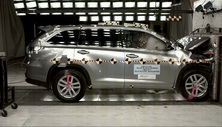
Frontal Crash Test
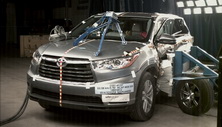
Side Crash Test
Overall Frontal Rating
Driver and Passenger Assessment
Driver Side
Passenger Side
Overall Side Rating
Side Barrier and Side Pole Tests
Driver Side
Passenger Side
Rollover Resistance
16.9% rollover risk in single-vehicle crash
Safety Features
ESC: StandardForward Collision Warning: OptionalLane Departure Warning: Optional
Recall Notices
NHTSANHTSA ID: 18E107000November 27, 2018
ELECTRICAL SYSTEM
Fujian Wanda Automobile Glass Industry (Wanda) is recalling certain aftermarket Replacement Windshields sold for use in 2014-2018 Toyota Highlander vehicles. The windshields have an attached wire harness that water may leak into, possibly causing damage to the vehicle's Engine Control Module (ECM).
Remedy Status
Wanda will notify owners, and service centers will replace the windshields, and inspect the ECM for damage, having it replaced, as necessary, free of charge. The recall began January 29, 2019. Owners may contact Wanda customer service at 1-864-281-2760.
NHTSA ID: 16V775000October 24, 2016
ELECTRICAL SYSTEM:WIRING
Toyota Motor Engineering & Manufacturing (Toyota) is recalling certain model year 2016 Highlander vehicles manufactured May 26, 2016, to September 16, 2016. The brake fluid level sensor may not be connected to the wire harness, preventing the sensor from detecting the brake fluid level. As such, these vehicles fail to comply with the requirements of Federal Motor Vehicle Safety Standard (FMVSS) No. 135, "Light Vehicle Brake Systems."
Remedy Status
Toyota will notify owners, and dealers will inspect and, as necessary, connect the wire harness to the sensor, free of charge. The recall began November 14, 2016. Owners may contact Toyota customer service at 1-800-331-4331. Toyota's number for this G03.
NHTSA ID: 16V420000June 09, 2016
EQUIPMENT:OTHER:LABELS
Southeast Toyota Distributors, LLC (SET) is recalling certain model year 2016 Toyota Camry and Highlander, 2015-2016 Toyota Tundra, Scion FR-S, and tC vehicles. The Load Carrying Capacity Modification Label may not reflect the correct added weight of the installed accessories. As a result, these vehicles fail to comply with the requirements of Federal Motor Vehicle Safety Standard number 110, "Tire Selection and Rims for Passenger Cars."
Remedy Status
SET will notify owners, and provide a corrected label for placement over the inaccurate label, free of charge. The recall began on July 14, 2016. Owners may contact SET customer service at 1-866-405-4226.
Owner Complaints
109 totalSTEERING
Feb 5, 2026
I was on Hwy 27 headed south bound at Bellecita Rd in Davenpoerrt, Fl. This is a busy four way intersection. I moved into the left hand turn lane. When the left turn green light came on I began my U-Turn to head north bound. The steering wheel would not respond to my input and th...
Preview excerpt
POWER TRAIN,WHEELS
CRASHJan 17, 2026
I was driving on a 2-lane road early in the morning with light snowfall. There was about 1" of snow on the road, with the roads not yet plowed or treated as it was the beginning of the snowfall. About 15 minutes into my trip, I was on a relatively flat and straight stretch of t...
Preview excerpt
AIR BAGS,UNKNOWN OR OTHER
CRASH1 injuryOct 21, 2025
I was traveling on an interstate going home from work. My speed was approximately 65mph. I noticed traffic slowing up ahead. I began to drop my speed (cost down), as I was approaching the traffic the car in front of me was applying their brakes; I had already began to apply mine....
Preview excerpt
TIRES
Sep 18, 2025
**Nature of Safety Defect Within 13,000 miles of normal mixed highway and light off-road use on a Toyota Highland, one tire developed a sidewall bubble and all four tires exhibited extreme and uneven tread wear—far below the advertised 50,000-mile treadwear warranty. The remainin...
Preview excerpt
TIRES
Aug 15, 2025
P245/55R19 103T Nitto Crosstek2 BW. Vehicle pulls to different directions when the tires are cross swapped. I have taken the vehicle to 4 to 5 wheel alignments within 3 months and 3 different shops after the purchase of the tire. Recently I took the vehicle Big O Tires and they ...
Preview excerpt
STEERING
Jun 3, 2025
Steering column can become worn prematurely causing loose steering and possibly loose control
FORWARD COLLISION AVOIDANCE
May 9, 2025
On multiple (3-5), but not all, occasions at the same location my pre collision warning and automatic breaking appear to have been triggered as I approached an expansion plate at the edge of a bridge. The pre collision warning sounded, then the brakes were automatically applied....
Preview excerpt
TIRES
Jan 5, 2025
The contact owns a 2016 Toyota Highlander equipped with Cooper Tires, Tire Line: Evolution H/T, Tire Size: 245/55/R19, DOT Number: UPPIILE. The contact stated that while his wife was driving approximately 55-65 MPH, the rear driver's side tire unexpectedly had a blowout. The cont...
Preview excerpt
ENGINE
Dec 3, 2024
The water pump on my 2016 Toyota Highlander XLE disintegrated while I was driving in heavy traffic. The pulley came loose from the water pump shaft. I have the water pump. Our safety was at risk because this happen in heavy traffic and it could have effected my control of the ve...
Preview excerpt
SERVICE BRAKES
CRASHNov 11, 2024
The contact owned a 2016 Toyota Highlander. The contact stated that while driving at an undisclosed low speeds on a decline, the brake pedal depressed all the way to the floorboard. As a result, the vehicle rolled downhill into a busy intersection and was struck by another vehicl...
Preview excerpt
Showing 10 recent complaints from 109 total
View Full Complaint LogCompare Related Vehicles
Why Compare These Pages
The strongest comparison flow is usually: exact vehicle-year page, then nearby years of the same model, then other 2016 Toyota models. That sequence helps separate one-off year spikes from broader make-wide patterns.
More Toyota Highlander Years
2017 Toyota HighlanderCompare this year against 2016 for complaint and recall shifts.4r252c2015 Toyota HighlanderCompare this year against 2016 for complaint and recall shifts.2r184c2018 Toyota HighlanderCompare this year against 2016 for complaint and recall shifts.5r246c2014 Toyota HighlanderCompare this year against 2016 for complaint and recall shifts.5r131c2019 Toyota HighlanderCompare this year against 2016 for complaint and recall shifts.3r441c2013 Toyota HighlanderCompare this year against 2016 for complaint and recall shifts.3r2i208c
More 2016 Toyota Models
2016 Toyota TacomaAnother 2016 Toyota option for same-year comparison.4r1i320c2016 Toyota RAV4Another 2016 Toyota option for same-year comparison.3r1i232c2016 Toyota CorollaAnother 2016 Toyota option for same-year comparison.1r2i209c2016 Toyota CamryAnother 2016 Toyota option for same-year comparison.2r179c2016 Toyota PriusAnother 2016 Toyota option for same-year comparison.5r1i177c2016 Toyota TundraAnother 2016 Toyota option for same-year comparison.6r1i116c
Frequently Asked Questions
How many recalls does the 2016 Toyota Highlander have?
The 2016 Toyota Highlander has 3 recalls recorded by NHTSA.
How many complaints have been filed for the 2016 Toyota Highlander?
NHTSA has received 109 owner-reported complaints for the 2016 Toyota Highlander.
What is the NHTSA safety rating for the 2016 Toyota Highlander?
The 2016 Toyota Highlander received an overall safety rating of 5 out of 5 stars from NHTSA.
What are the most common problems with the 2016 Toyota Highlander?
The most commonly reported complaint categories for the 2016 Toyota Highlander are unknown or other (16 reports), service brakes (13 reports), electrical system (8 reports).
Does the 2016 Toyota Highlander have any recalls?
Yes. NHTSA has 3 recalls on record for the 2016 Toyota Highlander. Scroll up to review the published recall summaries, consequences, and remedies. To check for unrepaired recalls on your specific vehicle, use your VIN at nhtsa.gov/recalls.
Check Another Vehicle
Look up recalls and complaints for any year, make, and model.
This page summarizes publicly available data from the National Highway Traffic Safety Administration (NHTSA). Complaint counts reflect reports submitted to NHTSA by vehicle owners and do not by themselves prove defect severity or vehicle safety. Safety ratings may not be available for all vehicle-years. This site is not affiliated with NHTSA or any vehicle manufacturer. For official information, visit the official NHTSA page for this vehicle.