Toyota · Tundra · 2025
2025 Toyota Tundra
4
Recalls
101
Complaints
5/5
Safety Rating
The 2025 Toyota Tundra has 4 recalls and 101 owner-reported complaints on file with NHTSA. Overall safety rating: 5 out of 5 stars. Most reported issue: engine (10 reports).
Source: NHTSA Public Records · Updated Apr 29, 2026
Research Context
The 2025 Toyota Tundra page works best as a research starting point. Complaint totals show how much owner-reported activity exists, while recalls and investigations help show whether any of that activity turned into formal safety action.
Because this is a newer-era vehicle page, it usually helps to compare this year against nearby model years before deciding whether a complaint pattern looks isolated or persistent. On this page, the most prominent complaint area is engine with 10 reported complaints.
Best Research Moves
- Use the complaint log to understand what owners were actually reporting instead of relying only on the raw complaint total.
- Review the recall section even if the total is smaller, because a limited number of recalls can still point to meaningful safety actions.
- This page is primarily a complaints-and-recalls research surface, so compare nearby model years before treating the complaint total as a standalone verdict.
Key Takeaways
- The 2025 Toyota Tundra currently shows 4 NHTSA recalls listed on this page and 101 owner-reported complaints.
- This page currently shows no linked NHTSA investigations.
- This page reflects complaint volume, recall history, and NHTSA test data, but it does not diagnose causes or rank reliability by itself.
- Safety data currently shows 5/5 overall NHTSA safety rating.
- The most frequently reported complaint categories on this page are engine (10), power train (10), vehicle speed control (8).
- Vehicle
- 2025 Toyota Tundra
- Recalls
- 4
- Complaints
- 101
- Safety Rating
- 5/5
How to Interpret This Page
This page combines three types of NHTSA data: recall campaigns (official manufacturer or government actions), owner complaints (unverified consumer reports), and crash test ratings (where available). A vehicle with many complaints is not necessarily less reliable — complaint volume correlates with sales volume and vehicle age. Recalls indicate identified defects, not overall quality. To compare this model year with others, use the year navigation in the sidebar or return to the model overview page.
If you are researching a used vehicle, start with the complaint categories, compare them against the recall list, and then check nearby model years to see whether the same issue profile repeats. That usually produces a better buying or research signal than treating the raw complaint total as a standalone safety ranking.
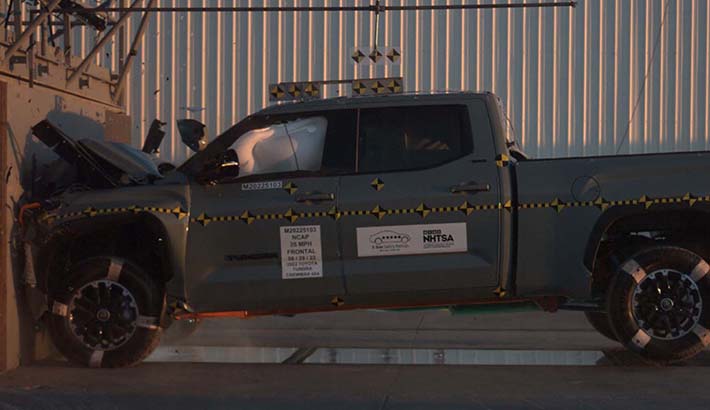
NHTSA Crash Test Performance
Frontal Crash Test
Side Crash Test

Overall Frontal Rating
Driver and Passenger Assessment
Driver Side
Passenger Side
Overall Side Rating
Side Barrier and Side Pole Tests
Driver Side
Passenger Side
Rollover Resistance
19.8% rollover risk in single-vehicle crash
Safety Features
ESC: StandardForward Collision Warning: StandardLane Departure Warning: Standard
Recall Notices
NHTSANHTSA ID: 26V179000March 24, 2026
EQUIPMENT:OTHER:LABELS
Toyota Motor Engineering & Manufacturing (Toyota) is recalling certain 2024-2025 Toyota Tundra, Tacoma Hybrid, Tacoma, RAV4 Hybrid, Land Cruiser Hybrid, Lexus GX550, 2024-2026 Tundra Hybrid, 2025 Sequoia Hybrid, Crown Signia, Grand Highlander, Lexus TX500 Hybrid, Lexus NX350 Hybrid, 2025-2026 Grand Highlander Hybrid, and Lexus TX350 vehicles. The load carrying capacity modification label may display inaccurate added weight values. As such, these vehicles fail to comply with the requirements of Federal Motor Vehicle Safety Standard number 110, "Tire Selection and Rims."
Remedy Status
Dealers will replace the load carrying capacity modification label, free of charge. Owner notification letters are expected to be mailed May 9, 2026. Owners may contact Toyota's customer service at 1-800-331-4331. Toyota's numbers for this recall are 26LB04, 26LA04, 26TB07, and 26TA07.
NHTSA ID: 26V038000January 23, 2026
BACK OVER PREVENTION:SOFTWARE
Toyota Motor Engineering & Manufacturing (Toyota) is recalling certain 2024-2025 Toyota Tundra and Tundra Hybrid vehicles equipped with a Panoramic View Monitor (PVM) system. The rearview camera image may not display when the vehicle is placed in reverse. As such, these vehicles fail to comply with the requirements of Federal Motor Vehicle Safety Standard (FMVSS) number 111, "Rear Visibility."
Remedy Status
Dealers will update the parking assist ECU software, free of charge. Owner notification letters were mailed March 23, 2026. Owners may contact Toyota's customer service at 1-800-331-4331. Toyota's numbers for this recall are 26TB02 and 26TA02.
NHTSA ID: 25V657000October 01, 2025
BACK OVER PREVENTION:SOFTWARE
Toyota Motor Engineering & Manufacturing (Toyota) is recalling certain 2022-2025 Tundra, Tundra Hybrid, and 2023-2025 Sequoia Hybrid vehicles. A software error may cause the rearview image not to display when the vehicle is placed in reverse. As such, these vehicles fail to comply with the requirements of Federal Motor Vehicle Safety Standard (FMVSS) number 111, "Rear Visibility."
Remedy Status
Dealers will update the multimedia display software, free of charge. Owner notification letters were mailed November 19, 2025. Owners may contact Toyota's customer service at 1-800-331-4331. Toyota's numbers for this recall are 25TB10 and 25TA10.
NHTSA ID: 25V322000May 15, 2025
EXTERIOR LIGHTING:BACK UP LIGHTS
Toyota Motor Engineering & Manufacturing (Toyota) is recalling certain 2022-2025 Toyota Tundra and Tundra Hybrid vehicles. Moisture may enter the reverse light assemblies and cause a light failure.
Remedy Status
Dealers will replace both reverse light assemblies and repair the wire harnesses as necessary, free of charge. Interim letters notifying owners of the safety risk were mailed in July 2025.Some owner notification letters were mailed September 11, 2025. The remaining owner notification letters will be mailed at a future date, anticipated in first quarter 2026. Owners may contact Toyota's customer service at 1-800-331-4331. Toyota's numbers for this recall are 24TB06 and 24TA06.
Owner Complaints
101 totalSEATS,ENGINE,VISIBILITY/WIPER
Apr 12, 2026
I am reporting multiple safety-related defects on my 2025 Toyota Tundra (approx. 18.5k miles, purchased 07/25). Toyota has been made aware and has not resolved these issues. The most serious defect is deterioration of the driver-side air intake housing. While replacing the air f...
Preview excerpt
STRUCTURE,UNKNOWN OR OTHER
Mar 29, 2026
Center console glossy trim around the gear shift gives off a blinding glare from the sunlight coming through the front windshield. Almost side swiped the adjacent vehicle on my right when blinded. This was noted and photographed after just owning the vehicle for one day. Talked t...
Preview excerpt
POWER TRAIN
Mar 27, 2026
I own a 2025 Toyota Tundra SR5 non-hybrid. The vehicle has transmission hesitation/delayed throttle response after a rolling stop. When I slow down but do not come to a complete stop, then press the accelerator again, the truck sometimes has a 1–2 second delay before it responds ...
Preview excerpt
POWER TRAIN,ENGINE,FUEL/PROPULSION SYSTEM
Mar 26, 2026
Dead pedal incidents. At least 4 times in the 6months of ownership, I've experienced where when you press on the gas to go, there is no acceleration for approx 2 seconds. Its almost caused an accident 2x of the 4x times its happened. I feel it may be related to the transmissi...
Preview excerpt
POWER TRAIN,ENGINE,FUEL/PROPULSION SYSTEM
Mar 18, 2026
I am seeking a case review regarding a persistent and unresolved drivetrain issue with my 2025 Toyota Tundra (non-hybrid) that began immediately following a dealership service visit and has continued for over one month without resolution despite multiple repair attempts. Since th...
Preview excerpt
POWER TRAIN
Mar 6, 2026
The same thing that I reported in incident number XXX happened again recently. From a stop. I went to make a right turn on Red in a four way intersection. The oncoming traffic to my left was also stopped. When I started to proceed the truck felt like it was in like 5th gear, ...
Preview excerpt
POWER TRAIN
Feb 28, 2026
I own a 2025 Toyota Tundra 1794 with the 3.4L twin-turbo engine. The engine failed at approximately 53,000 miles while I was driving on the freeway in Houston, Texas. I was traveling at highway speed when the engine suddenly lost power and the truck became unsafe to continue dri...
Preview excerpt
ENGINE
Feb 26, 2026
My Tundra Truck is having throttle lag. I pull out into traffic and there is no power. I put the throttle all the way to the floor and still nothing. After 2 to 3 seconds the engine starts to slowly throttling up, but very slow and no turbo. This has happened at least 15 times no...
Preview excerpt
WHEELS
Feb 24, 2026
Bad factory alignment caused OEM tires (Falken Wildpeak A/T, 265/60 R20) to wear prematurely. Tread depth reduced to 3/32 on all 4 tires at 10,500 miles. Clearly a safety risk as no reasonable person would expect new tires to last only 10,000 miles and; therefore, likely not ch...
Preview excerpt
LANE DEPARTURE
CRASH5 injuriesFeb 17, 2026
The contact owned a 2025 Toyota Tundra. The contact stated that while driving at approximately 60 MPH, there was an object in the road that he attempted to swerve around; however, the lane-keeping assist feature independently activated, causing the vehicle to jerk off the road, d...
Preview excerpt
Showing 10 recent complaints from 101 total
View Full Complaint LogCompare Related Vehicles
Why Compare These Pages
The strongest comparison flow is usually: exact vehicle-year page, then nearby years of the same model, then other 2025 Toyota models. That sequence helps separate one-off year spikes from broader make-wide patterns.
More Toyota Tundra Years
2026 Toyota TundraCompare this year against 2025 for complaint and recall shifts.10c2024 Toyota TundraCompare this year against 2025 for complaint and recall shifts.9r258c2023 Toyota TundraCompare this year against 2025 for complaint and recall shifts.13r342c2022 Toyota TundraCompare this year against 2025 for complaint and recall shifts.13r396c2021 Toyota TundraCompare this year against 2025 for complaint and recall shifts.3r23c2020 Toyota TundraCompare this year against 2025 for complaint and recall shifts.5r43c
More 2025 Toyota Models
2025 Toyota CamryAnother 2025 Toyota option for same-year comparison.1r114c2025 Toyota RAV4Another 2025 Toyota option for same-year comparison.3r56c2025 Toyota TacomaAnother 2025 Toyota option for same-year comparison.4r50c2025 Toyota 4RunnerAnother 2025 Toyota option for same-year comparison.1r42c2025 Toyota Grand HighlanderAnother 2025 Toyota option for same-year comparison.3r41c2025 Toyota Land CruiserAnother 2025 Toyota option for same-year comparison.23c
Frequently Asked Questions
How many recalls does the 2025 Toyota Tundra have?
The 2025 Toyota Tundra has 4 recalls recorded by NHTSA.
How many complaints have been filed for the 2025 Toyota Tundra?
NHTSA has received 101 owner-reported complaints for the 2025 Toyota Tundra.
What is the NHTSA safety rating for the 2025 Toyota Tundra?
The 2025 Toyota Tundra received an overall safety rating of 5 out of 5 stars from NHTSA.
What are the most common problems with the 2025 Toyota Tundra?
The most commonly reported complaint categories for the 2025 Toyota Tundra are engine (10 reports), power train (10 reports), vehicle speed control (8 reports).
Does the 2025 Toyota Tundra have any recalls?
Yes. NHTSA has 4 recalls on record for the 2025 Toyota Tundra. Scroll up to review the published recall summaries, consequences, and remedies. To check for unrepaired recalls on your specific vehicle, use your VIN at nhtsa.gov/recalls.
Check Another Vehicle
Look up recalls and complaints for any year, make, and model.
This page summarizes publicly available data from the National Highway Traffic Safety Administration (NHTSA). Complaint counts reflect reports submitted to NHTSA by vehicle owners and do not by themselves prove defect severity or vehicle safety. Safety ratings may not be available for all vehicle-years. This site is not affiliated with NHTSA or any vehicle manufacturer. For official information, visit the official NHTSA page for this vehicle.