Volvo · XC90 · 2021
2021 Volvo XC90
6
Recalls
30
Complaints
5/5
Safety Rating
The 2021 Volvo XC90 has 6 recalls and 30 owner-reported complaints on file with NHTSA. Overall safety rating: 5 out of 5 stars. Most reported issue: service brakes (4 reports).
Source: NHTSA Public Records · Updated Apr 28, 2026
Research Context
The 2021 Volvo XC90 page works best as a research starting point. Complaint totals show how much owner-reported activity exists, while recalls and investigations help show whether any of that activity turned into formal safety action.
Because this is a newer-era vehicle page, it usually helps to compare this year against nearby model years before deciding whether a complaint pattern looks isolated or persistent. On this page, the most prominent complaint area is service brakes with 4 reported complaints.
Best Research Moves
- Use the complaint log to understand what owners were actually reporting instead of relying only on the raw complaint total.
- Compare the recall list with the complaint mix to see whether the most reported issues overlap with formal NHTSA safety campaigns.
- This page is primarily a complaints-and-recalls research surface, so compare nearby model years before treating the complaint total as a standalone verdict.
Key Takeaways
- The 2021 Volvo XC90 currently shows 6 NHTSA recalls listed on this page and 30 owner-reported complaints.
- This page currently shows no linked NHTSA investigations.
- This page reflects complaint volume, recall history, and NHTSA test data, but it does not diagnose causes or rank reliability by itself.
- Safety data currently shows 5/5 overall NHTSA safety rating.
- The most frequently reported complaint categories on this page are service brakes (4), fuel/propulsion system (4), electrical system (3).
- Vehicle
- 2021 Volvo XC90
- Recalls
- 6
- Complaints
- 30
- Safety Rating
- 5/5
How to Interpret This Page
This page combines three types of NHTSA data: recall campaigns (official manufacturer or government actions), owner complaints (unverified consumer reports), and crash test ratings (where available). A vehicle with many complaints is not necessarily less reliable — complaint volume correlates with sales volume and vehicle age. Recalls indicate identified defects, not overall quality. To compare this model year with others, use the year navigation in the sidebar or return to the model overview page.
If you are researching a used vehicle, start with the complaint categories, compare them against the recall list, and then check nearby model years to see whether the same issue profile repeats. That usually produces a better buying or research signal than treating the raw complaint total as a standalone safety ranking.
NHTSA Crash Test Performance
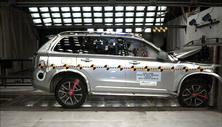
Frontal Crash Test
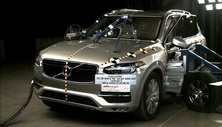
Side Crash Test
Overall Frontal Rating
Driver and Passenger Assessment
Driver Side
Passenger Side
Overall Side Rating
Side Barrier and Side Pole Tests
Driver Side
Passenger Side
Rollover Resistance
19.1% rollover risk in single-vehicle crash
Safety Features
ESC: StandardForward Collision Warning: StandardLane Departure Warning: No
Recall Notices
NHTSANHTSA ID: 25V179000March 24, 2025
ELECTRICAL SYSTEM:SOFTWARE
Volvo Car USA, LLC (Volvo Car) is recalling certain 2020-2021 S90, 2020-2022 S60, V60, XC60, XC90, and 2022 V90 plug-in hybrid vehicles. The high-voltage battery may experience a short circuit within the battery module when the battery is fully charged and the vehicle is parked.
Remedy Status
Owners are advised not to charge their vehicles until the remedy has been completed. Dealers will inspect and replace the high-voltage battery module as necessary. In addition, dealers will update the software to monitor the battery. All repairs will be performed free of charge. Owner notification letters were mailed May 28, 2025. Owners may contact Volvo Car's customer service at 1-800-458-1552. Volvo Car's number for this recall is R10312.
NHTSA ID: 23V827000December 07, 2023
SEAT BELTS:CRITICAL FASTENERS
Volvo Car USA, LLC (Volvo Car) is recalling certain 2015-2024 XC90 vehicles. The second-row seat belt buckle and lower belt anchor bolts may not be tightened properly.
Remedy Status
Dealers will inspect and tighten the second-row seat belt buckle anchorage bolts, as necessary, free of charge. Owner notification letters were mailed January 19, 2024. Owners may contact Volvo Car customer service at 1-800-458-1552. Volvo Car's number for this recall is R10259.
NHTSA ID: 23V001000January 05, 2023
STEERING
Volvo Car USA, LLC (Volvo Car) is recalling certain 2019-2022 V60CC, XC60, and XC90 vehicles. During steering gear assembly, double screws may have been assembled on top of each other, which can cause a screw to fall into the gearbox housing.
Remedy Status
Dealers will replace the steering gear, free of charge. Owner notification letters are expected to be mailed March 1, 2023. Owners may contact Volvo Car's customer service at 1-800-458-1552. Volvo Car's number for this recall is R10213.
NHTSA ID: 21V716000September 15, 2021
SERVICE BRAKES, HYDRAULIC:ANTILOCK/TRACTION CONTROL/ELECTRONIC LIMITED SLIP
Volvo Car USA, LLC (Volvo Car) is recalling certain 2021 S90L, 2020-2021 XC60, and XC90 vehicles. An improperly welded rotor and shaft may separate within the integrated brake system.
Remedy Status
Dealers will replace the hydraulic unit, free of charge. Owner notification letters were mailed October 22, 2021. Owners may contact Volvo Car customer service at 1-888-458-1552. Volvo Car's number for this recall is R10120.
NHTSA ID: 21V682000September 01, 2021
SEAT BELTS:FRONT:RETRACTOR
Volvo Car USA, LLC (Volvo Car) is recalling certain 2021 XC40, XC 40 Recharge, V60CC, V90, V90CC, XC90, and 2021-2022 V60, XC60, S60 vehicles. The seat belt automatic locking retractors may deactivate early, which can prevent the child restraint system from securing properly. As such, these vehicles fail to comply with the requirements of Federal Motor Vehicle Safety Standard number 208, "Occupant Crash Protection."
Remedy Status
Dealers will inspect and replace the seat belt assemblies, as necessary, free of charge. Owner notification letters were mailed October 13, 2021. Owners may contact Volvo Car customer service at 1-888-458-1552. Volvo Car's number for this recall is R10111.
NHTSA ID: 21V001000January 07, 2021
AIR BAGS
Volvo Cars USA, LLC (Volvo Car) is recalling certain 2021 Volvo V60, V60 Cross Country, V90, V90 Cross Country, XC60, and XC90 vehicles. The Supplementary Restraint System (SRS) control unit may not have been properly attached to the car body and may detach during a crash.
Remedy Status
Volvo Car will notify owners, and dealers will inspect and, as necessary, tighten the SRS control unit mounting screws, free of charge. The recall began February 12, 2021. Owners may contact Volvo Car customer service at 1-888-458-1552. Volvo Car's number for this recall is R10068.
Owner Complaints
30 totalFUEL/PROPULSION SYSTEM
Mar 14, 2026
I am reporting a failure of the fuel pump system in my Volvo vehicle, which currently has approximately 60,000 miles. The failed component is available for inspection upon request. The issue was confirmed by an authorized Volvo dealership, which diagnosed the fuel pump as defect...
Preview excerpt
SEATS
Mar 9, 2026
I drove the car (2021 Volvo XC 90) without incident on Sunday March 8, 2026 and at the end of the day parked the car in my garage. Monday morning, I came out to use the car and found that the seat back on the driver’s side had folded all the way forward and was immovable in a pos...
Preview excerpt
SERVICE BRAKES
Mar 8, 2026
Driving on a 45 mph road and brakes felt squishy, like air was going out of them. It was slow to stop and had to pump then stomp to get it to stop before crashing. Was fortunate to not hit anything. Pulled into gas station and had it towed to Volvo. There were no warning lights ...
Preview excerpt
VISIBILITY:SUN/MOON ROOF ASSEMBLY
Mar 2, 2026
The contact owns a 2021 Volvo XC90. The contact stated that while retrieving items from the trunk, the contact became aware that there was water leaking into the cargo area. The contact stated that the holders were full of water. There were no warning lights illuminated. The vehi...
Preview excerpt
VEHICLE SPEED CONTROL
CRASHFeb 26, 2026
Unintentional acceleration.First, I was in line at car wash proceeding slowly ahead as directed in line. Foot on accelerator lightly moving, when car surged rapidly hitting back end of Tesla about 6-8 ft ahead (2/26/26 12:30pm) Impact strong enough to push Tesla into truck hitch...
Preview excerpt
ENGINE
Feb 11, 2026
The ERAD (Electric Rear Axle Drive) transmission on my 2021 XC90 T8 Recharge has suffered an internal failure at approximately 112,550 miles. The vehicle makes loud grinding and slamming noises from the rear drivetrain and locks up when attempting to drive, making the vehicle com...
Preview excerpt
UNKNOWN OR OTHER
Feb 11, 2026
Our rear backup camera is no longer working. I see that other years have been recalled for the same issue, but our 2021 XC90 is not covered under the recall. It seems to be the same issue.
UNKNOWN OR OTHER
Jan 16, 2026
The aluminum trim on the center console of my 2022 Volvo xc90 has started peeling. The exposed edges are sharp and cut my fingers whenever I move my hands near the console. This issue is very common among this model and presents a serious safety hazard during normal vehicle use.
FUEL/PROPULSION SYSTEM
Dec 18, 2025
My vehicle was recalled for a faulty battery module. I turned the car into the dealer (Palo Alto Volvo in Palo Alto, Ca) on December 18 and the dealer has not been able to provide any ETA on repairs.
FUEL/PROPULSION SYSTEM
Oct 16, 2025
My 2021 Volvo XC90 Recharge has experienced multiple hybrid system failures under Volvo's factory 8-year/100,000-mile hybrid warranty, with fewer than 45,000 miles on the odometer. The high-voltage battery modules have failed multiple times, directly related to recall R10312 (NHT...
Preview excerpt
Showing 10 recent complaints from 30 total
View Full Complaint LogCompare Related Vehicles
Why Compare These Pages
The strongest comparison flow is usually: exact vehicle-year page, then nearby years of the same model, then other 2021 Volvo models. That sequence helps separate one-off year spikes from broader make-wide patterns.
More Volvo XC90 Years
2022 Volvo XC90Compare this year against 2021 for complaint and recall shifts.4r27c2020 Volvo XC90Compare this year against 2021 for complaint and recall shifts.7r24c2023 Volvo XC90Compare this year against 2021 for complaint and recall shifts.6r39c2019 Volvo XC90Compare this year against 2021 for complaint and recall shifts.6r32c2024 Volvo XC90Compare this year against 2021 for complaint and recall shifts.3r27c2018 Volvo XC90Compare this year against 2021 for complaint and recall shifts.3r42c
More 2021 Volvo Models
2021 Volvo XC40Another 2021 Volvo option for same-year comparison.5r49c2021 Volvo XC60Another 2021 Volvo option for same-year comparison.5r40c2021 Volvo S60Another 2021 Volvo option for same-year comparison.3r6c2021 Volvo V60Another 2021 Volvo option for same-year comparison.3r1c2021 Volvo V90Another 2021 Volvo option for same-year comparison.2r1c2021 Volvo S90Another 2021 Volvo option for same-year comparison.2r0c
Frequently Asked Questions
How many recalls does the 2021 Volvo XC90 have?
The 2021 Volvo XC90 has 6 recalls recorded by NHTSA.
How many complaints have been filed for the 2021 Volvo XC90?
NHTSA has received 30 owner-reported complaints for the 2021 Volvo XC90.
What is the NHTSA safety rating for the 2021 Volvo XC90?
The 2021 Volvo XC90 received an overall safety rating of 5 out of 5 stars from NHTSA.
What are the most common problems with the 2021 Volvo XC90?
The most commonly reported complaint categories for the 2021 Volvo XC90 are service brakes (4 reports), fuel/propulsion system (4 reports), electrical system (3 reports).
Does the 2021 Volvo XC90 have any recalls?
Yes. NHTSA has 6 recalls on record for the 2021 Volvo XC90. Scroll up to review the published recall summaries, consequences, and remedies. To check for unrepaired recalls on your specific vehicle, use your VIN at nhtsa.gov/recalls.
Check Another Vehicle
Look up recalls and complaints for any year, make, and model.
This page summarizes publicly available data from the National Highway Traffic Safety Administration (NHTSA). Complaint counts reflect reports submitted to NHTSA by vehicle owners and do not by themselves prove defect severity or vehicle safety. Safety ratings may not be available for all vehicle-years. This site is not affiliated with NHTSA or any vehicle manufacturer. For official information, visit the official NHTSA page for this vehicle.