Chevrolet · Bolt EV · 2019
2019 Chevrolet Bolt EV
6
Recalls
169
Complaints
5/5
Safety Rating
The 2019 Chevrolet Bolt EV has 6 recalls and 169 owner-reported complaints on file with NHTSA. Overall safety rating: 5 out of 5 stars. Most reported issue: electrical system (49 reports).
Source: NHTSA Public Records · Updated Apr 28, 2026
Research Context
The 2019 Chevrolet Bolt EV page works best as a research starting point. Complaint totals show how much owner-reported activity exists, while recalls and investigations help show whether any of that activity turned into formal safety action.
Because this is a newer-era vehicle page, it usually helps to compare this year against nearby model years before deciding whether a complaint pattern looks isolated or persistent. On this page, the most prominent complaint area is electrical system with 49 reported complaints.
Best Research Moves
- Use the complaint log to understand what owners were actually reporting instead of relying only on the raw complaint total.
- Compare the recall list with the complaint mix to see whether the most reported issues overlap with formal NHTSA safety campaigns.
- This page is primarily a complaints-and-recalls research surface, so compare nearby model years before treating the complaint total as a standalone verdict.
Key Takeaways
- The 2019 Chevrolet Bolt EV currently shows 6 NHTSA recalls listed on this page and 169 owner-reported complaints.
- This page currently shows no linked NHTSA investigations.
- This page reflects complaint volume, recall history, and NHTSA test data, but it does not diagnose causes or rank reliability by itself.
- Safety data currently shows 5/5 overall NHTSA safety rating.
- The most frequently reported complaint categories on this page are electrical system (49), steering (38), fuel/propulsion system (16).
- Vehicle
- 2019 Chevrolet Bolt EV
- Recalls
- 6
- Complaints
- 169
- Safety Rating
- 5/5
How to Interpret This Page
This page combines three types of NHTSA data: recall campaigns (official manufacturer or government actions), owner complaints (unverified consumer reports), and crash test ratings (where available). A vehicle with many complaints is not necessarily less reliable — complaint volume correlates with sales volume and vehicle age. Recalls indicate identified defects, not overall quality. To compare this model year with others, use the year navigation in the sidebar or return to the model overview page.
If you are researching a used vehicle, start with the complaint categories, compare them against the recall list, and then check nearby model years to see whether the same issue profile repeats. That usually produces a better buying or research signal than treating the raw complaint total as a standalone safety ranking.
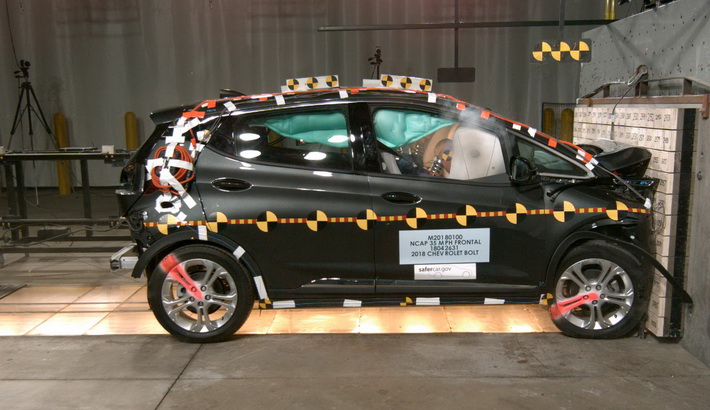
NHTSA Crash Test Performance
Frontal Crash Test
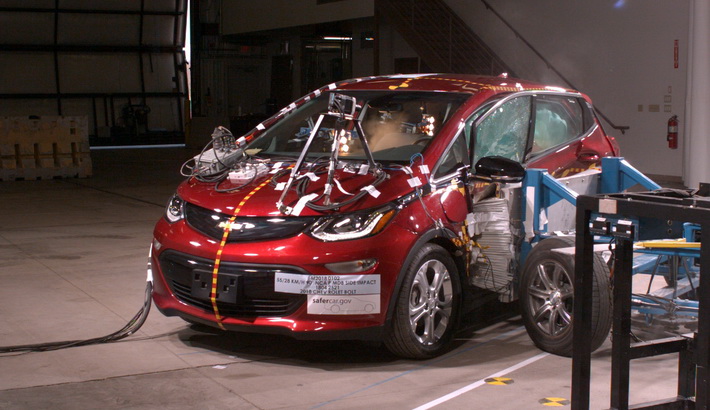
Side Crash Test
Overall Frontal Rating
Driver and Passenger Assessment
Driver Side
Passenger Side
Overall Side Rating
Side Barrier and Side Pole Tests
Driver Side
Passenger Side
Rollover Resistance
9.7% rollover risk in single-vehicle crash
Safety Features
ESC: StandardForward Collision Warning: OptionalLane Departure Warning: Optional
Recall Notices
NHTSANHTSA ID: 23V845000December 14, 2023
STRUCTURE:BODY:ROOF AND PILLARS
General Motors, LLC (GM) is recalling certain 2017-2023 Chevrolet Bolt EV vehicles. This recall includes certain vehicles previously repaired incorrectly under NHTSA recall number 22V-930. After a crash with seat belt pretensioner deployment, the pretensioner exhaust may ignite carpet fibers near the B-pillar, causing a fire.
Remedy Status
Dealers will inspect both front seat belt pretensioners and, if necessary, install metal foil at the carpet near the pretensioner exhaust. Certain vehicles will also need a pretensioner cover installed. Repairs will be performed free of charge. Owner notification letters were mailed January 24, 2024. These vehicles were previously recalled for this same issue under recall number 22V-930 and will need to have the new remedy performed. Owners may contact GM EV Concierge at 1-833-EVCHEVY (1-833-382-4389) (TTY 711 / 1-800-833-2438) or Customer Service at 1-800-222-1020. GM's number for this recall is N232421970.
NHTSA ID: 22V930000December 15, 2022
STRUCTURE:BODY:ROOF AND PILLARS
General Motors, LLC (GM) is recalling certain 2017-2023 Chevrolet Bolt EV vehicles. After a crash with seat belt pretensioner deployment, the pretensioner exhaust may ignite carpet fibers near the B-pillar, causing a fire.
Remedy Status
Dealers will install metal foil at the carpet near the pretensioner exhaust, and install a pretensioner cover as necessary, free of charge. Owner notification letters were mailed between January 23, 2023 and April 25, 2023. Owners may contact Chevrolet customer service at 1-800-222-1020. GM's number for this recall is N222383790.
NHTSA ID: 21V560000July 23, 2021
ELECTRICAL SYSTEM:PROPULSION SYSTEM:TRACTION BATTERY
General Motors LLC (GM) is recalling certain 2017-2019 Chevrolet Bolt EV vehicles previously recalled under NHTSA recall number 20V-701. The high voltage battery could catch fire when charged to full or nearly full capacity.
Remedy Status
Owners are advised to take the following interim steps: Activate either the Hill Top Reserve (2017 and 2018 models) or Target Charge Level (2019 models) feature in their vehicle to limit the charge level to 90%, charge their vehicle more frequently, avoid depleting the battery to 70 miles range remaining, park outside after charging, and do not charge the vehicle indoors overnight. Defective battery modules will be replaced by GM, free of charge. Interim notification letters notifying owners of the safety risk were mailed on August 13, 2021. Owner notification letters were mailed on August 13, 2021. Owners may contact the Bolt EV Concierge Team at 1-833-382-4389. GM's number for this recall is N212343880.
NHTSA ID: 20V701000November 13, 2020
ELECTRICAL SYSTEM:PROPULSION SYSTEM:TRACTION BATTERY
General Motors LLC (GM) is recalling all 2017-2018 and certain 2019 Chevrolet Bolt EV vehicles. The high voltage battery could catch fire when charged to full or nearly full capacity.
Remedy Status
This recall has been superseded by recall number 21V-560. Vehicles previously repaired under 20V-701 will still need to have the new remedy under recall 21V-560. GM will notify owners, and as an interim repair, beginning on November 17, 2020, dealers will reprogram the hybrid propulsion control module 2 (HPCM2) to limit the full charge to 90%, free of charge. Owners are advised to activate either the Hill Top Reserve (2017 and 2018 models) or Target Charge Level (2019 models) feature in their vehicle to limit the charge level to 90%, or park outside, until the software update is completed. Owners were notified of the interim repair beginning November 17, 2020. The second notice was mailed on May 11, 2021. Owners may contact the Bolt EV Concierge Team at 1-833-382-4389. GM's number for this recall is N202311730.
NHTSA ID: 20V184000March 26, 2020
LATCHES/LOCKS/LINKAGES:DOORS:LATCH
General Motors LLC (GM) is recalling certain 2019-2020 Chevrolet Bolt EV vehicles. The door-handle cable inside the rear doors may be too long, allowing contact with the window when it is opened, possibly damaging the cable. A damaged cable may cause the rear door to open unintentionally when the rear window is opened. Additionally, it may cause the rear inside door handle to not work.
Remedy Status
GM will notify owners, and dealers will replace the rear inside door-handle cables, free of charge. The recall began April 17, 2020. Owners may contact Chevrolet customer service at 1-800-222-1020. GM's number for this recall is A202298320.
NHTSA ID: 18V576000August 30, 2018
SERVICE BRAKES, HYDRAULIC:FOUNDATION COMPONENTS:DISC:CALIPER
General Motors LLC (GM) is recalling certain 2018-2019 Chevrolet Equinox, Impala, Cruze, Volt and Bolt EV vehicles, GMC Terrain vehicles, Buick Lacrosse and Regal vehicles, Cadillac XTS and XTS Professional vehicles and 2018 Chevrolet Malibu vehicles. The rear brake caliper pistons may have an insufficient coating causing gas pockets to form, potentially reducing rear brake performance.
Remedy Status
GM will notify owners, and dealers will bleed the vehicle's brake system, free of charge. The recall began October 11, 2018. Owners may contact Buick customer service at 1-800-521-7300, Cadillac customer service at 1-800-458-8006, Chevrolet customer service at 1-800-222-1020, or GMC customer service at 1-800-462-8782. GM's number for this recall is 18279.
Owner Complaints
169 totalSTEERING
Mar 21, 2026
Vehicle steering wheel fails to return to center after sweeping turn. Found it’s a common issue and is incredibly dangerous and should be recalled!
STEERING
Mar 10, 2026
The steering on my car is sticking and failing. When I make a turn, the steering wheel does not go back to the center on its own. I have to physically pull it back, otherwise the car will keep turning. When driving straight, the steering wheel gets "stuck." I have to use extra fo...
Preview excerpt
STEERING
Mar 1, 2026
Steering gear and torque sensor failure at 39,000 miles. Car is unsafe to drive and costs over $3500 to fix. The problem has been diagnosed at a dealership. No warning lights or codes apparent, problem is worsening and the car is becoming unsafe to drive. Steering gear or rack co...
Preview excerpt
STEERING
Mar 1, 2026
What component or system failed or malfunctioned, and is it available for inspection upon request? The steering gear in this vehicle began to fail around 40K miles. It clunks at low speed, doesn't roll out of turns, and recently has begun to oscillate during straight driving. I w...
Preview excerpt
STEERING
Dec 16, 2025
As with other Chevy bolts, the rack and pinion steering completely broke no longer able to steer vehicle.
STEERING
Dec 10, 2025
Steering will not return to center. After going around a turn, or even a curve like an exit ramp, the steering will remain locked in position and not re- center. It requires close attention and considerable force to return it to center and continue along a straight road.
ELECTRICAL SYSTEM,SEAT BELTS,LANE DEPARTURE
Dec 2, 2025
Water has infiltrated the lower trunk area and fried the sound amplifier. The result is no sounds can be heard from the speakers. This includes sounds and warnings from the safety systems. Seat belt, ADAS, BLIS, OnStar, Turn Signals, Radio. The rear hatch seals seem to be intac...
Preview excerpt
STEERING
Nov 3, 2025
Steering will not return to center. After going around a turn, or even a curve like an exit ramp, the steering will remain locked in position and not re- center. It requires close attention and considerable force to return it to center and continue along a straight road.
STEERING
Oct 15, 2025
The steering wheel does not return to center. This appears to be a common issue on Chevy Bolts based on various forums, for example https://www.chevybolt.org/threads/steering-wont-return-to-center-bad-steering-gear-steering-sticking-in-one-direction.42988/. One has to be very a...
Preview excerpt
STEERING
Jul 31, 2025
So I bought a used Bolt and the steering is sticking, at moderate speed (50mph) sweeping corners it lightly wants to pull harder into the corner and won't return to center if you let off the wheel, regardless of direction, you must always forcefully guide the steering wheel back ...
Preview excerpt
Showing 10 recent complaints from 169 total
View Full Complaint LogCompare Related Vehicles
Why Compare These Pages
The strongest comparison flow is usually: exact vehicle-year page, then nearby years of the same model, then other 2019 Chevrolet models. That sequence helps separate one-off year spikes from broader make-wide patterns.
More Chevrolet Bolt EV Years
2020 Chevrolet Bolt EVCompare this year against 2019 for complaint and recall shifts.8r164c2018 Chevrolet Bolt EVCompare this year against 2019 for complaint and recall shifts.5r85c2021 Chevrolet Bolt EVCompare this year against 2019 for complaint and recall shifts.5r66c2017 Chevrolet Bolt EVCompare this year against 2019 for complaint and recall shifts.4r334c2022 Chevrolet Bolt EVCompare this year against 2019 for complaint and recall shifts.7r58c2023 Chevrolet Bolt EVCompare this year against 2019 for complaint and recall shifts.3r49c
More 2019 Chevrolet Models
2019 Chevrolet SilveradoAnother 2019 Chevrolet option for same-year comparison.10r995c2019 Chevrolet TraverseAnother 2019 Chevrolet option for same-year comparison.3r378c2019 Chevrolet EquinoxAnother 2019 Chevrolet option for same-year comparison.4r281c2019 Chevrolet MalibuAnother 2019 Chevrolet option for same-year comparison.1r185c2019 Chevrolet BlazerAnother 2019 Chevrolet option for same-year comparison.2r177c2019 Chevrolet CorvetteAnother 2019 Chevrolet option for same-year comparison.1r147c
Frequently Asked Questions
How many recalls does the 2019 Chevrolet Bolt EV have?
The 2019 Chevrolet Bolt EV has 6 recalls recorded by NHTSA.
How many complaints have been filed for the 2019 Chevrolet Bolt EV?
NHTSA has received 169 owner-reported complaints for the 2019 Chevrolet Bolt EV.
What is the NHTSA safety rating for the 2019 Chevrolet Bolt EV?
The 2019 Chevrolet Bolt EV received an overall safety rating of 5 out of 5 stars from NHTSA.
What are the most common problems with the 2019 Chevrolet Bolt EV?
The most commonly reported complaint categories for the 2019 Chevrolet Bolt EV are electrical system (49 reports), steering (38 reports), fuel/propulsion system (16 reports).
Does the 2019 Chevrolet Bolt EV have any recalls?
Yes. NHTSA has 6 recalls on record for the 2019 Chevrolet Bolt EV. Scroll up to review the published recall summaries, consequences, and remedies. To check for unrepaired recalls on your specific vehicle, use your VIN at nhtsa.gov/recalls.
Check Another Vehicle
Look up recalls and complaints for any year, make, and model.
This page summarizes publicly available data from the National Highway Traffic Safety Administration (NHTSA). Complaint counts reflect reports submitted to NHTSA by vehicle owners and do not by themselves prove defect severity or vehicle safety. Safety ratings may not be available for all vehicle-years. This site is not affiliated with NHTSA or any vehicle manufacturer. For official information, visit the official NHTSA page for this vehicle.