Honda · Civic · 2016
2016 Honda Civic
4
Recalls
1,034
Complaints
5/5
Safety Rating
The 2016 Honda Civic has 4 recalls and 1,034 owner-reported complaints on file with NHTSA. Overall safety rating: 5 out of 5 stars. Most reported issue: steering (375 reports).
Source: NHTSA Public Records · Updated May 4, 2026
Research Context
The 2016 Honda Civic page works best as a research starting point. Complaint totals show how much owner-reported activity exists, while recalls and investigations help show whether any of that activity turned into formal safety action.
Because this is a newer-era vehicle page, it usually helps to compare this year against nearby model years before deciding whether a complaint pattern looks isolated or persistent. On this page, the most prominent complaint area is steering with 375 reported complaints.
Best Research Moves
- Use the complaint log to see whether the 2016 Honda Civic reports cluster around one repeated symptom or spread across multiple systems.
- Review the recall section even if the total is smaller, because a limited number of recalls can still point to meaningful safety actions.
- This page is primarily a complaints-and-recalls research surface, so compare nearby model years before treating the complaint total as a standalone verdict.
Key Takeaways
- The 2016 Honda Civic currently shows 4 NHTSA recalls listed on this page and 1,034 owner-reported complaints.
- This page currently shows no linked NHTSA investigations.
- This page reflects complaint volume, recall history, and NHTSA test data, but it does not diagnose causes or rank reliability by itself.
- Safety data currently shows 5/5 overall NHTSA safety rating.
- The most frequently reported complaint categories on this page are steering (375), unknown or other (179), engine (50).
- Vehicle
- 2016 Honda Civic
- Recalls
- 4
- Complaints
- 1034
- Safety Rating
- 5/5
How to Interpret This Page
This page combines three types of NHTSA data: recall campaigns (official manufacturer or government actions), owner complaints (unverified consumer reports), and crash test ratings (where available). A vehicle with many complaints is not necessarily less reliable — complaint volume correlates with sales volume and vehicle age. Recalls indicate identified defects, not overall quality. To compare this model year with others, use the year navigation in the sidebar or return to the model overview page.
If you are researching a used vehicle, start with the complaint categories, compare them against the recall list, and then check nearby model years to see whether the same issue profile repeats. That usually produces a better buying or research signal than treating the raw complaint total as a standalone safety ranking.
NHTSA Crash Test Performance
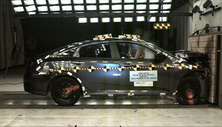
Frontal Crash Test
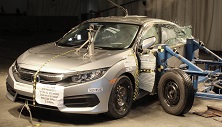
Side Crash Test
Overall Frontal Rating
Driver and Passenger Assessment
Driver Side
Passenger Side
Overall Side Rating
Side Barrier and Side Pole Tests
Driver Side
Passenger Side
Rollover Resistance
9.5% rollover risk in single-vehicle crash
Safety Features
ESC: StandardForward Collision Warning: OptionalLane Departure Warning: Optional
Recall Notices
NHTSANHTSA ID: 23V858000December 18, 2023
FUEL SYSTEM, GASOLINE:DELIVERY:FUEL PUMP
Honda (American Honda Motor Co.) is recalling certain 2013-2023 Honda Accord, Civic Coupe, Civic Sedan, Civic Hatchback, Civic Type R, CR-V, HR-V, Ridgeline, Odyssey, Acura ILX, MDX, MDX Hybrid, RDX, RLX, TLX, 2019-2022 Honda Insight, Passport, 2020 Honda CR-V Hybrid, 2018-2019 Honda Clarity PHEV, Fit, and 2015-2020 Honda Accord Hybrid, Pilot, Acura NSX vehicles. The fuel pump inside the fuel tank may fail.
Remedy Status
Dealers will replace the fuel pump module, free of charge. Owner letters were mailed September 6, 2024. Owners may contact Honda customer service at 1-888-234-2138. Honda's numbers for this recall are KGC and KGD. This recall is an expansion of NHTSA recall numbers 21V-215 and 20V-314.
NHTSA ID: 16V725000October 11, 2016
PARKING BRAKE
Honda (American Honda Motor Co.) is recalling certain model year 2016 Honda Civic two door and four door 1.5L turbo and 2.0L vehicles. The electric parking brake (EPB) may not engage if it is applied immediately after turning the ignition off.
Remedy Status
Honda will notify owners, and dealers will update the vehicle's software to allow the EPB to engage immediately after the ignition is turned off, free of charge. The recall began on November 8, 2016. Owners may contact Honda customer service at 1-888-234-2138. Honda's number for this recall is KC6.
NHTSA ID: 16V526000July 11, 2016
EXTERIOR LIGHTING
American Honda Motor Co. (Honda) is recalling certain model year 2016 Civic 2-Door vehicles manufactured February 23, 2016, through May 20, 2016. The affected vehicles may have a damaged LED side marker light circuit board inside the taillight assembly, making the marker light inoperable. As such, these vehicles fail to comply with the requirements of Federal Motor Vehicle Safety Standard (FMVSS) number 108, "Lamps, Reflective Devices, and Assoc. Equipment."
Remedy Status
Honda will notify owners, and dealers will inspect both the taillight assemblies, replacing them as necessary, free of charge. The recall began on August 31, 2016. Owners may contact Honda customer service at 1-888-234-2138. Honda's number for this recall is KB8.
NHTSA ID: 16V074000February 09, 2016
ENGINE AND ENGINE COOLING:ENGINE
Honda (American Honda Motor Co.) is recalling certain model year 2016 Civic vehicles manufactured September 22, 2015, to February 3, 2016 and equipped with 2.0L engines. The affected vehicles have engines with piston assemblies that may have been manufactured without a piston wrist pin circlip or with an incorrectly installed piston wrist pin circlip.
Remedy Status
Honda will notify owners, and dealers will inspect and replace the piston assemblies and damaged engine components, as necessary, free of charge. Parts are expected to be available in the Summer of 2016. Owners were mailed an interim notification beginning March 31, 2016, and will be mailed a second notice when parts are available. Owners may contact Honda customer service at 1-888-234-2138. Honda's number for this recall is JX9.
Owner Complaints
1034 totalSTEERING
Apr 25, 2026
Steering feels lime it is catching and becomes jerky
STEERING
Apr 24, 2026
While driving, my wheel often “sticks” and I have to over correct throughout the entire drive. I’m afraid it is going to get me in an accident. It becomes more noticeable at high speeds. I have to travel often for my job and recently have not felt safe while driving my car on t...
Preview excerpt
STEERING
Apr 23, 2026
Steering is sticky at highway speeds, steering wheel will not move without force that can cause lane departure. This is dangerous when attempting to follow the curve of the road. Component: steering rack. Inspection availability: yes. Safety: jerky steering and lane departure Rep...
Preview excerpt
ELECTRICAL SYSTEM,EXTERIOR LIGHTING,SERVICE BRAKES
Apr 11, 2026
I was driving my car home from work and many warning lights lit up on my car dashboard (brake problem, engine problem, uphill start, steering problem) etc.. I got off the freeway and my car dashboard lit up and notified me “to pull over to a safe location because my car needle (...
Preview excerpt
STEERING
Apr 4, 2026
My 2016 Honda Civic w/ 66000 miles has been experiencing issues with the steering wheel wherein after driving for approximately 10-15 minutes the steering wheel will start "sticking" when attempting to make micro-adjustments. This primarily occurs at highway speeds, however after...
Preview excerpt
UNKNOWN OR OTHER,VISIBILITY/WIPER
Mar 26, 2026
What component or system failed: The entire Air Conditioning system, specifically the AC Compressor, Condenser, and Evaporator, failed catastrophically. The authorized Honda dealer diagnosed it as "Black Death," meaning the AC compressor internally shattered, sending metal shrapn...
Preview excerpt
FUEL/PROPULSION SYSTEM
Mar 15, 2026
My car shuts off during long drives and carries the same behaviors of a car with a failing fuel pump.
STEERING
Mar 10, 2026
Increased resistance making minor adjustments to the steering wheel in either direction when driving the highway at high speeds. I've seen every symptom of the Honda 'sticky steering' problem that only has a recall for 2022-2025 right now, but I know it's not a coincidence.
UNKNOWN OR OTHER
Mar 10, 2026
Have had A/C issues for years, have had to replace compressor and condenser 4 times, only twice after a warranty finally came out for the defective parts. Now, the evaporator core has failed, but it is not under extended warranty or recall. Wild as I've seen so many with issues w...
Preview excerpt
STEERING
Mar 9, 2026
Steering intermittently sticks making driving awkward and difficult to hold a straight line.
Showing 10 recent complaints from 1,034 total
View Full Complaint LogCompare Related Vehicles
Why Compare These Pages
The strongest comparison flow is usually: exact vehicle-year page, then nearby years of the same model, then other 2016 Honda models. That sequence helps separate one-off year spikes from broader make-wide patterns.
More Honda Civic Years
2017 Honda CivicCompare this year against 2016 for complaint and recall shifts.5r561c2015 Honda CivicCompare this year against 2016 for complaint and recall shifts.1r2i374c2018 Honda CivicCompare this year against 2016 for complaint and recall shifts.5r672c2014 Honda CivicCompare this year against 2016 for complaint and recall shifts.2r2i285c2019 Honda CivicCompare this year against 2016 for complaint and recall shifts.3r388c2013 Honda CivicCompare this year against 2016 for complaint and recall shifts.2i312c
More 2016 Honda Models
2016 Honda PilotAnother 2016 Honda option for same-year comparison.7r4i1,623c2016 Honda AccordAnother 2016 Honda option for same-year comparison.3r573c2016 Honda CR-VAnother 2016 Honda option for same-year comparison.3r1i386c2016 Honda OdysseyAnother 2016 Honda option for same-year comparison.6r251c2016 Honda HR-VAnother 2016 Honda option for same-year comparison.2r232c2016 Honda FitAnother 2016 Honda option for same-year comparison.1r1i116c
Frequently Asked Questions
How many recalls does the 2016 Honda Civic have?
The 2016 Honda Civic has 4 recalls recorded by NHTSA.
How many complaints have been filed for the 2016 Honda Civic?
NHTSA has received 1,034 owner-reported complaints for the 2016 Honda Civic.
What is the NHTSA safety rating for the 2016 Honda Civic?
The 2016 Honda Civic received an overall safety rating of 5 out of 5 stars from NHTSA.
What are the most common problems with the 2016 Honda Civic?
The most commonly reported complaint categories for the 2016 Honda Civic are steering (375 reports), unknown or other (179 reports), engine (50 reports).
Does the 2016 Honda Civic have any recalls?
Yes. NHTSA has 4 recalls on record for the 2016 Honda Civic. Scroll up to review the published recall summaries, consequences, and remedies. To check for unrepaired recalls on your specific vehicle, use your VIN at nhtsa.gov/recalls.
Check Another Vehicle
Look up recalls and complaints for any year, make, and model.
This page summarizes publicly available data from the National Highway Traffic Safety Administration (NHTSA). Complaint counts reflect reports submitted to NHTSA by vehicle owners and do not by themselves prove defect severity or vehicle safety. Safety ratings may not be available for all vehicle-years. This site is not affiliated with NHTSA or any vehicle manufacturer. For official information, visit the official NHTSA page for this vehicle.