Honda · Ridgeline · 2023
2023 Honda Ridgeline
3
Recalls
112
Complaints
5/5
Safety Rating
The 2023 Honda Ridgeline has 3 recalls and 112 owner-reported complaints on file with NHTSA. Overall safety rating: 5 out of 5 stars. Most reported issue: exterior lighting (37 reports).
If you're researching 2023 Honda Ridgeline problems, use this page to separate owner complaint patterns, recalls, and linked investigations instead of relying on a single anecdote.
Source: NHTSA Public Records · Updated Apr 28, 2026
Research Context
The 2023 Honda Ridgeline page works best as a research starting point. Complaint totals show how much owner-reported activity exists, while recalls and investigations help show whether any of that activity turned into formal safety action.
Because this is a newer-era vehicle page, it usually helps to compare this year against nearby model years before deciding whether a complaint pattern looks isolated or persistent. On this page, the most prominent complaint area is exterior lighting with 37 reported complaints.
Best Research Moves
- Use the complaint log to understand what owners were actually reporting instead of relying only on the raw complaint total.
- Review the recall section even if the total is smaller, because a limited number of recalls can still point to meaningful safety actions.
- Check the linked investigations for extra ODI context if you want to see whether owner complaints escalated into formal defect review.
Key Takeaways
- The 2023 Honda Ridgeline currently shows 3 NHTSA recalls listed on this page and 112 owner-reported complaints.
- This page currently shows 2 NHTSA investigations linked to this page.
- This page reflects complaint volume, recall history, and NHTSA test data, but it does not diagnose causes or rank reliability by itself.
- Safety data currently shows 5/5 overall NHTSA safety rating.
- The most frequently reported complaint categories on this page are exterior lighting (37), unknown or other (12), electrical system (11).
Recommended Reading For This Search
If this page matches the question you searched for, these guides usually make the next step clearer before you compare nearby years or decide what to check on a specific vehicle.
- Vehicle
- 2023 Honda Ridgeline
- Recalls
- 3
- Complaints
- 112
- Safety Rating
- 5/5
How to Interpret This Page
This page combines three types of NHTSA data: recall campaigns (official manufacturer or government actions), owner complaints (unverified consumer reports), and crash test ratings (where available). A vehicle with many complaints is not necessarily less reliable — complaint volume correlates with sales volume and vehicle age. Recalls indicate identified defects, not overall quality. To compare this model year with others, use the year navigation in the sidebar or return to the model overview page.
If you are researching a used vehicle, start with the complaint categories, compare them against the recall list, and then check nearby model years to see whether the same issue profile repeats. That usually produces a better buying or research signal than treating the raw complaint total as a standalone safety ranking.
For problem research, start with top complaint categories, then check whether recalls or investigations touch the same systems.
NHTSA Crash Test Performance
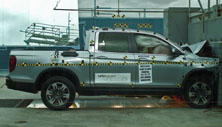
Frontal Crash Test
Side Crash Test
Overall Frontal Rating
Driver and Passenger Assessment
Driver Side
Passenger Side
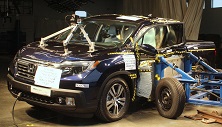
Overall Side Rating
Side Barrier and Side Pole Tests
Driver Side
Passenger Side
Rollover Resistance
16.4% rollover risk in single-vehicle crash
Safety Features
ESC: StandardForward Collision Warning: StandardLane Departure Warning: Standard
Recall Notices
NHTSANHTSA ID: 24V321000May 09, 2024
BACK OVER PREVENTION: SENSING SYSTEM: CAMERA
Honda (America Honda Motor Co) is recalling certain 2020-2024 Ridgeline vehicles. The rearview camera (RVC) tailgate wire harness may fatigue and break, which can prevent the rearview camera image from displaying.
Remedy Status
Dealers will replace the RVC tailgate wire harness, free of charge. Owner letters were mailed November 8, 2024. Owners may contact Honda service at 1-888-234-2138. Honda's number for this recall is YI7.
NHTSA ID: 24V184000March 07, 2024
STEERING:RACK AND PINION
Honda (American Honda Motor Co.) is recalling certain 2023 Passport and Ridgeline vehicles. The inner ball joint housing in the steering gearbox assembly may loosen and detach from the steering rack and result in a loss of steering control.
Remedy Status
Dealers will inspect and replace the steering gearbox as necessary, free of charge. Owner notification letters were mailed April 11, 2024. Owners may contact Honda customer service at 1-888-234-2138. Honda's number for this recall is LHY.
NHTSA ID: 23V458000June 29, 2023
SERVICE BRAKES, HYDRAULIC:FOUNDATION COMPONENTS:MASTER CYLINDER
Honda (American Honda Motor Co.) is recalling certain 2020-2021 Civic, 2020-2023 Ridgeline, 2021-2023 Passport, 2021-2022 Pilot, and 2020 Acura MDX vehicles. The tie rod fastener that connects the brake booster and the brake master cylinder may have been improperly assembled during manufacturing, which can cause the brake master cylinder to separate from the booster assembly.
Remedy Status
Dealers will inspect and repair the brake booster assembly as necessary, free of charge. Owner notification letters were mailed August 7, 2023. Owners may contact Honda customer service at 1-888-234-2138. Honda's numbers for this recall are VEU, AEV, and ZET.
Investigations
2 totalOn June 3, 2022, the Office of Defects Investigation (ODI) opened Preliminary Evaluation PE22005 after the agency received VOQs and several field reports concerning the Auto Idle Stop (AIS) feature on 2016-2019MY Honda Pilot vehicles. The complaints allege that the engine fails to restart on its own from a complete stop at a traffic light or road intersection with the AIS function engaged. The subject vehicles are equipped with a 3.5L engine with a 9-speed automatic transmission. On January 6, 2023, Honda released service bulletins 23-008 and 23-009. These service bulletins address the failure to restart issue in the 2016-2019MY Honda Pilot vehicles, as well as the 2015-2020 Acura TLX, 2016-2020 Acura MDX, 2019-2022 Honda Passport, and 2020-2023 Honda Ridgeline vehicles. The repair outlined in the service bulletins is a two-stage countermeasure to remedy the issue. The first stage is a Programmed Fuel Injection (“PGM-FI”) software update. The second stage is only deployed if the software update fails to remedy the issue. The second stage, depending on the model and model year, consists of replacement of the starter assembly, starter relays, and a valve adjustment. Additionally, Honda extended the warranty coverage to 10 years with unlimited mileage for vehicles requiring the second stage component replacement. ODI continues to receive complaints of the AIS failure to restart, with many complainants alleging the campaign countermeasures had been completed.NHTSA has reviewed Honda's Information Request Letter responses involving warranty claims, lawsuits, and consumer complaints in addition to ODI's own data. This Engineering Analysis is being opened to further consider the potential safety defect, including gathering additional data regarding Honda’s service campaign efficacy. ODI is additionally expanding the scope to encompass all vehicles addressed in Honda’s service bulletins 23-008 and 23-009 as well as newer model year vehicles, which are substantially similar to the vehicles covered by the service campaign. To review the ODI reports cited in the Opening Resume ODI Report Identification Number document, go to NHTSA.gov.
Component: ENGINE AND ENGINE COOLING:ENGINE:CRANK/CAMSHAFT POSITION SENSOROpened: Mar 26, 2025
PEClosed
On February 13, 2024, the Office of Defects Investigation (ODI) opened Preliminary Evaluation PE24004 to assess alleged failures of the rear-view camera (RVC) in 2020-2023 Model Year (MY) Honda Ridgeline vehicles. At this time, ODI has received a total of 50 complaints with allegations of the RVC image failing to display when the vehicle was in reverse. The RVC wire harness is routed near the hinge in the tailgate, in a location where frequent opening and closing of the tailgate causes bending stress on the harness. Honda determined the wire harness was manufactured with a material which is permeable to water and salt, which when it freezes and thaws, combined with tailgate usage, ultimately leads to breakage of the wiring in the tailgate harness. This results in a failure to display the RVC image. On May 9, 2024, Honda filed a Part 573 Safety Recall Report recalling all 2020-2024 MY Honda Ridgeline vehicles. The dealer will replace the RVC tailgate harness with a wire harness that is manufactured by a new supplier and has improved material properties to withstand wear from bending. In view of Honda filing recall 24V-321 addressing the subject of this investigation, ODI is closing this Preliminary Evaluation. NHTSA reserves the right to take additional action if warranted by future circumstances. To review the ODI reports cited in the Closing Resume ODI Report Identification Number document, go to NHTSA.gov.
Owner Complaints
112 totalELECTRICAL SYSTEM
Apr 1, 2026
The contact owns a 2023 Honda Ridgeline. The contact stated that while driving or while stopped at a stop light, the Auto Idle Stop system activated, and the vehicle hesitated to respond. The message "Auto Idle Stop Temporarily Unavailable" was displayed. The vehicle was taken to...
Preview excerpt
EXTERIOR LIGHTING
Mar 9, 2026
03/09/26 Driver side Headlight assembly filling with a lot of water when driving in wet conditions. Headlight has a significant amount of water and condensation inside. It is very noticeable. I can see a slight difference in positioning of the driver side headlamp vs the passenge...
Preview excerpt
FORWARD COLLISION AVOIDANCE
Feb 27, 2026
A car turning left on a one lane both way street. The the auto breaking system hit the breaks I was about 6’ away from car going 10 miles per hour. Car behind me almost hit the back of my truck. It took second before breaks let off. System was in normal mode.
EXTERIOR LIGHTING
Feb 21, 2026
While driving home on 2/21/26 at night in light sleet/snow conditions, I noticed a dramatic decrease in headlight effectiveness in my Honda Ridgeline. When I stopped to check the headlights, they were coated with ice that needed to be scraped off. This is my first vehicle that ha...
Preview excerpt
ELECTRICAL SYSTEM,UNKNOWN OR OTHER,BACK OVER PREVENTION
Feb 15, 2026
The infotainment system failed intermittently two times prior, causing failure of the backup camera and cross traffic warning sensor system. The entire system failed a month ago and Honda has no idea when they can get parts.
POWER TRAIN
Jan 27, 2026
Engine had complete loss of power and loud knocking noise.
EXTERIOR LIGHTING
Jan 1, 2026
There is constant water intrusion on the driverside headlight causing poor headlamp performance. I have reported the issue to a dealer for a warranty claim and was told that it is normal for water to be inside the headlight housing. If this is the case than I believe there is po...
Preview excerpt
FORWARD COLLISION AVOIDANCE
Dec 6, 2025
Oftentimes, while driving on a 2-lane road, the Ridgeline will produce an alarm (beeping sound and flashing amber "BRAKE" illuminated on dash display) when driving through a right hand curve with opposite direction traffic in the opposing lane. In every instance, my vehicle and t...
Preview excerpt
ENGINE AND ENGINE COOLING
Dec 5, 2025
The contact owns a 2023 Honda Ridgeline. The contact stated that while driving at various speeds, there was an abnormal clicking sound coming from the vehicle. The contact stated there was no warning light illuminated. The contact had taken the vehicle to a local dealer, where it...
Preview excerpt
ENGINE,FUEL/PROPULSION SYSTEM
Nov 1, 2025
Approximately six(6) months ago, my wife and I noticed a very noxious gasoline smell in the cabin of our truck, and upon further investigation determined that the smell was a direct result of gasoline that had infiltrated the oil in the engine. The oil was changed and the used oi...
Preview excerpt
Showing 10 recent complaints from 112 total
View Full Complaint LogCompare Related Vehicles
Why Compare These Pages
The strongest comparison flow is usually: exact vehicle-year page, then nearby years of the same model, then other 2023 Honda models. That sequence helps separate one-off year spikes from broader make-wide patterns.
More Honda Ridgeline Years
2024 Honda RidgelineCompare this year against 2023 for complaint and recall shifts.1r1i44c2022 Honda RidgelineCompare this year against 2023 for complaint and recall shifts.2r2i109c2025 Honda RidgelineCompare this year against 2023 for complaint and recall shifts.1r1i53c2021 Honda RidgelineCompare this year against 2023 for complaint and recall shifts.5r2i92c2026 Honda RidgelineCompare this year against 2023 for complaint and recall shifts.6c2020 Honda RidgelineCompare this year against 2023 for complaint and recall shifts.7r2i159c
More 2023 Honda Models
2023 Honda HR-VAnother 2023 Honda option for same-year comparison.3r1i675c2023 Honda CR-VAnother 2023 Honda option for same-year comparison.3r1i495c2023 Honda CivicAnother 2023 Honda option for same-year comparison.4r2i246c2023 Honda Accord HybridAnother 2023 Honda option for same-year comparison.5r1i139c2023 Honda CR-V HybridAnother 2023 Honda option for same-year comparison.4r1i104c2023 Honda PilotAnother 2023 Honda option for same-year comparison.5r2i99c
Frequently Asked Questions
What are the most reported problems for the 2023 Honda Ridgeline?
Current NHTSA complaint data for the 2023 Honda Ridgeline shows repeated reports in categories such as exterior lighting, unknown or other, and electrical system. Use those categories as research context, then compare them with recalls and investigations.
How many recalls does the 2023 Honda Ridgeline have?
The 2023 Honda Ridgeline has 3 recalls recorded by NHTSA.
How many complaints have been filed for the 2023 Honda Ridgeline?
NHTSA has received 112 owner-reported complaints for the 2023 Honda Ridgeline.
What is the NHTSA safety rating for the 2023 Honda Ridgeline?
The 2023 Honda Ridgeline received an overall safety rating of 5 out of 5 stars from NHTSA.
What are the most common problems with the 2023 Honda Ridgeline?
The most commonly reported complaint categories for the 2023 Honda Ridgeline are exterior lighting (37 reports), unknown or other (12 reports), electrical system (11 reports).
Does the 2023 Honda Ridgeline have any recalls?
Yes. NHTSA has 3 recalls on record for the 2023 Honda Ridgeline. Scroll up to review the published recall summaries, consequences, and remedies. To check for unrepaired recalls on your specific vehicle, use your VIN at nhtsa.gov/recalls.
Check Another Vehicle
Look up recalls and complaints for any year, make, and model.
This page summarizes publicly available data from the National Highway Traffic Safety Administration (NHTSA). Complaint counts reflect reports submitted to NHTSA by vehicle owners and do not by themselves prove defect severity or vehicle safety. Safety ratings may not be available for all vehicle-years. This site is not affiliated with NHTSA or any vehicle manufacturer. For official information, visit the official NHTSA page for this vehicle.