Hyundai · Ioniq 6 · 2023
2023 Hyundai Ioniq 6
5
Recalls
52
Complaints
5/5
Safety Rating
The 2023 Hyundai Ioniq 6 has 5 recalls and 52 owner-reported complaints on file with NHTSA. Overall safety rating: 5 out of 5 stars. Most reported issue: electrical system (23 reports).
Source: NHTSA Public Records · Updated Apr 28, 2026
Research Context
The 2023 Hyundai Ioniq 6 page works best as a research starting point. Complaint totals show how much owner-reported activity exists, while recalls and investigations help show whether any of that activity turned into formal safety action.
Because this is a newer-era vehicle page, it usually helps to compare this year against nearby model years before deciding whether a complaint pattern looks isolated or persistent. On this page, the most prominent complaint area is electrical system with 23 reported complaints.
Best Research Moves
- Use the complaint log to understand what owners were actually reporting instead of relying only on the raw complaint total.
- Compare the recall list with the complaint mix to see whether the most reported issues overlap with formal NHTSA safety campaigns.
- This page is primarily a complaints-and-recalls research surface, so compare nearby model years before treating the complaint total as a standalone verdict.
Key Takeaways
- The 2023 Hyundai Ioniq 6 currently shows 5 NHTSA recalls listed on this page and 52 owner-reported complaints.
- This page currently shows no linked NHTSA investigations.
- This page reflects complaint volume, recall history, and NHTSA test data, but it does not diagnose causes or rank reliability by itself.
- Safety data currently shows 5/5 overall NHTSA safety rating.
- The most frequently reported complaint categories on this page are electrical system (23), unknown or other (6), forward collision avoidance (3).
- Vehicle
- 2023 Hyundai Ioniq 6
- Recalls
- 5
- Complaints
- 52
- Safety Rating
- 5/5
How to Interpret This Page
This page combines three types of NHTSA data: recall campaigns (official manufacturer or government actions), owner complaints (unverified consumer reports), and crash test ratings (where available). A vehicle with many complaints is not necessarily less reliable — complaint volume correlates with sales volume and vehicle age. Recalls indicate identified defects, not overall quality. To compare this model year with others, use the year navigation in the sidebar or return to the model overview page.
If you are researching a used vehicle, start with the complaint categories, compare them against the recall list, and then check nearby model years to see whether the same issue profile repeats. That usually produces a better buying or research signal than treating the raw complaint total as a standalone safety ranking.
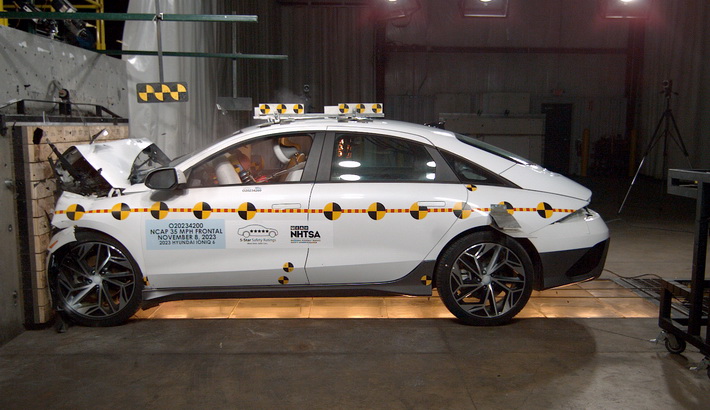
NHTSA Crash Test Performance
Frontal Crash Test
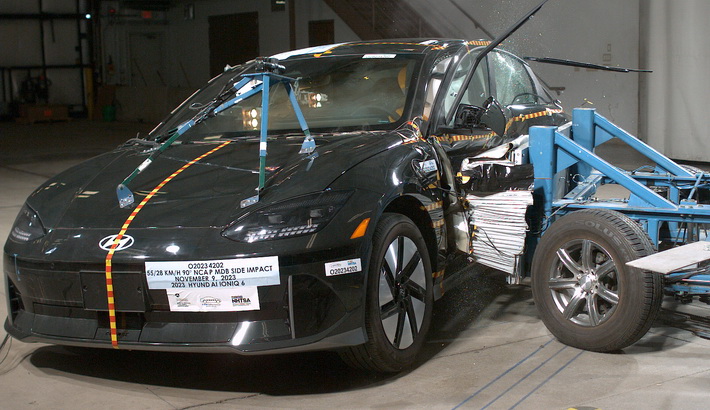
Side Crash Test
Overall Frontal Rating
Driver and Passenger Assessment
Driver Side
Passenger Side
Overall Side Rating
Side Barrier and Side Pole Tests
Driver Side
Passenger Side
Rollover Resistance
6.7% rollover risk in single-vehicle crash
Safety Features
ESC: StandardForward Collision Warning: Standard & OptionalLane Departure Warning: Standard
Recall Notices
NHTSANHTSA ID: 26V218000April 06, 2026
SEAT BELTS:FRONT:ANCHORAGE
Hyundai Motor America (Hyundai) is recalling certain 2023-2025 Hyundai Ioniq 6, 2023-2026 Genesis G90, 2024-2026 Hyundai Santa Fe, and Hyundai Santa Fe Hybrid vehicles. The driver and passenger seat belt anchors may detach.
Remedy Status
Dealers will inspect and reinforce or replace the seat belt anchors, as necessary, free of charge. Owner notification letters are expected to be mailed June 5, 2026. Owners may contact Hyundai customer service at 1-855-371-9460 and Genesis customer service at 844-340-9741. Hyundai's numbers for this recall are 298 and 032G. Vehicle Identification Numbers (VINs) involved in this recall became searchable on NHTSA.gov April 8, 2026.
NHTSA ID: 25V606000September 12, 2025
ELECTRICAL SYSTEM:PROPULSION SYSTEM:CHARGING:PORT
Hyundai Motor America (Hyundai) is recalling certain 2023-2025 IONIQ 6 electric vehicles. The charging port door panel may detach.
Remedy Status
Dealers will apply an adhesive on the charging port door assembly, free of charge. Owner notification letters were mailed beginning October 10, 2025. Owners may contact Hyundai customer service at 1-855-371-9460. Hyundai's number for this recall is 282. Vehicle Identification Numbers (VINs) involved in this recall became searchable on NHTSA.gov on September 13, 2025.
NHTSA ID: 24V868000November 18, 2024
ELECTRICAL SYSTEM:12V/24V/48V BATTERY
Hyundai Motor America (Hyundai) is recalling certain 2022-2024 IONIQ 5, 2023-2025 IONIQ 6, Genesis GV60, Genesis GV70 "Electrified," and Genesis G80 "Electrified" vehicles. The Integrated Charging Control Unit (ICCU) may become damaged and stop charging the 12-volt battery, which can result in a loss of drive power.
Remedy Status
Dealers will inspect and replace the ICCU and its fuse, as necessary. In addition, dealers will update the ICCU software. All repairs will be performed free of charge. Owner notification letters were mailed December 20, 2024. Owners may contact Hyundai customer service at 1-855-371-9460 or Genesis customer service at 1-844-340-9741. Hyundai's numbers for this recall are 272 (Hyundai) and 025G (Genesis). This recall expands and replaces previous recall number 24V-204. Vehicles previously repaired under recall 24V-204 will need to have the new remedy completed.
NHTSA ID: 24V204000March 15, 2024
ELECTRICAL SYSTEM:12V/24V/48V BATTERY
Hyundai Motor America (Hyundai) is recalling certain 2022-2024 IONIQ 5, 2023-2024 IONIQ 6, Genesis GV60, Genesis GV70 "Electrified," and Genesis G80 "Electrified" vehicles. The Integrated Charging Control Unit (ICCU) may become damaged and stop charging the 12-Volt battery, which can result in a loss of drive power.
Remedy Status
This recall is replaced by NHTSA recall number 24V-868. Vehicles already repaired under this recall will need to have the new remedy completed. Dealers will inspect and replace the ICCU and its fuse, as necessary. In addition, dealers will update the ICCU software. All repairs will be performed free of charge. Owner notification letters were mailed April 22, 2024. Owners may contact Hyundai customer service at 1-855-371-9460. Hyundai's number for this recall is 257/021G.
NHTSA ID: 24V065000February 01, 2024
POWER TRAIN:DRIVELINE:DRIVESHAFT
Hyundai Motor America (Hyundai) is recalling certain 2023 IONIQ 5, IONIQ 6, and Genesis GV60 vehicles. The rear inner driveshaft may have been improperly heat-treated, allowing it to break under load and resulting in a loss of drive power.
Remedy Status
Dealers will replace the rear inner driveshaft, free of charge. Owner notification letters were mailed March 29, 2024. Owners may contact Hyundai customer service at 1-855-371-9460. Hyundai's numbers for this recall are 253(H), 017G(G).
Owner Complaints
52 totalPOWER TRAIN,VEHICLE SPEED CONTROL,ENGINE
Apr 19, 2026
I was pulling into a parking spot and my vehicle suddenly lurch forward, and I had to slam on the brakes quickly, scraping the front of the curb. I checked there was no warning lights. I checked the floor mat, and this was not impeding the accelerator pedal I am certainly I did n...
Preview excerpt
FUEL/PROPULSION SYSTEM
Mar 27, 2026
The fuel door/charge door would not open. Conditions were such that I was safe and had sufficient range without charging, but were I farther from home this could have left me stranded. The problem has not been confirmed by a dealer, other service center, manufacturer, police, or ...
Preview excerpt
ELECTRICAL SYSTEM
Mar 19, 2026
On March 19, 2026 my Hyundai Ioniq 6 broke. It was clearly the ICCU problem. The car went into turtle mode with a maximum speed of 22 miles an hour and told me to get to a safe area , stop the car and have it brought in. It was brought to my local Hyundai dealer and a few days la...
Preview excerpt
ELECTRICAL SYSTEM
Mar 16, 2026
I WAS DRIVING AND MY ELECTRICAL WARNING LIGHT CAME ON AGAIN FOR THE SECOND TIME IN A YEAR. I WAS TOLD IT WAS THE ICCU LAST YEAR AND THEY SAID IT WAS FIXED AND WOULDNT HAVE A PROBLEM AGAIN. I HAD TO RENT A CAR FOR ALMOST TWO MONTHS. THE SAME PROBLEM AGAIN WITH THE ICCU HAPPENED AB...
Preview excerpt
ELECTRICAL SYSTEM,SERVICE BRAKES
Mar 12, 2026
I leased a 2023 Ioniq 6 electric car on September 2023. Since leasing the vehicle, the vehicle has been towed four times for the same problem, the parking brake malfunctions rendering the vehicle unusable. I have multiple photos and videos documenting this. This has happened eit...
Preview excerpt
ELECTRICAL SYSTEM
Feb 26, 2026
The check electric vehicle system error message showed up on my dashboard, meaning the iccu has failed
UNKNOWN OR OTHER
Jan 28, 2026
Horn fuse has blown 4 times in 5000 miles leaving the vehicle unsafe to operate. Problem is reproduced and confirmed. First started in November 2025 and 4th fuse was placed January 2026.
ELECTRICAL SYSTEM
Jan 28, 2026
January 28, 2026 The vehicle has stopped in the middle Of the street with sign «loss of power, check your battery» or something like that and after few attempts to turn it off and on it went to Accessory mode. After 15-20 minutes it completely died. So unsafe with kids in the ca...
Preview excerpt
POWER TRAIN
Jan 19, 2026
I was driving, there was a loud pop, then warnings popped up on the dash and I lost power. I was able to limp the car back to my house, because I had just left. I assume it is the ICCU. I’m reporting this because it is a known issue that Hyundai has not seemingly been able to...
Preview excerpt
ELECTRICAL SYSTEM
Jan 19, 2026
Iccu 12 v battery failed
Showing 10 recent complaints from 52 total
View Full Complaint LogCompare Related Vehicles
Why Compare These Pages
The strongest comparison flow is usually: exact vehicle-year page, then nearby years of the same model, then other 2023 Hyundai models. That sequence helps separate one-off year spikes from broader make-wide patterns.
More Hyundai Ioniq 6 Years
More 2023 Hyundai Models
2023 Hyundai Ioniq 5Another 2023 Hyundai option for same-year comparison.3r367c2023 Hyundai PalisadeAnother 2023 Hyundai option for same-year comparison.5r358c2023 Hyundai Santa FeAnother 2023 Hyundai option for same-year comparison.1r186c2023 Hyundai TucsonAnother 2023 Hyundai option for same-year comparison.2r110c2023 Hyundai ElantraAnother 2023 Hyundai option for same-year comparison.2r85c2023 Hyundai SonataAnother 2023 Hyundai option for same-year comparison.2r79c
Frequently Asked Questions
How many recalls does the 2023 Hyundai Ioniq 6 have?
The 2023 Hyundai Ioniq 6 has 5 recalls recorded by NHTSA.
How many complaints have been filed for the 2023 Hyundai Ioniq 6?
NHTSA has received 52 owner-reported complaints for the 2023 Hyundai Ioniq 6.
What is the NHTSA safety rating for the 2023 Hyundai Ioniq 6?
The 2023 Hyundai Ioniq 6 received an overall safety rating of 5 out of 5 stars from NHTSA.
What are the most common problems with the 2023 Hyundai Ioniq 6?
The most commonly reported complaint categories for the 2023 Hyundai Ioniq 6 are electrical system (23 reports), unknown or other (6 reports), forward collision avoidance (3 reports).
Does the 2023 Hyundai Ioniq 6 have any recalls?
Yes. NHTSA has 5 recalls on record for the 2023 Hyundai Ioniq 6. Scroll up to review the published recall summaries, consequences, and remedies. To check for unrepaired recalls on your specific vehicle, use your VIN at nhtsa.gov/recalls.
Check Another Vehicle
Look up recalls and complaints for any year, make, and model.
This page summarizes publicly available data from the National Highway Traffic Safety Administration (NHTSA). Complaint counts reflect reports submitted to NHTSA by vehicle owners and do not by themselves prove defect severity or vehicle safety. Safety ratings may not be available for all vehicle-years. This site is not affiliated with NHTSA or any vehicle manufacturer. For official information, visit the official NHTSA page for this vehicle.