Hyundai · Ioniq 6 · 2025
2025 Hyundai Ioniq 6
3
Recalls
29
Complaints
5/5
Safety Rating
The 2025 Hyundai Ioniq 6 has 3 recalls and 29 owner-reported complaints on file with NHTSA. Overall safety rating: 5 out of 5 stars. Most reported issue: electrical system (11 reports).
Source: NHTSA Public Records · Updated Apr 28, 2026
Research Context
The 2025 Hyundai Ioniq 6 page works best as a research starting point. Complaint totals show how much owner-reported activity exists, while recalls and investigations help show whether any of that activity turned into formal safety action.
Because this is a newer-era vehicle page, it usually helps to compare this year against nearby model years before deciding whether a complaint pattern looks isolated or persistent. On this page, the most prominent complaint area is electrical system with 11 reported complaints.
Best Research Moves
- Use the complaint log to understand what owners were actually reporting instead of relying only on the raw complaint total.
- Review the recall section even if the total is smaller, because a limited number of recalls can still point to meaningful safety actions.
- This page is primarily a complaints-and-recalls research surface, so compare nearby model years before treating the complaint total as a standalone verdict.
Key Takeaways
- The 2025 Hyundai Ioniq 6 currently shows 3 NHTSA recalls listed on this page and 29 owner-reported complaints.
- This page currently shows no linked NHTSA investigations.
- This page reflects complaint volume, recall history, and NHTSA test data, but it does not diagnose causes or rank reliability by itself.
- Safety data currently shows 5/5 overall NHTSA safety rating.
- The most frequently reported complaint categories on this page are electrical system (11), unknown or other (4), electrical system,unknown or other (2).
- Vehicle
- 2025 Hyundai Ioniq 6
- Recalls
- 3
- Complaints
- 29
- Safety Rating
- 5/5
How to Interpret This Page
This page combines three types of NHTSA data: recall campaigns (official manufacturer or government actions), owner complaints (unverified consumer reports), and crash test ratings (where available). A vehicle with many complaints is not necessarily less reliable — complaint volume correlates with sales volume and vehicle age. Recalls indicate identified defects, not overall quality. To compare this model year with others, use the year navigation in the sidebar or return to the model overview page.
If you are researching a used vehicle, start with the complaint categories, compare them against the recall list, and then check nearby model years to see whether the same issue profile repeats. That usually produces a better buying or research signal than treating the raw complaint total as a standalone safety ranking.
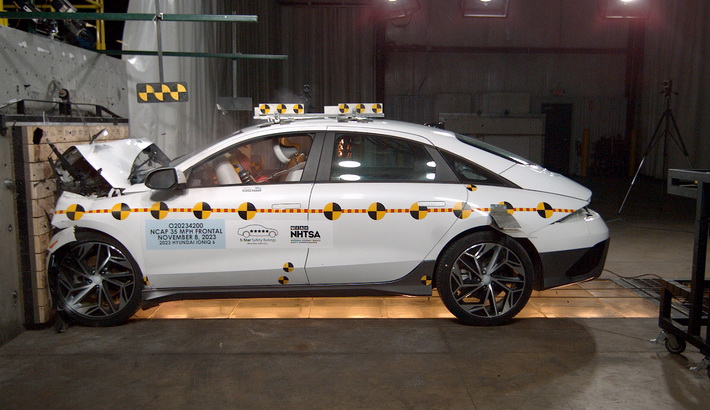
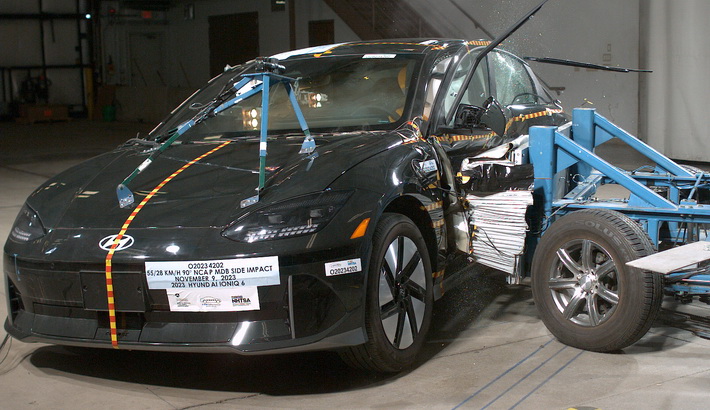
NHTSA Crash Test Performance
Frontal Crash Test
Side Crash Test
Overall Frontal Rating
Driver and Passenger Assessment
Driver Side
Passenger Side
Overall Side Rating
Side Barrier and Side Pole Tests
Driver Side
Passenger Side
Rollover Resistance
6.7% rollover risk in single-vehicle crash
Safety Features
ESC: StandardForward Collision Warning: Standard & OptionalLane Departure Warning: Standard
Recall Notices
NHTSANHTSA ID: 26V218000April 06, 2026
SEAT BELTS:FRONT:ANCHORAGE
Hyundai Motor America (Hyundai) is recalling certain 2023-2025 Hyundai Ioniq 6, 2023-2026 Genesis G90, 2024-2026 Hyundai Santa Fe, and Hyundai Santa Fe Hybrid vehicles. The driver and passenger seat belt anchors may detach.
Remedy Status
Dealers will inspect and reinforce or replace the seat belt anchors, as necessary, free of charge. Owner notification letters are expected to be mailed June 5, 2026. Owners may contact Hyundai customer service at 1-855-371-9460 and Genesis customer service at 844-340-9741. Hyundai's numbers for this recall are 298 and 032G. Vehicle Identification Numbers (VINs) involved in this recall became searchable on NHTSA.gov April 8, 2026.
NHTSA ID: 25V606000September 12, 2025
ELECTRICAL SYSTEM:PROPULSION SYSTEM:CHARGING:PORT
Hyundai Motor America (Hyundai) is recalling certain 2023-2025 IONIQ 6 electric vehicles. The charging port door panel may detach.
Remedy Status
Dealers will apply an adhesive on the charging port door assembly, free of charge. Owner notification letters were mailed beginning October 10, 2025. Owners may contact Hyundai customer service at 1-855-371-9460. Hyundai's number for this recall is 282. Vehicle Identification Numbers (VINs) involved in this recall became searchable on NHTSA.gov on September 13, 2025.
NHTSA ID: 24V868000November 18, 2024
ELECTRICAL SYSTEM:12V/24V/48V BATTERY
Hyundai Motor America (Hyundai) is recalling certain 2022-2024 IONIQ 5, 2023-2025 IONIQ 6, Genesis GV60, Genesis GV70 "Electrified," and Genesis G80 "Electrified" vehicles. The Integrated Charging Control Unit (ICCU) may become damaged and stop charging the 12-volt battery, which can result in a loss of drive power.
Remedy Status
Dealers will inspect and replace the ICCU and its fuse, as necessary. In addition, dealers will update the ICCU software. All repairs will be performed free of charge. Owner notification letters were mailed December 20, 2024. Owners may contact Hyundai customer service at 1-855-371-9460 or Genesis customer service at 1-844-340-9741. Hyundai's numbers for this recall are 272 (Hyundai) and 025G (Genesis). This recall expands and replaces previous recall number 24V-204. Vehicles previously repaired under recall 24V-204 will need to have the new remedy completed.
Owner Complaints
29 totalELECTRICAL SYSTEM,VEHICLE SPEED CONTROL
Apr 22, 2026
I was driving at 60mph. I heard a sudden pop that felt like it came from behind me / under the car. While I glanced to see if I ran over something (I did not), the car suddenly felt like it was about to stall. It was slowing down quickly and dramatically. My safety was in danger ...
Preview excerpt
ELECTRICAL SYSTEM
Apr 10, 2026
On April 10,2026 I heard a pop while driving and a check electrical system light came on, my vehicle lost power while driving. This appears to be a common problem with ioniq5 and 6 going back years. Also failure in their ICCU and 12 volt batteries.A veh. Losing power unexpectedly...
Preview excerpt
ELECTRICAL SYSTEM
CRASHApr 2, 2026
The contact owns a 2025 Hyundai Ioniq 6. The contact stated that as his wife was pulling into the residence driveway at approximately 3 MPH, the vehicle inadvertently accelerated. The contact stated that the front end of the vehicle crashed into the side of the house. The contact...
Preview excerpt
POWER TRAIN,ELECTRICAL SYSTEM,FUEL/PROPULSION SYSTEM
Mar 24, 2026
"While traveling in fast-moving traffic, my 2025 Hyundai IONIQ 6 suffered a catastrophic electrical system failure and an immediate loss of motive power. The vehicle instantly entered a 'limp mode' and dropped to a maximum speed of 11 mph, creating a life-threatening hazard for m...
Preview excerpt
ELECTRICAL SYSTEM
Feb 23, 2026
ICCU failure. Sudden total electrical shutdown. According to this site, there was a recall filled but NOT COMPLETE since November 2024! We are now February 2026. There has been NO warning issued to Hyundai consumers about this. When the ICCU fails, it puts consumers at risk. When...
Preview excerpt
UNKNOWN OR OTHER
Feb 13, 2026
I TOOK POSSESSION OF THIS VEHICLE ON SEPT 1, 2025 SINCE DAY 1 THE BLUELINK APP STATES THAT THE CAR NEEDS SERVICE I SPOKE TO HYUANDI CUSTOMER SERVICE & THEIR ONLY RECOMMENDATION IS THAT I GO BACK TO THE DEAL / I SAID TO THEM JUST YESTERDAY (FEB 12, 2026) SO LET ME GET THIS STRAIG...
Preview excerpt
VISIBILITY/WIPER
Feb 13, 2026
THIS CAR WAS PREPPED BY COCONUT CREEK HYUNDAI AND I AM BEING TOLD BY YOUR CUSTOMER SERVICE DEPARTNEMTN THAT THERE MIGHT HAVE BEEN SOME DEBRIS ON THE WIPERS THAT CAUSED THE SCRATCHES / HOW IS THAT MY FAULT HYUANDI HAS WALKED AWAY FROM ANY RESPONSIBILITY / IN FACT THEY ASKED ME IF...
Preview excerpt
ELECTRICAL SYSTEM
Feb 11, 2026
On the evening of February 11, 2026, my 2025 Hyundai Ioniq 6 SEL experienced a complete ICCU failure while I was traveling with my minor son. The vehicle became fully inoperable and left us stranded on the side of the road at night, in the middle of a winter storm. I was forced t...
Preview excerpt
ELECTRICAL SYSTEM,UNKNOWN OR OTHER
Feb 10, 2026
My leased 2025 Hyundai Ioniq 6 experienced a sudden malfunction resulting in loss of vehicle operation. The vehicle has been at the dealership with delayed diagnosis and no clear repair timeline provided. This appears to be a safety-related defect involving the electric system. ...
Preview excerpt
ELECTRICAL SYSTEM
Feb 9, 2026
The car displayed “Check Electric Vehicle System”. The 12‑V battery stopped charging. The vehicle could not be driven very far or very fast. The car had to be towed to a Hyundai dealer.The ICCU was diagnosed as failed. The ICCU has been an ongoing issue with Hyundai EVs.
Showing 10 recent complaints from 29 total
View Full Complaint LogCompare Related Vehicles
Why Compare These Pages
The strongest comparison flow is usually: exact vehicle-year page, then nearby years of the same model, then other 2025 Hyundai models. That sequence helps separate one-off year spikes from broader make-wide patterns.
More Hyundai Ioniq 6 Years
More 2025 Hyundai Models
2025 Hyundai Ioniq 5Another 2025 Hyundai option for same-year comparison.8r234c2025 Hyundai TucsonAnother 2025 Hyundai option for same-year comparison.4r214c2025 Hyundai PalisadeAnother 2025 Hyundai option for same-year comparison.3r193c2025 Hyundai Santa FeAnother 2025 Hyundai option for same-year comparison.5r99c2025 Hyundai KonaAnother 2025 Hyundai option for same-year comparison.20c2025 Hyundai ElantraAnother 2025 Hyundai option for same-year comparison.17c
Frequently Asked Questions
How many recalls does the 2025 Hyundai Ioniq 6 have?
The 2025 Hyundai Ioniq 6 has 3 recalls recorded by NHTSA.
How many complaints have been filed for the 2025 Hyundai Ioniq 6?
NHTSA has received 29 owner-reported complaints for the 2025 Hyundai Ioniq 6.
What is the NHTSA safety rating for the 2025 Hyundai Ioniq 6?
The 2025 Hyundai Ioniq 6 received an overall safety rating of 5 out of 5 stars from NHTSA.
What are the most common problems with the 2025 Hyundai Ioniq 6?
The most commonly reported complaint categories for the 2025 Hyundai Ioniq 6 are electrical system (11 reports), unknown or other (4 reports), electrical system,unknown or other (2 reports).
Does the 2025 Hyundai Ioniq 6 have any recalls?
Yes. NHTSA has 3 recalls on record for the 2025 Hyundai Ioniq 6. Scroll up to review the published recall summaries, consequences, and remedies. To check for unrepaired recalls on your specific vehicle, use your VIN at nhtsa.gov/recalls.
Check Another Vehicle
Look up recalls and complaints for any year, make, and model.
This page summarizes publicly available data from the National Highway Traffic Safety Administration (NHTSA). Complaint counts reflect reports submitted to NHTSA by vehicle owners and do not by themselves prove defect severity or vehicle safety. Safety ratings may not be available for all vehicle-years. This site is not affiliated with NHTSA or any vehicle manufacturer. For official information, visit the official NHTSA page for this vehicle.