Mazda · Mazda3 · 2020
2020 Mazda Mazda3
2
Recalls
31
Complaints
5/5
Safety Rating
The 2020 Mazda Mazda3 has 2 recalls and 31 owner-reported complaints on file with NHTSA. Overall safety rating: 5 out of 5 stars. Most reported issue: forward collision avoidance (12 reports).
Source: NHTSA Public Records · Updated Apr 28, 2026
Research Context
The 2020 Mazda Mazda3 page works best as a research starting point. Complaint totals show how much owner-reported activity exists, while recalls and investigations help show whether any of that activity turned into formal safety action.
Because this is a newer-era vehicle page, it usually helps to compare this year against nearby model years before deciding whether a complaint pattern looks isolated or persistent. On this page, the most prominent complaint area is forward collision avoidance with 12 reported complaints.
Best Research Moves
- Use the complaint log to understand what owners were actually reporting instead of relying only on the raw complaint total.
- Review the recall section even if the total is smaller, because a limited number of recalls can still point to meaningful safety actions.
- This page is primarily a complaints-and-recalls research surface, so compare nearby model years before treating the complaint total as a standalone verdict.
Key Takeaways
- The 2020 Mazda Mazda3 currently shows 2 NHTSA recalls listed on this page and 31 owner-reported complaints.
- This page currently shows no linked NHTSA investigations.
- This page reflects complaint volume, recall history, and NHTSA test data, but it does not diagnose causes or rank reliability by itself.
- Safety data currently shows 5/5 overall NHTSA safety rating.
- The most frequently reported complaint categories on this page are forward collision avoidance (12), service brakes,forward collision avoidance (2), equipment (1).
- Vehicle
- 2020 Mazda Mazda3
- Recalls
- 2
- Complaints
- 31
- Safety Rating
- 5/5
How to Interpret This Page
This page combines three types of NHTSA data: recall campaigns (official manufacturer or government actions), owner complaints (unverified consumer reports), and crash test ratings (where available). A vehicle with many complaints is not necessarily less reliable — complaint volume correlates with sales volume and vehicle age. Recalls indicate identified defects, not overall quality. To compare this model year with others, use the year navigation in the sidebar or return to the model overview page.
If you are researching a used vehicle, start with the complaint categories, compare them against the recall list, and then check nearby model years to see whether the same issue profile repeats. That usually produces a better buying or research signal than treating the raw complaint total as a standalone safety ranking.
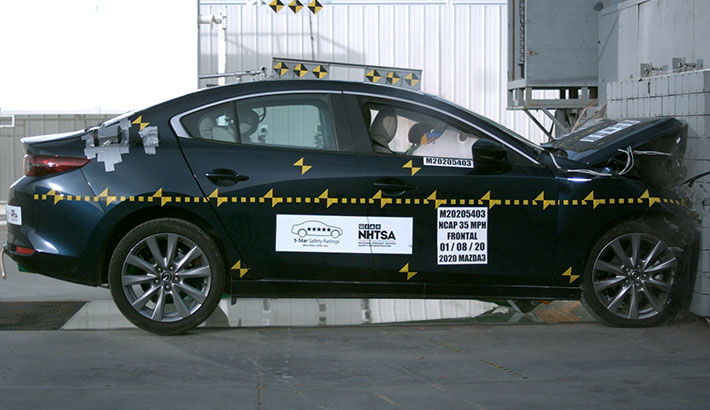
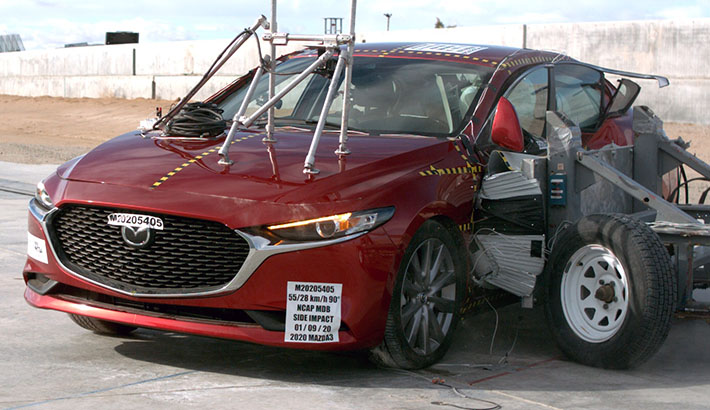
NHTSA Crash Test Performance
Frontal Crash Test
Side Crash Test
Overall Frontal Rating
Driver and Passenger Assessment
Driver Side
Passenger Side
Overall Side Rating
Side Barrier and Side Pole Tests
Driver Side
Passenger Side
Rollover Resistance
10.1% rollover risk in single-vehicle crash
Safety Features
ESC: StandardForward Collision Warning: StandardLane Departure Warning: Standard
Recall Notices
NHTSANHTSA ID: 20V346000June 12, 2020
SERVICE BRAKES, HYDRAULIC:FOUNDATION COMPONENTS:DISC:CALIPER
Mazda North American Operations (Mazda) is recalling certain 2020 CX-30 and Mazda3 vehicles. The front brake caliper mounting bolts may not have been tightened properly during assembly, possibly allowing the calipers to loosen.
Remedy Status
Mazda will notify owners, and dealers will inspect the front brake caliper bolts, tightening them as necessary. If bolts are missing, the affected brake caliper will be replaced. Repairs will be performed free of charge. The recall began July 24, 2020. Owners may contact Mazda customer service at 1-800-222-5500, Option 4. Mazda's number for this recall is 4420F.
NHTSA ID: 19V907000December 19, 2019
FORWARD COLLISION AVOIDANCE: AUTOMATIC EMERGENCY BRAKING
Mazda North American Operations (Mazda) is recalling certain 2019-2020 Mazda3 vehicles. The Smart Brake System (SBS) can falsely detect an obstacle while driving, activating the automatic emergency braking system and suddenly stopping the vehicle.
Remedy Status
Mazda will notify owners, and dealers will update the SBS software. In addition, vehicles with certain production dates will receive an instrument cluster software update or replacement and a replacement owner's manual. These repairs will be performed free of charge. The recall began February 14, 2020. Owners may contact Mazda customer service at 1-800-222-5500, Option 4. Mazda's number for this recall is 4219L.
Owner Complaints
31 totalTIRES
Dec 5, 2025
size 21545ZR18 93Y. replaced these oem tires with these from costco on feb 27 2025. in dec 5 2025 the tire developed a large bubble. miles bought was 27790. current miles 31212. per tire center steal belting was broken no signs of road hazard or other damage. the belt broke and...
Preview excerpt
SUSPENSION
Oct 8, 2025
I pulled into the driveway (at about 5 mph) of my passenger's home, when a very loud, metallic pop occurred somewhere inside my vehicle. I could not discern the problem by visually inspecting the car. Upon returning to my home, I arranged for the dealership to inspect the car's...
Preview excerpt
POWER TRAIN
Sep 1, 2025
My Mazda3 began producing a chirp when shifting from 3rd to 4th gear (automatic transmission). The dealer stated that the car needed a new torque converter. At the time the car only 37,000 miles on it, quite low mileage for a torque converter to fail. Mazda has previously admitte...
Preview excerpt
EQUIPMENT
Jun 18, 2025
See attached document for complaint.
STEERING,SUSPENSION
Aug 1, 2024
TSB 02-003/24 Car front suspension bolts corroded and making metal on metal sounds during turning and braking
SEAT BELTS
Jun 1, 2024
Passenger seat belt won’t retract and remains in a locked state.
ELECTRICAL SYSTEM,EXTERIOR LIGHTING,LANE DEPARTURE
Mar 12, 2024
Google search shows Mazda has common problem with their front sensing camera, people are reporting the issue for different Mazda models across the board for the last few years including newer models as well. My car display shows few malfunction warning messages. Following captu...
Preview excerpt
FORWARD COLLISION AVOIDANCE
Sep 18, 2023
While driving on a residential street the automatic emergency braking system activated and brought the car to a very abrupt stop but there was nothing in the front of the car to activate the system. There were no cars in the on-coming lane and no cars in the lane beside my car. W...
Preview excerpt
SERVICE BRAKES,FORWARD COLLISION AVOIDANCE
Aug 18, 2023
My car's automatic emergency brake is deploying without warning, during driving, when there are no other cars in my forward proximity. I took it to the dealership to have it fixed, and on the drive home, it did it again. There is a recall for similar makes and models for this yea...
Preview excerpt
FORWARD COLLISION AVOIDANCE
Jul 17, 2023
on 3 occasions may 2023, June 2023 and July 2023 the forward Collison camera activated. in May and June it showed the vehicle to near stop like radar cruise control in rush hour speed traffic. in July 2023 it sounded the alarm and came to a full stop in heavy traffic. it occur...
Preview excerpt
Showing 10 recent complaints from 31 total
View Full Complaint LogCompare Related Vehicles
Why Compare These Pages
The strongest comparison flow is usually: exact vehicle-year page, then nearby years of the same model, then other 2020 Mazda models. That sequence helps separate one-off year spikes from broader make-wide patterns.
More Mazda Mazda3 Years
2021 Mazda Mazda3Compare this year against 2020 for complaint and recall shifts.1r49c2019 Mazda Mazda3Compare this year against 2020 for complaint and recall shifts.6r72c2022 Mazda Mazda3Compare this year against 2020 for complaint and recall shifts.23c2018 Mazda Mazda3Compare this year against 2020 for complaint and recall shifts.4r106c2023 Mazda Mazda3Compare this year against 2020 for complaint and recall shifts.12c2017 Mazda Mazda3Compare this year against 2020 for complaint and recall shifts.2r83c
More 2020 Mazda Models
2020 Mazda CX-5Another 2020 Mazda option for same-year comparison.102c2020 Mazda CX-30Another 2020 Mazda option for same-year comparison.3r31c2020 Mazda CX-9Another 2020 Mazda option for same-year comparison.1r16c2020 Mazda Mazda6Another 2020 Mazda option for same-year comparison.2c2020 Mazda CX-3Another 2020 Mazda option for same-year comparison.1r1c2020 Mazda MX-5 MiataAnother 2020 Mazda option for same-year comparison.1r1c
Frequently Asked Questions
How many recalls does the 2020 Mazda Mazda3 have?
The 2020 Mazda Mazda3 has 2 recalls recorded by NHTSA.
How many complaints have been filed for the 2020 Mazda Mazda3?
NHTSA has received 31 owner-reported complaints for the 2020 Mazda Mazda3.
What is the NHTSA safety rating for the 2020 Mazda Mazda3?
The 2020 Mazda Mazda3 received an overall safety rating of 5 out of 5 stars from NHTSA.
What are the most common problems with the 2020 Mazda Mazda3?
The most commonly reported complaint categories for the 2020 Mazda Mazda3 are forward collision avoidance (12 reports), service brakes,forward collision avoidance (2 reports), equipment (1 reports).
Does the 2020 Mazda Mazda3 have any recalls?
Yes. NHTSA has 2 recalls on record for the 2020 Mazda Mazda3. Scroll up to review the published recall summaries, consequences, and remedies. To check for unrepaired recalls on your specific vehicle, use your VIN at nhtsa.gov/recalls.
Check Another Vehicle
Look up recalls and complaints for any year, make, and model.
This page summarizes publicly available data from the National Highway Traffic Safety Administration (NHTSA). Complaint counts reflect reports submitted to NHTSA by vehicle owners and do not by themselves prove defect severity or vehicle safety. Safety ratings may not be available for all vehicle-years. This site is not affiliated with NHTSA or any vehicle manufacturer. For official information, visit the official NHTSA page for this vehicle.