Toyota · Camry · 2018
2018 Toyota Camry
8
Recalls
704
Complaints
5/5
Safety Rating
The 2018 Toyota Camry has 8 recalls and 704 owner-reported complaints on file with NHTSA. Overall safety rating: 5 out of 5 stars. Most reported issue: power train (90 reports).
Source: NHTSA Public Records · Updated May 4, 2026
Research Context
The 2018 Toyota Camry page works best as a research starting point. Complaint totals show how much owner-reported activity exists, while recalls and investigations help show whether any of that activity turned into formal safety action.
Because this is a newer-era vehicle page, it usually helps to compare this year against nearby model years before deciding whether a complaint pattern looks isolated or persistent. On this page, the most prominent complaint area is power train with 90 reported complaints.
Best Research Moves
- Use the complaint log to see whether the 2018 Toyota Camry reports cluster around one repeated symptom or spread across multiple systems.
- Compare the recall list with the complaint mix to see whether the most reported issues overlap with formal NHTSA safety campaigns.
- This page is primarily a complaints-and-recalls research surface, so compare nearby model years before treating the complaint total as a standalone verdict.
Key Takeaways
- The 2018 Toyota Camry currently shows 8 NHTSA recalls listed on this page and 704 owner-reported complaints.
- This page currently shows no linked NHTSA investigations.
- This page reflects complaint volume, recall history, and NHTSA test data, but it does not diagnose causes or rank reliability by itself.
- Safety data currently shows 5/5 overall NHTSA safety rating.
- The most frequently reported complaint categories on this page are power train (90), service brakes (69), unknown or other (43).
- Vehicle
- 2018 Toyota Camry
- Recalls
- 8
- Complaints
- 704
- Safety Rating
- 5/5
How to Interpret This Page
This page combines three types of NHTSA data: recall campaigns (official manufacturer or government actions), owner complaints (unverified consumer reports), and crash test ratings (where available). A vehicle with many complaints is not necessarily less reliable — complaint volume correlates with sales volume and vehicle age. Recalls indicate identified defects, not overall quality. To compare this model year with others, use the year navigation in the sidebar or return to the model overview page.
If you are researching a used vehicle, start with the complaint categories, compare them against the recall list, and then check nearby model years to see whether the same issue profile repeats. That usually produces a better buying or research signal than treating the raw complaint total as a standalone safety ranking.
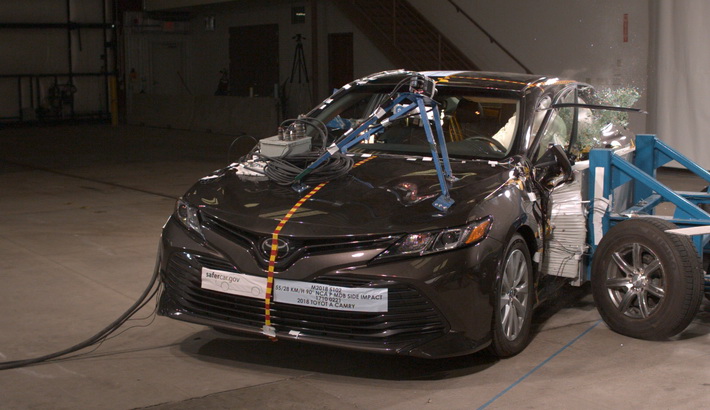
NHTSA Crash Test Performance
Frontal Crash Test

Side Crash Test
Overall Frontal Rating
Driver and Passenger Assessment
Driver Side
Passenger Side
Overall Side Rating
Side Barrier and Side Pole Tests
Driver Side
Passenger Side
Rollover Resistance
9.9% rollover risk in single-vehicle crash
Safety Features
ESC: StandardForward Collision Warning: NoLane Departure Warning: Standard
Recall Notices
NHTSANHTSA ID: 25V028000January 22, 2025
FUEL SYSTEM, GASOLINE:DELIVERY:FUEL PUMP
Toyota Motor Engineering & Manufacturing (Toyota) is recalling certain 2018 Camry, 2019 Lexus NX300, and 2019 RX350L vehicles. The low-pressure fuel pump inside the fuel tank may fail.
Remedy Status
Dealers will replace the fuel pump assembly, free of charge. Owner notification letters were mailed March 12, 2025. Owners may contact Toyota's customer service at 1-800-331-4331. Toyota's numbers for this recall are 25TA01 and 25LA01.
NHTSA ID: 21V890000November 17, 2021
SERVICE BRAKES, HYDRAULIC:POWER ASSIST:VACUUM
Toyota Motor Engineering & Manufacturing (Toyota) is recalling certain 2018-2019 Camry vehicles. The vane cap inside the vacuum pump may break, causing the pump to fail, which could result in a sudden loss of braking assist.
Remedy Status
Dealers will repair or replace the vacuum pump, as necessary, free of charge. Owner notification letters were mailed May 16, 2022. Owners may contact Toyota customer service at 1-800-331-4331.
NHTSA ID: 20V682000November 04, 2020
FUEL SYSTEM, GASOLINE:DELIVERY:FUEL PUMP
Toyota Motor Engineering & Manufacturing (Toyota) is recalling certain 2018-2019 4Runner, 2019-2020 Avalon, 2019 Corolla Hatchback, 2017-2019 Highlander, 2018-2020 Camry, 2020 Corolla, 2018-2019 Land Cruiser, 2017-2020 Tacoma, 2019-2020 RAV4, 2019-2020 Sequoia, 2017-2020 Sienna, 2019-2020 Tundra, 2018-2020 Lexus ES350, 2017 Lexus GS200t, 2017-2019 Lexus GS350, 2019 Lexus GS300, 2018-2020 Lexus LC500h, 2019-2020 Lexus LS500, 2018-2019 Lexus GX460, 2017 Lexus IS200t, 2019 Lexus IS300, 2019 Lexus IS350, 2018-2020 Lexus LC500, 2018 Lexus LS500, 2019 Lexus LS500h, 2018-2019 Lexus LX570, 2017 Lexus RC200t, 2019 Lexus RC300, RC350, 2017 and 2019-2020 Lexus RX350, 2018-2020 RX350L, 2019 Lexus UX200, 2018-2019 Lexus NX300 vehicles. The low-pressure fuel pump inside the fuel tank may fail.
Remedy Status
Toyota will notify owners, and dealers will replace the fuel pump assembly with an improved one, free of charge. Owners of specific models were notified that remedy parts were available starting January 21, 2021. Owners of other models will be notified as remedy parts become available. Remedy parts should be available for all affected vehicles by late March 2021. Owners may contact Toyota customer service at 1-888-270-9371 or Lexus customer service at 1-800-255-3987. Note: This recall is an expansion of recall 20V-012. Toyota's number for this recall is 20TA02. Lexus' number for this recall is 20LA01.
NHTSA ID: 20V012000January 13, 2020
FUEL SYSTEM, GASOLINE:DELIVERY:FUEL PUMP
Toyota Motor Engineering & Manufacturing (Toyota) recalled certain 2018-2019 4Runner, Highlander, Camry, Land Cruiser, Sequoia, Sienna, Tacoma and Tundra, and Lexus RC 300, RC 350, GS 350, GX 460, IS 300, LC 500, LS 500, LX 570, RX 350L, and 2019 Toyota Avalon and Corolla, and certain Lexus NX 300, and ES 350 vehicles on January 13, 2020. On March 4, 2020, Toyota expanded the recall to include certain 2014-2015 Toyota 4Runner and Land Cruiser, 2018 Avalon, Corolla, 2014 FJ Cruiser, 2017 Sienna and Lexus 2018 ES 350, 2018-2019 GS 300, 2013-2014 GS350, 2014-2015 GX 460, IS 350 and LX 570, 2014 IS F, 2018-2019 IS 350, LC 500H and LS 500H, 2013-2015 LS 460, 2015 NX 200T and RC350, 2017 RC 200T and RX 350. Toyota also removed the 2018-2019 Toyota 4Runner and Land Cruiser and 2018-2019 Lexus GX 460 and LX 570 and 2019 NX300 from inclusion in this recall. On March 19, 2020, Toyota expanded the recall to include 2015 Lexus GS350 vehicles. The low-pressure fuel pump inside the fuel tank may fail.
Remedy Status
Toyota will notify owners, and dealers will replace the fuel pump, free of charge. The recall began May 4, 2020. Owners may contact Toyota customer service at 1-888-270-9371 or Lexus customer service at 1-800-255-3987. Toyota's numbers for this recall are 20TB02 and 20TA02 for Toyota vehicles and 20LB01 and 20LA01 for Lexus vehicles.
NHTSA ID: 19V503000June 28, 2019
EQUIPMENT:OTHER:LABELS
Southeast Toyota Distributors, LLC (SET) is recalling certain 2017-2019 Toyota Camry, Corolla, Rav4, Sienna, and Yaris iA vehicles equipped with factory-installed floor mats. The load carrying capacity modification label may be incorrect. As such, these vehicles fail to comply with the requirements of Federal Motor Vehicle Safety Standard (FMVSS) number 110, "Tire Selection and Rims."
Remedy Status
SET will notify owners and provide a corrected label for placement over the inaccurate label, free of charge. The recall began August 23, 2019. Owners may contact Toyota customer service at 1-888-270-9371. SET's number for this recall is SET19A.
NHTSA ID: 18V211000April 03, 2018
SERVICE BRAKES, HYDRAULIC:POWER ASSIST:VACUUM
Toyota Motor Engineering & Manufacturing (Toyota) is recalling certain 2018 Toyota Camry and Highlander vehicles, 2017 Toyota Sienna and Tacoma vehicles and 2017 Lexus RX350 vehicles. During the manufacturing process, the oil galley in the rotor for the brake booster vacuum pump assembly may have been improperly machined possibly resulting in a sudden loss of brake assist.
Remedy Status
Toyota will notify owners, and dealers will replace the brake booster vacuum pump, free of charge. The recall began on May 9, 2018. Owners may contact Toyota customer service at 1-888-270-9371, or Lexus customer service at 1-800-255-3987. Toyota's numbers for this recall are J0K/JLD.
NHTSA ID: 18V200000March 28, 2018
ENGINE AND ENGINE COOLING:ENGINE
Toyota Motor Engineering & Manufacturing (Toyota) is recalling certain 2018 Toyota Camry vehicles equipped with a 2.5L, four-cylinder engine. The pistons on these vehicles may be larger than specified, possibly causing the engine to stall.
Remedy Status
Toyota will notify owners, and dealers will inspect the production date codes of the pistons and, if an engine contains a piston from the affected production period, the engine assembly will be replaced, free of charge. The recall is expected to begin May 25, 2018. Owners may contact Toyota customer service at 1-888-270-9371. Toyota's number for this recall is J1M/J0M.
NHTSA ID: 18V108000February 14, 2018
FUEL SYSTEM, GASOLINE:DELIVERY:HOSES, LINES/PIPING, AND FITTINGS
Toyota Motor Engineering & Manufacturing (Toyota) is recalling certain 2018 Toyota Camry vehicles equipped with V6 engines. These vehicles have fuel delivery pipes that may not be properly connected to the fuel hoses in the engine compartment.
Remedy Status
Toyota will notify owners, and dealers will inspect the fuel pipes for the correct installation, correcting them as necessary, free of charge. The recall is expected to begin March 30, 2018. Owners may contact Toyota customer service at 1-888-270-9371. Toyota's number for this recall is J0G.
Owner Complaints
704 totalSERVICE BRAKES,FORWARD COLLISION AVOIDANCE
Apr 17, 2026
While driving on the interstate 10 in California in rush hour traffic my vehicles’ brakes pedal suddenly became hard to press down and slow the vehicle down.fortunately I was able to safely get to the right shoulder and call a tow truck to get my car towed home.
ENGINE
Apr 1, 2026
I am reporting a severe safety and vehicle integrity issue involving a Toyota vehicle purchased from Wolfchase Toyota. After a technical inspection (Invoice #XXX), it was confirmed that the Engine VIN does not match the Chassis VIN. This indicates an undocumented engine replacem...
Preview excerpt
FUEL/PROPULSION SYSTEM
Mar 29, 2026
Toyota has recognized a problem with the low pressure fuel pump on some 2018 Camry cars which causes a hesitation when driving from a stop creating a rear danger of a rear-end collision. It has been happening intermitantly everysince car was new.. Toyota claimed that my vin wa...
Preview excerpt
POWER TRAIN
Mar 25, 2026
The vehicle experienced a complete transmission failure following a period of abnormal operation. The component that failed is the automatic transmission (8-speed). Prior to total failure, the vehicle began exhibiting multiple symptoms, including delayed engagement when shifting ...
Preview excerpt
STEERING
Mar 23, 2026
having problem with power steering. there is no place to add power steering fluid in my 2018 toyota camry. (this is my 4th toyota camry). steering rack and pinion probaly need to be replaced. i have read online that this is a known problem with toyota camrys
POWER TRAIN,VEHICLE SPEED CONTROL,ENGINE
Mar 19, 2026
On March 19, 2026, I was driving to work when traffic began to slow, and I reduced my speed accordingly. As traffic started to return to normal speed, I pressed the accelerator; however, although the engine revved, the vehicle did not accelerate beyond approximately 15 mph. I saf...
Preview excerpt
ELECTRICAL SYSTEM,ENGINE,FORWARD COLLISION AVOIDANCE
Mar 12, 2026
ICS malfunction error light and check engine light came on. I received a recall notice that this was being looked into but now the water pump has went out. The car is overheating.
STEERING
Mar 12, 2026
My steering was tight on my 2018 Toyota Camry. I started to have difficulty steering my car. After a day, I could not steer the car at all. I took it to my mechanic at Exxon, and when he ordered a new steering intermediate shaft assembly, he found a defect in the one Toyota sent ...
Preview excerpt
VISIBILITY
Mar 9, 2026
I own a 2018 Toyota Camry XSE with a sunroof that is currently stuvck in tilt/ open position and will not close. Multiple independent mechanics have refused to attempt repair due to the high likelihood of the glass or mechanism breaking, and have advised that only Toyota dealersh...
Preview excerpt
SERVICE BRAKES
Mar 4, 2026
The Vacuum Pump for the Power Assist Brake System failed on my vehicle, the dealership would not provide me with the failed unit as they "have to send it back to Toyota". My brake assist was very inconsistent, sometimes barely had any which lead to very poor braking, accompanied ...
Preview excerpt
Showing 10 recent complaints from 704 total
View Full Complaint LogCompare Related Vehicles
Why Compare These Pages
The strongest comparison flow is usually: exact vehicle-year page, then nearby years of the same model, then other 2018 Toyota models. That sequence helps separate one-off year spikes from broader make-wide patterns.
More Toyota Camry Years
2019 Toyota CamryCompare this year against 2018 for complaint and recall shifts.6r365c2017 Toyota CamryCompare this year against 2018 for complaint and recall shifts.3r145c2020 Toyota CamryCompare this year against 2018 for complaint and recall shifts.3r256c2016 Toyota CamryCompare this year against 2018 for complaint and recall shifts.2r179c2021 Toyota CamryCompare this year against 2018 for complaint and recall shifts.1r150c2015 Toyota CamryCompare this year against 2018 for complaint and recall shifts.1r264c
More 2018 Toyota Models
2018 Toyota RAV4Another 2018 Toyota option for same-year comparison.3r1i322c2018 Toyota C-HRAnother 2018 Toyota option for same-year comparison.1r262c2018 Toyota HighlanderAnother 2018 Toyota option for same-year comparison.5r246c2018 Toyota TacomaAnother 2018 Toyota option for same-year comparison.3r1i193c2018 Toyota CorollaAnother 2018 Toyota option for same-year comparison.3r2i132c2018 Toyota TundraAnother 2018 Toyota option for same-year comparison.9r96c
Frequently Asked Questions
How many recalls does the 2018 Toyota Camry have?
The 2018 Toyota Camry has 8 recalls recorded by NHTSA.
How many complaints have been filed for the 2018 Toyota Camry?
NHTSA has received 704 owner-reported complaints for the 2018 Toyota Camry.
What is the NHTSA safety rating for the 2018 Toyota Camry?
The 2018 Toyota Camry received an overall safety rating of 5 out of 5 stars from NHTSA.
What are the most common problems with the 2018 Toyota Camry?
The most commonly reported complaint categories for the 2018 Toyota Camry are power train (90 reports), service brakes (69 reports), unknown or other (43 reports).
Does the 2018 Toyota Camry have any recalls?
Yes. NHTSA has 8 recalls on record for the 2018 Toyota Camry. Scroll up to review the published recall summaries, consequences, and remedies. To check for unrepaired recalls on your specific vehicle, use your VIN at nhtsa.gov/recalls.
Check Another Vehicle
Look up recalls and complaints for any year, make, and model.
This page summarizes publicly available data from the National Highway Traffic Safety Administration (NHTSA). Complaint counts reflect reports submitted to NHTSA by vehicle owners and do not by themselves prove defect severity or vehicle safety. Safety ratings may not be available for all vehicle-years. This site is not affiliated with NHTSA or any vehicle manufacturer. For official information, visit the official NHTSA page for this vehicle.