Toyota · Camry · 2020
2020 Toyota Camry
3
Recalls
256
Complaints
5/5
Safety Rating
The 2020 Toyota Camry has 3 recalls and 256 owner-reported complaints on file with NHTSA. Overall safety rating: 5 out of 5 stars. Most reported issue: electrical system (38 reports).
Source: NHTSA Public Records · Updated May 4, 2026
Research Context
The 2020 Toyota Camry page works best as a research starting point. Complaint totals show how much owner-reported activity exists, while recalls and investigations help show whether any of that activity turned into formal safety action.
Because this is a newer-era vehicle page, it usually helps to compare this year against nearby model years before deciding whether a complaint pattern looks isolated or persistent. On this page, the most prominent complaint area is electrical system with 38 reported complaints.
Best Research Moves
- Use the complaint log to see whether the 2020 Toyota Camry reports cluster around one repeated symptom or spread across multiple systems.
- Review the recall section even if the total is smaller, because a limited number of recalls can still point to meaningful safety actions.
- This page is primarily a complaints-and-recalls research surface, so compare nearby model years before treating the complaint total as a standalone verdict.
Key Takeaways
- The 2020 Toyota Camry currently shows 3 NHTSA recalls listed on this page and 256 owner-reported complaints.
- This page currently shows no linked NHTSA investigations.
- This page reflects complaint volume, recall history, and NHTSA test data, but it does not diagnose causes or rank reliability by itself.
- Safety data currently shows 5/5 overall NHTSA safety rating.
- The most frequently reported complaint categories on this page are electrical system (38), air bags (36), engine (21).
- Vehicle
- 2020 Toyota Camry
- Recalls
- 3
- Complaints
- 256
- Safety Rating
- 5/5
How to Interpret This Page
This page combines three types of NHTSA data: recall campaigns (official manufacturer or government actions), owner complaints (unverified consumer reports), and crash test ratings (where available). A vehicle with many complaints is not necessarily less reliable — complaint volume correlates with sales volume and vehicle age. Recalls indicate identified defects, not overall quality. To compare this model year with others, use the year navigation in the sidebar or return to the model overview page.
If you are researching a used vehicle, start with the complaint categories, compare them against the recall list, and then check nearby model years to see whether the same issue profile repeats. That usually produces a better buying or research signal than treating the raw complaint total as a standalone safety ranking.
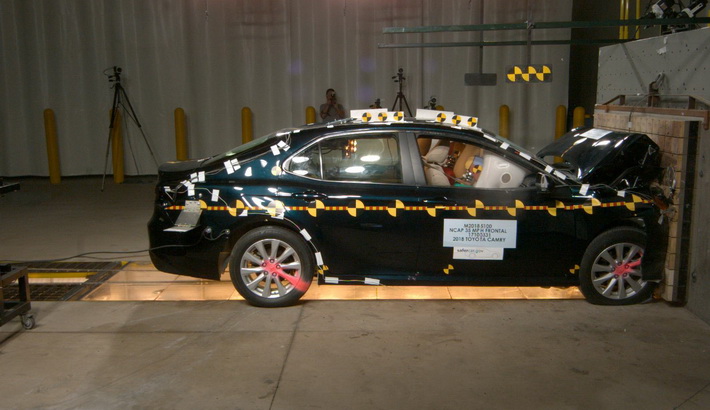
NHTSA Crash Test Performance
Frontal Crash Test
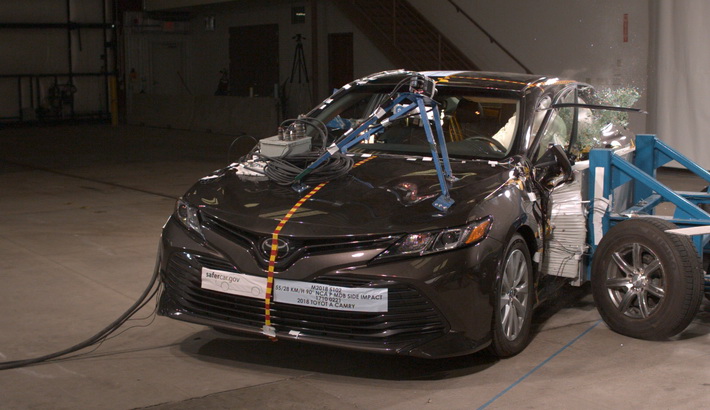
Side Crash Test
Overall Frontal Rating
Driver and Passenger Assessment
Driver Side
Passenger Side
Overall Side Rating
Side Barrier and Side Pole Tests
Driver Side
Passenger Side
Rollover Resistance
9.9% rollover risk in single-vehicle crash
Safety Features
ESC: StandardForward Collision Warning: StandardLane Departure Warning: Standard
Recall Notices
NHTSANHTSA ID: 23V865000December 20, 2023
AIR BAGS:SENSOR:OCCUPANT CLASSIFICATION
Toyota Motor Engineering & Manufacturing (Toyota) is recalling certain 2020-2021 Avalon, Avalon Hybrid, Corolla, Highlander, Highlander Hybrid, RAV4, RAV4 Hybrid, Lexus ES350, Lexus RX350, Lexus RX450H, 2021 Sienna Hybrid, Lexus ES250, 2020-2022 Camry, Camry Hybrid, and ES300H vehicles. A short circuit may develop in the Occupant Classification System (OCS) sensor, preventing the front passenger air bag from deploying.
Remedy Status
Dealers will inspect and replace the sensor as necessary, free of charge. Interim letters notifying owners of the safety risk were mailed in February 2024. Some final remedy owner letters were mailed October 31, 2024. Letters will continue to be mailed in phases through January 2026. Owners may contact Toyota customer service at 1-800-331-4331. Toyota's number for this recall is 23TB15/23TA15 Lexus 23LB03/23LA03.
NHTSA ID: 20V682000November 04, 2020
FUEL SYSTEM, GASOLINE:DELIVERY:FUEL PUMP
Toyota Motor Engineering & Manufacturing (Toyota) is recalling certain 2018-2019 4Runner, 2019-2020 Avalon, 2019 Corolla Hatchback, 2017-2019 Highlander, 2018-2020 Camry, 2020 Corolla, 2018-2019 Land Cruiser, 2017-2020 Tacoma, 2019-2020 RAV4, 2019-2020 Sequoia, 2017-2020 Sienna, 2019-2020 Tundra, 2018-2020 Lexus ES350, 2017 Lexus GS200t, 2017-2019 Lexus GS350, 2019 Lexus GS300, 2018-2020 Lexus LC500h, 2019-2020 Lexus LS500, 2018-2019 Lexus GX460, 2017 Lexus IS200t, 2019 Lexus IS300, 2019 Lexus IS350, 2018-2020 Lexus LC500, 2018 Lexus LS500, 2019 Lexus LS500h, 2018-2019 Lexus LX570, 2017 Lexus RC200t, 2019 Lexus RC300, RC350, 2017 and 2019-2020 Lexus RX350, 2018-2020 RX350L, 2019 Lexus UX200, 2018-2019 Lexus NX300 vehicles. The low-pressure fuel pump inside the fuel tank may fail.
Remedy Status
Toyota will notify owners, and dealers will replace the fuel pump assembly with an improved one, free of charge. Owners of specific models were notified that remedy parts were available starting January 21, 2021. Owners of other models will be notified as remedy parts become available. Remedy parts should be available for all affected vehicles by late March 2021. Owners may contact Toyota customer service at 1-888-270-9371 or Lexus customer service at 1-800-255-3987. Note: This recall is an expansion of recall 20V-012. Toyota's number for this recall is 20TA02. Lexus' number for this recall is 20LA01.
NHTSA ID: 20V064000February 06, 2020
ENGINE AND ENGINE COOLING
Toyota Motor Engineering & Manufacturing (Toyota) is recalling certain 2020 Toyota Avalon Hybrid, Camry, Camry Hybrid and Lexus ES300h and 2019-2020 RAV4 and RAV4 Hybrid vehicles equipped with 2.5L 4-Cylinder engines. Porosity in the engine castings may result in cracks than can allow coolant to leak internally and/or externally.
Remedy Status
Toyota will notify owners, and dealers will inspect and replace the engine including the engine block, as necessary, free of charge. The recall began April 3, 2020. Owners may contact Toyota customer service at 1-888-270-9371 or Lexus at 1-800-255-3987. Toyota's number for this recall is 20TA04. Lexus' number for this recall is 20LA02.
Owner Complaints
256 totalUNKNOWN OR OTHER,FUEL/PROPULSION SYSTEM,FORWARD COLLISION AVOIDANCE
Apr 19, 2026
Coolant leak pink fluid under the car and thermostat going crazy.
ENGINE
Mar 16, 2026
coolant bypass valve
UNKNOWN OR OTHER
Mar 11, 2026
I don’t have any problem
UNKNOWN OR OTHER
Mar 11, 2026
Don’t have any problem
ELECTRICAL SYSTEM,SERVICE BRAKES,ENGINE
Feb 8, 2026
While driving the car just shut-off in the middle of the road. If you tried to restart the car it would turn on rev the engine and shut off. The dash display displayed a message " precollision system malfunction" and "secondary brake collision malfunction". Safety wise if this ha...
Preview excerpt
FUEL/PROPULSION SYSTEM
Feb 7, 2026
Hesitant and sluggish acceleration caused check engine light and activated limp mode. Code P0087 - fuel rail/system pressure too low. My VIN isn’t included on the major fuel pump recall, but I’m experiencing issue and being told it’s going to cost thousands to repair.
SEAT BELTS
Jan 29, 2026
The seat belt latch broke . The seat belt is not retracting . Dangerous situation . The seat belt too loose and will not secure driver
FUEL/PROPULSION SYSTEM
Jan 5, 2026
My vehicle has being acting faulty. The vehicle looses power and stops while driving. It has done it multiple times. I took it for check up on the dealer and said it was fuel pump. They said that unfortunately this car is not in the recall list even though other same year camrys ...
Preview excerpt
POWER TRAIN
Jan 5, 2026
Around 67,000 miles I've been noticing a whining sound whenever accelerating. Sound disappears whenever foot is off the gas pedal.
UNKNOWN OR OTHER
Jan 3, 2026
My 2020 Toyota Camry is experiencing a persistent failure with the Data Communication Module (DCM), resulting in **Error Code ** in the Toyota app: "Request could not be completed. Please contact your dealer for assistance." This error prevents all Toyota Remote Connect features ...
Preview excerpt
Showing 10 recent complaints from 256 total
View Full Complaint LogCompare Related Vehicles
Why Compare These Pages
The strongest comparison flow is usually: exact vehicle-year page, then nearby years of the same model, then other 2020 Toyota models. That sequence helps separate one-off year spikes from broader make-wide patterns.
More Toyota Camry Years
2021 Toyota CamryCompare this year against 2020 for complaint and recall shifts.1r150c2019 Toyota CamryCompare this year against 2020 for complaint and recall shifts.6r365c2022 Toyota CamryCompare this year against 2020 for complaint and recall shifts.1r52c2018 Toyota CamryCompare this year against 2020 for complaint and recall shifts.8r704c2023 Toyota CamryCompare this year against 2020 for complaint and recall shifts.2r50c2017 Toyota CamryCompare this year against 2020 for complaint and recall shifts.3r145c
More 2020 Toyota Models
2020 Toyota RAV4Another 2020 Toyota option for same-year comparison.6r611c2020 Toyota CorollaAnother 2020 Toyota option for same-year comparison.3r296c2020 Toyota HighlanderAnother 2020 Toyota option for same-year comparison.4r271c2020 Toyota TacomaAnother 2020 Toyota option for same-year comparison.1r84c2020 Toyota C-HRAnother 2020 Toyota option for same-year comparison.1r44c2020 Toyota TundraAnother 2020 Toyota option for same-year comparison.5r43c
Frequently Asked Questions
How many recalls does the 2020 Toyota Camry have?
The 2020 Toyota Camry has 3 recalls recorded by NHTSA.
How many complaints have been filed for the 2020 Toyota Camry?
NHTSA has received 256 owner-reported complaints for the 2020 Toyota Camry.
What is the NHTSA safety rating for the 2020 Toyota Camry?
The 2020 Toyota Camry received an overall safety rating of 5 out of 5 stars from NHTSA.
What are the most common problems with the 2020 Toyota Camry?
The most commonly reported complaint categories for the 2020 Toyota Camry are electrical system (38 reports), air bags (36 reports), engine (21 reports).
Does the 2020 Toyota Camry have any recalls?
Yes. NHTSA has 3 recalls on record for the 2020 Toyota Camry. Scroll up to review the published recall summaries, consequences, and remedies. To check for unrepaired recalls on your specific vehicle, use your VIN at nhtsa.gov/recalls.
Check Another Vehicle
Look up recalls and complaints for any year, make, and model.
This page summarizes publicly available data from the National Highway Traffic Safety Administration (NHTSA). Complaint counts reflect reports submitted to NHTSA by vehicle owners and do not by themselves prove defect severity or vehicle safety. Safety ratings may not be available for all vehicle-years. This site is not affiliated with NHTSA or any vehicle manufacturer. For official information, visit the official NHTSA page for this vehicle.