Honda · CR-V · 2024
2024 Honda CR-V
2
Recalls
357
Complaints
5/5
Safety Rating
The 2024 Honda CR-V has 2 recalls and 357 owner-reported complaints on file with NHTSA. Overall safety rating: 5 out of 5 stars. Most reported issue: steering (85 reports).
Source: NHTSA Public Records · Updated May 4, 2026
Research Context
The 2024 Honda CR-V page works best as a research starting point. Complaint totals show how much owner-reported activity exists, while recalls and investigations help show whether any of that activity turned into formal safety action.
Because this is a newer-era vehicle page, it usually helps to compare this year against nearby model years before deciding whether a complaint pattern looks isolated or persistent. On this page, the most prominent complaint area is steering with 85 reported complaints.
Best Research Moves
- Use the complaint log to see whether the 2024 Honda CR-V reports cluster around one repeated symptom or spread across multiple systems.
- Review the recall section even if the total is smaller, because a limited number of recalls can still point to meaningful safety actions.
- Check the linked investigations for extra ODI context if you want to see whether owner complaints escalated into formal defect review.
Key Takeaways
- The 2024 Honda CR-V currently shows 2 NHTSA recalls listed on this page and 357 owner-reported complaints.
- This page currently shows 1 NHTSA investigation linked to this page.
- This page reflects complaint volume, recall history, and NHTSA test data, but it does not diagnose causes or rank reliability by itself.
- Safety data currently shows 5/5 overall NHTSA safety rating.
- The most frequently reported complaint categories on this page are steering (85), unknown or other (47), visibility/wiper (33).
- Vehicle
- 2024 Honda CR-V
- Recalls
- 2
- Complaints
- 357
- Safety Rating
- 5/5
How to Interpret This Page
This page combines three types of NHTSA data: recall campaigns (official manufacturer or government actions), owner complaints (unverified consumer reports), and crash test ratings (where available). A vehicle with many complaints is not necessarily less reliable — complaint volume correlates with sales volume and vehicle age. Recalls indicate identified defects, not overall quality. To compare this model year with others, use the year navigation in the sidebar or return to the model overview page.
If you are researching a used vehicle, start with the complaint categories, compare them against the recall list, and then check nearby model years to see whether the same issue profile repeats. That usually produces a better buying or research signal than treating the raw complaint total as a standalone safety ranking.
NHTSA Crash Test Performance
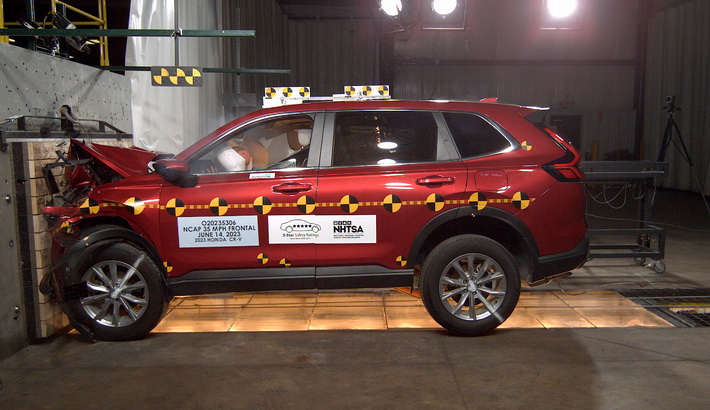
Frontal Crash Test
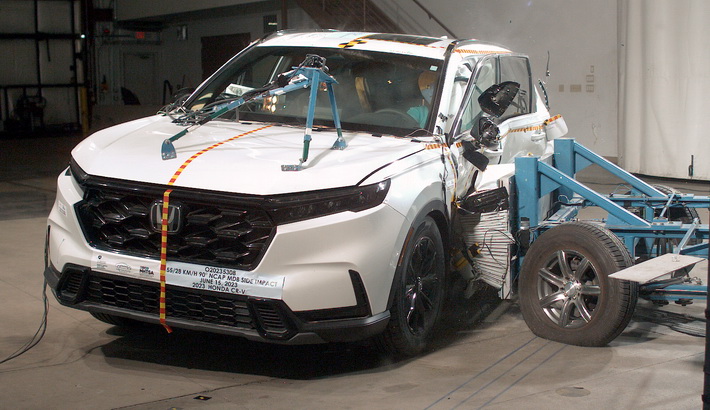
Side Crash Test
Overall Frontal Rating
Driver and Passenger Assessment
Driver Side
Passenger Side
Overall Side Rating
Side Barrier and Side Pole Tests
Driver Side
Passenger Side
Rollover Resistance
15.5% rollover risk in single-vehicle crash
Safety Features
ESC: StandardForward Collision Warning: StandardLane Departure Warning: Standard
Recall Notices
NHTSANHTSA ID: 24V744000October 03, 2024
STEERING
Honda (American Honda Motor Co.) is recalling certain 2023-2025 Acura Integra, Civic Type R, CR-V Hybrid, CR-V, HR-V, 2022-2025 Civic, Civic Hatchback, 2024-2025 Acura Integra Type S, 2025 CR-V Fuel Cell EV, Civic Hybrid, and Civic Hatchback Hybrid vehicles. The steering gearbox assembly may have been manufactured incorrectly, which can cause excessive internal friction and lead to difficulty steering the vehicle.
Remedy Status
Dealers will replace the worm gear spring and redistribute or add grease as necessary, free of charge. Owner notification letters were mailed November 18, 2024. Owners may contact Honda Customer Service at 1-888-234-2138. Honda's numbers for this recall are SJS, MJU, QJT and VJV.
NHTSA ID: 24V508000July 02, 2024
TIRES:MARKINGS
Honda (America Honda Motor Co.) is recalling certain 2024 CR-V vehicles. The tire identification number (TIN) is missing the four-digit date code. As such, these vehicles fail to comply with the requirements of Federal Motor Vehicle Safety Standard number 139, "New Pneumatic Radial Tires for Light Vehicles."
Remedy Status
Dealers will inspect and replace the tires as necessary, free of charge. Owner notification letters were mailed August 27, 2024. Owners may contact Honda customer service at 1-888-234-2138. Honda's number for this recall is BIS.
Investigations
1 totalOn November 29, 2023, the Office of Defects Investigation (ODI) opened this Engineering Analysis (EA23003) to assess allegations of momentary increase in steering effort in model years (MY) 2022-2023 Honda Civic, 2023MY Honda CR-V, and 2023MY Acura Integra vehicles (subject vehicles). The complaints received by ODI alleged that the subject vehicles experienced a momentary increase in required steering effort (described as “sticky steering”) occurring mostly at highway speeds after driving for an extended amount of time; these complaints could not be duplicated during dealer service technicians’ quick test drives. The complaints had been received over the previous two years with most occurring with low vehicle mileage. The steering gear of these vehicles is aided by an electrical power assist unit. This power assist unit inputs force on the steering rack via a worm gear and worm wheel assembly. During PE23005, Honda stated this condition of momentary increase in steering effort occurs due to two factors within this power assist unit. First, during manufacturing, the steering worm wheel goes through annealing and component conditioning processes. These processes cause internal stress and strain within the steering worm wheel. This strain is slowly released over the first few months of the vehicle life. Over time, the released strain causes deformation of the teeth on the worm wheel, causing the worm gear to catch on the worm wheel. This catching results in the driver’s momentary increased steering effort. Second, the manufacturing process did not guarantee consistent grease application and, therefore, some subject vehicles received insufficient grease which contributed to the momentary increase in steering effort. During EA23003, ODI further analyzed the potential safety related consequences of the momentary increase in steering effort. NHTSA’s Vehicle Research and Test Center (VRTC) duplicated the allegations of increased steering effort. In addition, VRTC discovered the steering worm wheel and worm gear tended to push grease out of the meshing area, resulting in large amounts of grease resting on top of the worm wheel. Information Request responses collected and reviewed by ODI showed Honda had also discovered this additional root cause during NHTSA’s EA. In addition, Honda discovered the preload of the worm wheel gear spring was set too high, increasing the gear slide load and resulting in higher friction and increased torque fluctuation when steering. The number of consumer complaints made to ODI continued to increase with the expansion of scope from the PE to the EA. Additionally, during EA23003, ODI received ten complaints alleging a crash, in addition to the 13 complaints ODI had received as of the time it opened EA23003. In total, 23 crashes have been reported to ODI due to this alleged defect. On October 3, 2024, Honda filed NHTSA Recall No. 24V-744 to address this defect. The recall will provide consumers with a new steering worm wheel gear spring with a decreased load. Additionally, dealerships will add additional grease and relocate any grease sitting on top of the worm wheel back into the meshing area. The scope of this recall includes all Honda vehicles that were manufactured with this specific improperly produced steering worm wheel and spring. In view of the recall action being taken by Honda, ODI is closing EA23003. NHTSA reserves the right to take additional action if warranted by future circumstances. To review the ODI reports cited in the Closing Resume ODI Report Identification Number document, go to NHTSA.gov.
Owner Complaints
357 totalUNKNOWN OR OTHER
Apr 23, 2026
Incident 1 — April 23, 2026 | ~71,289 miles While merging onto the freeway, multiple warning lights illuminated simultaneously on the dashboard. Vehicle exhibited uncontrolled acceleration and became unsafe to operate. Incident was captured on video. Vehicle was driven to Salina...
Preview excerpt
ENGINE
Apr 15, 2026
Vehicle has an "Engine Hot" warning and coolant loss, which creates a safety risk of stalling in traffic.
STEERING
Apr 15, 2026
The contact owns a 2024 Honda CR-V. The contact stated that while attempting to make a left or right turn, there was a dragging sound coming from the front end of the vehicle. There was no warning light illuminated. The vehicle was repaired under NHTSA Campaign Number: 24V744000 ...
Preview excerpt
VISIBILITY/WIPER,FORWARD COLLISION AVOIDANCE
Apr 14, 2026
Windshield wipers don’t have the same amount of travel each stroke. Sometimes the driver wiper will contact the A pillar and sometimes it will be several inches shy of the pillar. It seems it depends on how wet the windshield is. On several occasions, independent of wiper issue,...
Preview excerpt
STRUCTURE
Apr 14, 2026
While driving down the highway early in the morning the sunroof glass exploded. There were no other vehicles on the road, there was no impact. My vehicle is stored under a carport.
STEERING
CRASH2 injuriesApr 5, 2026
The contact's brother owned a 2024 Honda CR-V. The contact stated that while her brother was driving at approximately 54 MPH as he turned the steering wheel to the left to follow the road, the steering wheel locked up and stayed turned to the left. The contact stated that her bro...
Preview excerpt
SERVICE BRAKES
Apr 1, 2026
I have a Honda 2024 CRV Hybrid. After 18 Months the rear and front brake rotors went bad. I hear a metal screach on the car wheels without using the brages. Dealer Honda states that rotors are under warranty for the first 12 Months and charging $1480 to resurface front rotors and...
Preview excerpt
SERVICE BRAKES,FORWARD COLLISION AVOIDANCE
CRASHMar 9, 2026
I was pulling into my son's driveway to park, and my vehicle did not stop when using the brakes. I struck the rear of his vehicle parked in the driveway. When put in reverse, my vehicle would not stop when using the brakes. My vehicle crossed the street, hit a tree, and eventuall...
Preview excerpt
ELECTRICAL SYSTEM,SERVICE BRAKES,ENGINE
Mar 3, 2026
I have taken the vehicle to dealership twice and told there was nothing wrong with the car. On three occasions the car has shut off when I stop and will re-engage but lurches and makes a crunching sound upon accelerating.
ENGINE
Feb 20, 2026
Throttle body replacement at only 23294 miles. Replaced under warranty . Did some searching and Honda is aware of coolant seeping into throttle body. This could cause failure while on road or hwy causing injury or death. This issue should have a priority permanent fix as my famil...
Preview excerpt
Showing 10 recent complaints from 357 total
View Full Complaint LogCompare Related Vehicles
Why Compare These Pages
The strongest comparison flow is usually: exact vehicle-year page, then nearby years of the same model, then other 2024 Honda models. That sequence helps separate one-off year spikes from broader make-wide patterns.
More Honda CR-V Years
2025 Honda CR-VCompare this year against 2024 for complaint and recall shifts.1r198c2023 Honda CR-VCompare this year against 2024 for complaint and recall shifts.3r1i495c2026 Honda CR-VCompare this year against 2024 for complaint and recall shifts.64c2022 Honda CR-VCompare this year against 2024 for complaint and recall shifts.2r2i197c2021 Honda CR-VCompare this year against 2024 for complaint and recall shifts.3r2i277c2020 Honda CR-VCompare this year against 2024 for complaint and recall shifts.6r2i312c
More 2024 Honda Models
2024 Honda PrologueAnother 2024 Honda option for same-year comparison.2r750c2024 Honda CivicAnother 2024 Honda option for same-year comparison.3r1i114c2024 Honda AccordAnother 2024 Honda option for same-year comparison.3r1i110c2024 Honda HR-VAnother 2024 Honda option for same-year comparison.4r1i101c2024 Honda PilotAnother 2024 Honda option for same-year comparison.6r2i87c2024 Honda Accord HybridAnother 2024 Honda option for same-year comparison.3r1i75c
Frequently Asked Questions
How many recalls does the 2024 Honda CR-V have?
The 2024 Honda CR-V has 2 recalls recorded by NHTSA.
How many complaints have been filed for the 2024 Honda CR-V?
NHTSA has received 357 owner-reported complaints for the 2024 Honda CR-V.
What is the NHTSA safety rating for the 2024 Honda CR-V?
The 2024 Honda CR-V received an overall safety rating of 5 out of 5 stars from NHTSA.
What are the most common problems with the 2024 Honda CR-V?
The most commonly reported complaint categories for the 2024 Honda CR-V are steering (85 reports), unknown or other (47 reports), visibility/wiper (33 reports).
Does the 2024 Honda CR-V have any recalls?
Yes. NHTSA has 2 recalls on record for the 2024 Honda CR-V. Scroll up to review the published recall summaries, consequences, and remedies. To check for unrepaired recalls on your specific vehicle, use your VIN at nhtsa.gov/recalls.
Check Another Vehicle
Look up recalls and complaints for any year, make, and model.
This page summarizes publicly available data from the National Highway Traffic Safety Administration (NHTSA). Complaint counts reflect reports submitted to NHTSA by vehicle owners and do not by themselves prove defect severity or vehicle safety. Safety ratings may not be available for all vehicle-years. This site is not affiliated with NHTSA or any vehicle manufacturer. For official information, visit the official NHTSA page for this vehicle.