Hyundai · Veloster · 2017
0
Recalls
48
Complaints
5/5
Safety Rating
The 2017 Hyundai Veloster has no recalls and 48 owner-reported complaints on file with NHTSA. Overall safety rating: 5 out of 5 stars. Most reported issue: engine (18 reports).
Source: NHTSA Public Records · Updated Apr 22, 2026
This page combines three types of NHTSA data: recall campaigns (official manufacturer or government actions), owner complaints (unverified consumer reports), and crash test ratings (where available). A vehicle with many complaints is not necessarily less reliable — complaint volume correlates with sales volume and vehicle age. Recalls indicate identified defects, not overall quality. To compare this model year with others, use the year navigation in the sidebar or return to the model overview page.
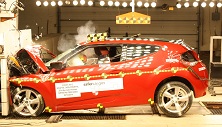
Frontal Crash Test

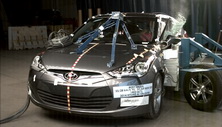
Side Crash Test

Overall Frontal Rating
Driver and Passenger Assessment
Driver Side
Passenger Side
Overall Side Rating
Side Barrier and Side Pole Tests
Driver Side
Passenger Side
Rollover Resistance
10.5% rollover risk in single-vehicle crash
Safety Features
The engine failed due to suspected rod bearing failure related to Hyundai’s known rod bearing recall issue. The vehicle exhibited a flashing check engine light with diagnostic trouble code P1326, knocking noises, metal debris found in the oil control solenoid, and subsequent secondary damage to the catalytic converter. The engine has not been opened by the Hyundai dealership despite these indicators. The vehicle and affected components are available for inspection upon request. The engine condition poses a serious safety risk. An independent mechanic advised that the rod bearing issue presents a fire hazard and stated the vehicle should not be driven due to the risk of engine failure, fire, loss of life, loss of power while driving. A sudden engine failure or fire could endanger the driver, passengers, and other motorists. Yes. The Hyundai dealership documented secondary engine damage but failed to perform the required open-engine rod bearing clearance test despite recall-related symptoms. An independent mechanic confirmed the issue is consistent with rod bearing failure and advised that the vehicle is unsafe to drive. The vehicle was inspected by an authorized Hyundai dealership and reviewed by Hyundai corporate. Hyundai corporate relied solely on the dealership’s incomplete inspection and denied further investigation or goodwill repair. The vehicle has also been inspected by an independent mechanic who identified the rod bearing issue as a safety hazard. Yes. Prior to the failure, the vehicle experienced a flashing check engine light and stored diagnostic code P1326. The engine produced knocking noises and showed signs of internal metal debris and secondary damages. The absence of early warning indicators prevented earlier detection. However, the extent of internal metal debris and secondary component damage demonstrates a progressive engine failure consistent with known rod bearing defects, rather than a sudden event after the warranty threshold.
The contact owns a 2017 Hyundai Veloster. The contact stated that while her sister was driving approximately 65 MPH, the vehicle stalled. The driver pulled over to the side of the road. The vehicle was able to be restarted, but made an abnormal knocking sound. The check engine warning light was flashing. The vehicle was towed to the residence. The dealer was contacted and informed that the vehicle needed to be diagnosed to confirm whether it was covered under warranty. The dealer informed the contact that towing assistance would be provided; however, the dealer drove the vehicle to the repair center, where it was diagnosed, and metal debris was found in the oil control solenoid. The vehicle was not repaired. The vehicle was driven back to the residence. A mobile independent mechanic diagnosed the vehicle and recommended either the rod bearings or engine replacement. The manufacturer was notified of the failure and contacted the dealer. The manufacturer then informed the contact that the dealer advised that the vehicle could not be diagnosed or receive a free repair unless unrelated repairs were first performed. The manufacturer denied a Goodwill Assistance. The failure mileage was approximately 161,000.
I bought the vehicle 14 days ago and everything was going well until black smoke started to come out of the exhaust and it started to smell burnt. I brought a mechanic to my house and he told me that the engine had already died
Here is what happened I left my house about 8 am and I head towards the 101 south from union hills drive and 83rd Ave I'm on the 101 south and yhe time I am passing the Thunderbird exit I hear a loud explosion and I duck a little bit and I see a bunch of black debris in the air it happened so fast and then a bunch of glass from my sunroof starts hitting me in the head on my neck falling into my lap going down my shirt and into my coffee. So I pull over off the next exit ramp and pull into and industrial park and I got out and started to sweep glass off of me and out of my car so I can still make it to work on time, I took a couple pics at that time, then I proceeded back towards the highway to make it to work. I get back onto the 101 south and make it to work in Goodyear, I cleaned some more glass off of me and called my insurance. This is a huge safety issue, glass landed everywhere. I could have crashed, it could have hit other vehicles, im not injured but it scared me really bad after the explosion I was covered in glass from head to toe.
The 2017 Hyundai Veloster- Value edition is a Lemon straight from the manufacturer. I purchased mine in July of 2024 with 27,000 miles. When I test drove it I questioned the clicking noises that could be heard while switching gears along with minor "shuddering" at acceleration. I was informed by gentleman at Dealer that it was a normal characteristic of owning a DCT vehicle. One year later 7/2025 I have been experiencing more intense issues with clutch/transmission. I have a great loss of power at acceleration, it will stay bogged at 1,000-1,500 RPM'S before it engages and revs with a jolt forward. It is unsafe to pull out or lane change on highway. It also is shuddering upon every acceleration from a dead stop. The clicking noises are now accompanied by clicking noises any time it shift gears. I get an intermittent smell of something burning. It is DEFINITELY UNSAFE to drive in any temperature above 75° due to the vehicle not being able to get out of its own way. All issues are intensified. I brought the vehicle to Hyundai service center and all that was recommended was a coolant flush and Dual Clutch Transmission service, which I paid to have done. I am not the original owner so any manufacturer warranty is out the window. Any research done by consumer will show pages and pages of complaints about the 2017 Veloster and DCT problems. Hyundai NEEDS TO MAKE GOOD on the unsafe garbage they sold us! Let me inform you that the vehicle I am currently making this complaint about has less than 48,000 miles today 7/9/2025
The contact owns a 2017 Hyundai Veloster. The contact stated that on three separate occasions while driving at undisclosed speeds, the vehicle went into LIMP Mode with the check engine warning light flashing on the instrument panel. The vehicle had been towed and driven to the dealer and an independent mechanic to be repaired. The contact was informed by the dealer and an independent mechanic that a knock sensor failure had caused the failure. The contact stated that the combustion chamber had been cleaned and the catalytic converter was replaced; however, the failure persisted. The contact also stated that the vehicle was consuming an excessive amount of engine oil. The manufacturer was not notified of the failure. The vehicle was not repaired and remained with the dealer. The failure mileage was approximately 100,000.
I was driving on the highway; the speed limit is 70mph. I had the sunroof of my 2017 Hyundai Veloster open to the first stage. The glass in the sunroof literally exploded, (it sounded like a gun going off) blasting shattered glass down on me and all of the interior of the car, (scared the [XXX] out of me!) Luckily, I wasn't hurt and managed to pull over without any traffic incident, but this could have easily caused personal injury or a collision on the highway at 70mph. It wasn't struck by anything, and the glass was in perfect condition without visual defects, i.e., chips, scratches etc. It has been turned into my insurance and I am going to request that the new glass gets a coating like the windshield to prevent the glass from coming apart like this in the event that this happens again. I think all sunroof glass should be treated this way from the factory, a broken window or sunroof is enough distraction while driving without being showered in glass. INFORMATION REDACTED PURSUANT TO THE FREEDOM OF INFORMATION ACT (FOIA), 5 U.S.C. 552(B)(6)
The contact owns a 2017 Hyundai Veloster. The contact stated while driving at various speeds, the vehicle hesitated while depressing the accelerator pedal before the vehicle surged forward. There was no warning light illuminated. The vehicle was taken to a dealer where the DTC scanner determined that the transmission had failed and needed to be replaced. Prior to the transmission failure, the engine and exhaust system were replaced. The manufacturer was notified of the failure and informed the contact that there were no recalls on the vehicle. The vehicle was not yet repaired. The failure mileage was approximately 160,000.
Paint peeling issue on hood. Filed for Hyundai to repair last 12/24, Hyundai denied claim 12/20/2024, without detailed reasons. Secondary extended warranty is suppose to be for 10 years regardless of mileage.p Hyundai case# [XXX] INFORMATION REDACTED PURSUANT TO THE FREEDOM OF INFORMATION ACT (FOIA), 5 U.S.C. 552(B)(6)
White paint peeling on hood.
I took my vehicle in to get the initial KSDS recall campaign updated (knock sensor). The car failed on my way home from the dealership and they scheduled me the next day to fix the problem (the acknowledged the knock sensor update caused the failure and is the that beginning step in obtaining a new engine from Hyundai. They then gave me a loaner car while my car was going to be repaired. I then recieve a call from the Hyundai service center about how my salvage title status excludes me from further repairs. I am then forced to drive my car home again with a failed engine. The sneaky way this is being done is horrific and on a massive scale. I was duped into getting the recalls from the letters sent out by Hyundai and at no point was there transparency about what would and did happen with my vehicle (and many others). No acknowledgement on how most if not all cars who get the update fail about 10 miles after driving it again, and lose power (I was on the highway in the far left lane). I was robbed of my ability to make an informed decision about my vehicle, this whole process is shrouded in secrecy from the consumer and I'm left holding the bag and the dangerous un drivable vehicle. I'm not sure how I can be cohersed from the manufacturer to let them fix their initial errors and be left with a non working car and expected to pay for the bill. There was no transparency about what I was signing up for, the ramifications and the safety hazards with the cars being statistically most likely to fail on the way home. What they are doing to me and many other people is dangerous and extremely wrong on many levels. When the engine failed I was extremely close to being rear ended and causing a large accident as it was full and fast moving traffic on the highway. I was fast acting and maneuvered properly and safely. Some will probably not be that lucky. There was no real warning, just a heavy thud and lose of power in tandum with the check engine light flashing (never has before
Today the vehicle was hesitant to start but did. After two stops I turned car off, went into a business. When I came out the car would start but would not go forward or backwards but rev up. I nearly slammed into a curb in the process. I have a video of this.
My cars battery continues to die with a check engine light coming on constantly. The vehicle continues to hesitate. The car door mounting lock broke while driving while my toddler was in the back of the vehicle and the door flew open on a road.
I own a 2017 hyundai veloster with roughly 122,000 miles on it, recently I got in my car to go to work, started the vehicle and exited my apartment complex onto a local road drove roughly a half mile to the on ramp for the highway, the car was just about up to its usual operating temperature when I accelerated down the on ramp and merged into traffic, at this time there were no warning lights, the engine temperature was normal, the car reached roughly 55/60mph and immediately lost power, pressing the gas pedal harder caused the car to lose more power and buck. At this time there were still no warning lights on the dash, the car slowed down to roughly 30/35mph presenting a significant danger to myself and other traffic as this was on a major highway with heavy amounts of traffic. It was approximately 4 miles to the next exit and the only safe place that I could exit the highway/ flow of traffic. The car was turned off and sat for roughly 5 minutes at which time I restarted the vehicle and drove it home on a local side road, the vehicle had no power and would not accelerate or maintain a speed above 30mph, at this time there were still no check engine lights on. A tow truck was called to haul the car to a local repair shop as the dealer had no openings for service, at the time the tow truck showed up to load up my car the vehicle was started breifly and a check engine light was now on, the local repair shop diagnosed the issue as a failed catalytic converter and the engine code as indicating inefficient emissions control readings on an 02 sensor. The repair shop could not come up with a reasonable answer as to how the catalytic converter had failed other than saying it had completely melted the material in the converter. The engine had no misfires, fuel issues, excessive oil consumption at this time and no engine codes were active or stored indicating any of theses issues. The catalytic converter failure is a major saftey issue that is happening on hyundai engines.
Purchased the car as a used vehicle in October 2023, dealer claimed to have changed the oil , in May the car we no longer running, I took it to a Hyundai dealership where they told me that I need a new engine because of oil consumption… This is something that should be included in the current class action lawsuit, the car is dangerous to drive as it will not stay running stalls in traffic, not to mention I’m out thousands of dollars due to an issue
Occasionally when traveling at speeds under 30 mph and you depress the accelerator the engine will hesitate to respond for several seconds.
The contact owns a 2017 Hyundai Veloster. The contact stated while driving at approximately 60 MPH, the check engine warning light illuminated, and the vehicle lost motive power and decelerated before stalling. The vehicle was later towed to the local mechanic who diagnosed that cylinder #1 experienced low compression. The contact was informed that the engine needed to be replaced or repaired. The vehicle was not repaired. The manufacturer was not notified of the failure. A service appointment was scheduled with the local dealer. The failure mileage was 130,000.
I was leaving work and the car lost power and it would barely move. I was able to get it to the side of the road. After that, then engine light came on and the car would not start. The engine was shaking very bad. I had to have my Veloster towed while my daughter and I were stuck on the side of the road.
While driving this vehicle, it suffered catastrophic engine failure, I had no low oil pressure or check engine warning lights until the failure occurred. I was stranded on the I-270 outer-belt of Columbus, OH during the early morning hours of July 20, 2022, That is a hazardous place to be with traffic passing my vehicle at high rates of speed. I checked my engine oil and there was nothing on the dipstick. The vehicle had not exceeded its oil change window. The vehicle has not been inspected by the manufacturer/police/or insurer. AAA Gahanna New Albany Service Center 614-750-8350 verified that the engine was blown. It is unsafe that and engine can be suddenly oil starved with no low oil pressure light, leaving the driver at the side of the highway amid fast moving traffic.
The vacuum pump had an internal mechanical failure, resulting in complete failure of the airbag control module, electronic stability control system, power steering, ABS, and speedometer. These were all shown as warning lights on the dashboard, starting with the ESC, then sporadic airbag light, sporadic steering light, etc.. In the event of a crash, the airbags would not have deployed. In the event of low-traction conditions, the car would not have been able to maintain control and I could have crashed. In the event of turning across traffic, my steering could have failed and I could have crashed. Due to the speedometer malfunction, I could have been going too fast and put myself and others at risk for high-speed collision. This problem has been confirmed and repaired by a Hyundai Dealership. The repairs would have been covered under warranty, but the vehicle is no longer under warranty. The dealership specified that there was nothing I could have done to prevent this failure. Occurred at 78,000 miles on March 18, 2022.
Showing 1–20 of 25 complaints
The 2017 Hyundai Veloster has 0 recalls recorded by NHTSA.
NHTSA has received 48 owner-reported complaints for the 2017 Hyundai Veloster.
The 2017 Hyundai Veloster received an overall safety rating of 5 out of 5 stars from NHTSA.
The most commonly reported complaint categories for the 2017 Hyundai Veloster are engine (18 reports), power train (5 reports), structure (3 reports).
NHTSA does not currently list any recalls on record for the 2017 Hyundai Veloster. To verify the status of your specific vehicle, check nhtsa.gov/recalls with your VIN.
Look up recalls and complaints for any year, make, and model.
This page summarizes publicly available data from the National Highway Traffic Safety Administration (NHTSA). Complaint counts reflect reports submitted to NHTSA by vehicle owners and do not by themselves prove defect severity or vehicle safety. Safety ratings may not be available for all vehicle-years. This site is not affiliated with NHTSA or any vehicle manufacturer. For official information, visit the official NHTSA page for this vehicle.