Hyundai · Sonata · 2017
2017 Hyundai Sonata
3
Recalls
743
Complaints
5/5
Safety Rating
The 2017 Hyundai Sonata has 3 recalls and 743 owner-reported complaints on file with NHTSA. Overall safety rating: 5 out of 5 stars. Most reported issue: engine (258 reports).
Source: NHTSA Public Records · Updated Apr 28, 2026
Research Context
The 2017 Hyundai Sonata page works best as a research starting point. Complaint totals show how much owner-reported activity exists, while recalls and investigations help show whether any of that activity turned into formal safety action.
Because this is a newer-era vehicle page, it usually helps to compare this year against nearby model years before deciding whether a complaint pattern looks isolated or persistent. On this page, the most prominent complaint area is engine with 258 reported complaints.
Best Research Moves
- Use the complaint log to see whether the 2017 Hyundai Sonata reports cluster around one repeated symptom or spread across multiple systems.
- Review the recall section even if the total is smaller, because a limited number of recalls can still point to meaningful safety actions.
- This page is primarily a complaints-and-recalls research surface, so compare nearby model years before treating the complaint total as a standalone verdict.
Key Takeaways
- The 2017 Hyundai Sonata currently shows 3 NHTSA recalls listed on this page and 743 owner-reported complaints.
- This page currently shows no linked NHTSA investigations.
- This page reflects complaint volume, recall history, and NHTSA test data, but it does not diagnose causes or rank reliability by itself.
- Safety data currently shows 5/5 overall NHTSA safety rating.
- The most frequently reported complaint categories on this page are engine (258), steering (144), unknown or other (51).
- Vehicle
- 2017 Hyundai Sonata
- Recalls
- 3
- Complaints
- 743
- Safety Rating
- 5/5
How to Interpret This Page
This page combines three types of NHTSA data: recall campaigns (official manufacturer or government actions), owner complaints (unverified consumer reports), and crash test ratings (where available). A vehicle with many complaints is not necessarily less reliable — complaint volume correlates with sales volume and vehicle age. Recalls indicate identified defects, not overall quality. To compare this model year with others, use the year navigation in the sidebar or return to the model overview page.
If you are researching a used vehicle, start with the complaint categories, compare them against the recall list, and then check nearby model years to see whether the same issue profile repeats. That usually produces a better buying or research signal than treating the raw complaint total as a standalone safety ranking.
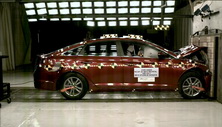
NHTSA Crash Test Performance
Frontal Crash Test
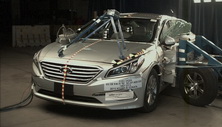
Side Crash Test
Overall Frontal Rating
Driver and Passenger Assessment
Driver Side
Passenger Side
Overall Side Rating
Side Barrier and Side Pole Tests
Driver Side
Passenger Side
Rollover Resistance
10.5% rollover risk in single-vehicle crash
Safety Features
ESC: StandardForward Collision Warning: OptionalLane Departure Warning: Optional
Recall Notices
NHTSANHTSA ID: 21V749000September 24, 2021
EXTERIOR LIGHTING:TURN SIGNAL
Hyundai Motor America (Hyundai) is recalling certain 2015-2017 Sonata, 2016-2017 Sonata Hybrid, and Sonata Plug-In Hybrid vehicles. The Smart Junction Box (SJB) software logic may not properly interpret the signals received from the multifunction switch, which could cause the turn signal to activate in the opposite direction of what the driver intended.
Remedy Status
Dealers will update the SJB software, free of charge. Owner notification letters were mailed November 19, 2021. Owners may contact Hyundai customer service at 1-855-371-9460. Hyundai's number for this recall is 210.
NHTSA ID: 21V619000August 06, 2021
LATCHES/LOCKS/LINKAGES:TRUNK LID:LATCH
Hyundai Motor America (Hyundai) is recalling certain 2017-2018 Sonata, 2016-2018 Sonata Hybrid, 2018-2020 Accent, and 2016-2017 Azera vehicles. The trunk latch may become damaged, preventing the opening of the trunk from the inside. As such, these vehicles fail to comply with the requirements of Federal Motor Vehicle Safety Standard number 401, "Internal Trunk Release."
Remedy Status
Dealers will replace the trunk latch base, free of charge. Owner notification letters were mailed December 4, 2021. Owners may contact Hyundai customer service at 1-855-371-9460. Hyundai's number for this recall is 208.
NHTSA ID: 16V956000December 30, 2016
AIR BAGS:FRONTAL:DRIVER SIDE:INFLATOR MODULE
Hyundai Motor Company (Hyundai) is recalling certain model year 2017 Hyundai Elantra vehicles manufactured April 15, 2016, to September 13, 2016, and Sonata vehicles manufactured May 27, 2016 to September 16, 2016. In these vehicles, the end seal for the driver's frontal air bag inflator may not have been properly installed, possibly resulting in reduced inflation of the frontal air bag in the event of a crash.
Remedy Status
Hyundai will notify owners, and dealers will replace the driver's frontal air bag module, free of charge. The recall began February 13, 2017. Owners may contact Hyundai customer service at 1-855-371-9460. Hyundai's number for this recall is 156.
Owner Complaints
743 totalENGINE
Apr 17, 2026
Burns through oil Oil will be black and barely any on the dip stick Cannot make it to recommended oil change miles or date Goes into limp mode
ENGINE
Mar 20, 2026
Care recently became inoperable. The engine was knocking, then stalling and then inoperable. Checked Hyundai website to find Engine Recall describing exactly what my Hyundai was/is experiencing. I brought vehicle to Clay Cooley dealership (39444 Lyndon B Johnson Fwy, 75232) a...
Preview excerpt
ENGINE AND ENGINE COOLING
Mar 17, 2026
See attached document for complaint.
UNKNOWN OR OTHER
Feb 22, 2026
Sun roof flew off while driving, the metal framing was twisted and dent. Sun Roof was closed at the time. Pictures were sent to insurance company but no one has looked at it yet. No warning. Sun roof was working properly.
ELECTRICAL SYSTEM,UNKNOWN OR OTHER
Feb 17, 2026
Here is your updated review with that included: ⸻ I am very disappointed with Hyundai Motor America and the service I received at Hyundai of Renton. I own a 2017 Hyundai Sonata and received a letter about a required software update and ignition cylinder protector due to known ...
Preview excerpt
STEERING
Feb 11, 2026
While driving around 45 mph, the steering wheel locked up and car came to a hard stop. Luckily cars swerved to avoid me. This was the second time it happened. The first time I was in a parking garage and the steering wheel locked up. After restarting the vehicle, the steering whe...
Preview excerpt
ENGINE
Feb 8, 2026
My 2017 Hyundai Sonata Hybrid has a permanent and recurring DTC P1326 (Knock signal range/performance) from the Knock Sensor Detection System (KSDS), indicating potential connecting rod bearing wear in the Nu 2.0L engine. The vehicle enters limp mode (reduced power, limited accel...
Preview excerpt
ELECTRICAL SYSTEM,UNKNOWN OR OTHER,ENGINE
Feb 6, 2026
This car is becoming more of a headache than it’s worth. Turned the car on, My car started shaking and my check engine light came on. then I got this message “A possible condition with your engine control system has been detected on a 2017 Hyundai Sonata”
STEERING
Feb 3, 2026
Was just driving and lost steering, basically very hard to turn the wheel. Traction control light and a red steering wheel light came on.
ENGINE
Jan 19, 2026
Please see the attached paperwork and I have more if needed. I am not receiving any help from the local Hyundai dealership in which I purchased the car, and I have reached out to the main Headquarter. This is the 2nd Hyundai I purchased, and I was not made aware of the oil consum...
Preview excerpt
Showing 10 recent complaints from 743 total
View Full Complaint LogCompare Related Vehicles
Why Compare These Pages
The strongest comparison flow is usually: exact vehicle-year page, then nearby years of the same model, then other 2017 Hyundai models. That sequence helps separate one-off year spikes from broader make-wide patterns.
More Hyundai Sonata Years
2018 Hyundai SonataCompare this year against 2017 for complaint and recall shifts.1r353c2016 Hyundai SonataCompare this year against 2017 for complaint and recall shifts.6r706c2019 Hyundai SonataCompare this year against 2017 for complaint and recall shifts.146c2015 Hyundai SonataCompare this year against 2017 for complaint and recall shifts.9r1,105c2020 Hyundai SonataCompare this year against 2017 for complaint and recall shifts.4r154c2014 Hyundai SonataCompare this year against 2017 for complaint and recall shifts.7r735c
More 2017 Hyundai Models
2017 Hyundai TucsonAnother 2017 Hyundai option for same-year comparison.3r1,060c2017 Hyundai Santa FeAnother 2017 Hyundai option for same-year comparison.6r910c2017 Hyundai ElantraAnother 2017 Hyundai option for same-year comparison.4r753c2017 Hyundai AccentAnother 2017 Hyundai option for same-year comparison.66c2017 Hyundai VelosterAnother 2017 Hyundai option for same-year comparison.48c2017 Hyundai AzeraAnother 2017 Hyundai option for same-year comparison.1r12c
Frequently Asked Questions
How many recalls does the 2017 Hyundai Sonata have?
The 2017 Hyundai Sonata has 3 recalls recorded by NHTSA.
How many complaints have been filed for the 2017 Hyundai Sonata?
NHTSA has received 743 owner-reported complaints for the 2017 Hyundai Sonata.
What is the NHTSA safety rating for the 2017 Hyundai Sonata?
The 2017 Hyundai Sonata received an overall safety rating of 5 out of 5 stars from NHTSA.
What are the most common problems with the 2017 Hyundai Sonata?
The most commonly reported complaint categories for the 2017 Hyundai Sonata are engine (258 reports), steering (144 reports), unknown or other (51 reports).
Does the 2017 Hyundai Sonata have any recalls?
Yes. NHTSA has 3 recalls on record for the 2017 Hyundai Sonata. Scroll up to review the published recall summaries, consequences, and remedies. To check for unrepaired recalls on your specific vehicle, use your VIN at nhtsa.gov/recalls.
Check Another Vehicle
Look up recalls and complaints for any year, make, and model.
This page summarizes publicly available data from the National Highway Traffic Safety Administration (NHTSA). Complaint counts reflect reports submitted to NHTSA by vehicle owners and do not by themselves prove defect severity or vehicle safety. Safety ratings may not be available for all vehicle-years. This site is not affiliated with NHTSA or any vehicle manufacturer. For official information, visit the official NHTSA page for this vehicle.