Toyota · Prius · 2017
2017 Toyota Prius
3
Recalls
100
Complaints
5/5
Safety Rating
The 2017 Toyota Prius has 3 recalls and 100 owner-reported complaints on file with NHTSA. Overall safety rating: 5 out of 5 stars. Most reported issue: visibility/wiper (20 reports).
Source: NHTSA Public Records · Updated Apr 29, 2026
Research Context
The 2017 Toyota Prius page works best as a research starting point. Complaint totals show how much owner-reported activity exists, while recalls and investigations help show whether any of that activity turned into formal safety action.
Because this is a newer-era vehicle page, it usually helps to compare this year against nearby model years before deciding whether a complaint pattern looks isolated or persistent. On this page, the most prominent complaint area is visibility/wiper with 20 reported complaints.
Best Research Moves
- Use the complaint log to understand what owners were actually reporting instead of relying only on the raw complaint total.
- Review the recall section even if the total is smaller, because a limited number of recalls can still point to meaningful safety actions.
- Check the linked investigations for extra ODI context if you want to see whether owner complaints escalated into formal defect review.
Key Takeaways
- The 2017 Toyota Prius currently shows 3 NHTSA recalls listed on this page and 100 owner-reported complaints.
- This page currently shows 1 NHTSA investigation linked to this page.
- This page reflects complaint volume, recall history, and NHTSA test data, but it does not diagnose causes or rank reliability by itself.
- Safety data currently shows 5/5 overall NHTSA safety rating.
- The most frequently reported complaint categories on this page are visibility/wiper (20), service brakes (8), unknown or other (6).
- Vehicle
- 2017 Toyota Prius
- Recalls
- 3
- Complaints
- 100
- Safety Rating
- 5/5
How to Interpret This Page
This page combines three types of NHTSA data: recall campaigns (official manufacturer or government actions), owner complaints (unverified consumer reports), and crash test ratings (where available). A vehicle with many complaints is not necessarily less reliable — complaint volume correlates with sales volume and vehicle age. Recalls indicate identified defects, not overall quality. To compare this model year with others, use the year navigation in the sidebar or return to the model overview page.
If you are researching a used vehicle, start with the complaint categories, compare them against the recall list, and then check nearby model years to see whether the same issue profile repeats. That usually produces a better buying or research signal than treating the raw complaint total as a standalone safety ranking.
NHTSA Crash Test Performance
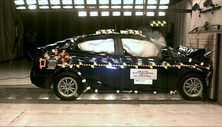
Frontal Crash Test
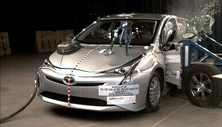
Side Crash Test
Overall Frontal Rating
Driver and Passenger Assessment
Driver Side
Passenger Side
Overall Side Rating
Side Barrier and Side Pole Tests
Driver Side
Passenger Side
Rollover Resistance
10.7% rollover risk in single-vehicle crash
Safety Features
ESC: StandardForward Collision Warning: OptionalLane Departure Warning: Optional
Recall Notices
NHTSANHTSA ID: 18V579000September 05, 2018
ELECTRICAL SYSTEM:WIRING
Toyota Motor Engineering & Manufacturing (Toyota) is recalling certain 2016-2018 Toyota Prius vehicles. A portion of the engine wire harness connected to the hybrid Power Control Unit (PCU), could contact the cover at this connection and wear, causing an electrical short circuit.
Remedy Status
Toyota will notify owners, and dealers will inspect the engine wire harness assembly and replace it if damage is found. A protective sleeve or protective tape will be included to prevent any future damage. These repairs will be performed free of charge. The recall began October 30, 2018. Owners may contact Toyota customer service at 1-888-270-9371. Toyota's number for this recall is J0T.
NHTSA ID: 17V295000May 02, 2017
TIRES:TEMPORARY/EMERGENCY SPARE TIRE
Gulf States Toyota, Inc. (Gulf States) is recalling certain 2017 4Runner , 86, Avalon, Camry, Camry Hybrid, Corolla, Corolla iM, Highlander, Highlander Hybrid, Prius, Prius C, RAV4, RAV4 Hybrid, Sienna and Yaris vehicles. The spare tire air pressure was not adjusted to the proper pressure as stated on the Tire Pressure Label.
Remedy Status
Gulf States will notify owners, and dealers will inspect the spare tires, adjusting their pressure as necessary, free of charge. The recall began June 15, 2017. Owners may contact Gulf States customer service at 1-800-444-1074. Toyota's number for this recall is 17R2.
NHTSA ID: 16V741000October 14, 2016
PARKING BRAKE
Toyota Motor Engineering & Manufacturing (Toyota) is recalling certain model year 2016-2017 Prius vehicles manufactured August 6, 2015, to October 3, 2016. The affected vehicles are equipped with a foot-operated parking brake system that has a parking brake cable that may disengage.
Remedy Status
Toyota will notify owners, and dealers will install a clip at the parking brake cable end to prevent the cable from disengaging, free of charge. The recall began November 10, 2016. Owners may contact Toyota customer service at 1-888-270-9371. Toyota's number for this recall is G01.
Investigations
1 totalDPClosed
NHTSA received a petition on or about July 18, 2022, requesting that Federal Motor Vehicle Safety Standard (FMVSS) 141 be applied to all electric and hybrid vehicles operating in the United States. The petition can be reviewed at NHTSA.gov under ODI Number 11486072. FMVSS 141 establishes performance requirements for pedestrian alert sounds for motor vehicles. The standard applies to hybrid and electric vehicles that have a gross vehicle weight rating of 4,536 KG or less or are defined as low-speed vehicles. The standard became fully applicable to all such vehicles manufactured on or after March 1, 2021.On January 27, 2023, NHTSA opened Defect Petition (DP) 22-005 to evaluate the subject matter described in the petition. On June 24, 2023 and as supplemented on June 25, 2023, the petitioner notified NHTSA he was withdrawing his petition. The petitioner indicated that, based on his review of data, there is no justification for asserting potential benefits that could be derived from actions sought by my petition. Based on the petitioner's withdrawal, DP22-005 is closed. Closure of this DP does not represent a determination by NHTSA regarding the subject matter of the petition.
Component: ELECTRICAL SYSTEM:PROPULSION SYSTEMOpened: Jan 27, 2023Closed: Aug 7, 2023Related recall: 22V063000
Owner Complaints
100 totalELECTRICAL SYSTEM
Sep 10, 2025
Odometer Fraud. The contact purchased a 2017 Toyota Prius. It was discovered when the contact listed the vehicle for sale that there was a mileage discrepancy. The vehicle was as a private sale. At the time of the purchase, the mileage was 126,611. The potential purchaser provide...
Preview excerpt
FUEL/PROPULSION SYSTEM
Jul 18, 2025
During hot temperatures and after coming to a full stop, the car stalls/hesitates significantly (5-6seconds) when pushing the gas pedal. The car eventually proceeds but the issue reoccurs. It can only be intermittently reproduced and no codes are shown on the car dashboard. Mecha...
Preview excerpt
ENGINE AND ENGINE COOLING
Feb 21, 2025
The contact owns a 2017 Toyota Prius. The contact stated that while driving approximately 25-30 MPH, the vents were blowing out cold air. The check engine warning light was illuminated. The contact was adding coolant to the coolant reservoir every three to four days. The vehicle ...
Preview excerpt
STRUCTURE,UNKNOWN OR OTHER
CRASHSep 23, 2024
Standing at a red light and someone rear ended
UNKNOWN OR OTHER
Jul 21, 2024
While driving the speed limit of 70mph on a major highway, the sunroof on my 2017 Toyota Prius exploded. There was no warning of any kind: no other traffic nearby so no rock or debris from another vehicle; no overpass or bridge so nothing from above; it was a mild sunny day of ...
Preview excerpt
POWER TRAIN
Jun 17, 2024
The contact owns a 2017 Toyota Prius. The contact stated while the contact's wife was driving at an undisclosed speed, the accelerator pedal was depressed. The accelerator pedal was depressed, however the vehicle failed to accelerate as intended. The contact stated that the vehi...
Preview excerpt
ENGINE,FUEL/PROPULSION SYSTEM
Mar 23, 2024
Dashboard pop up came up saying that the grille shutter is inoperable to visit a dealer. Went online and noticed there were recalls for my Prius year and because emissions is affected I contacted Toyota financial customer service who said to go to a dealer and that they would fix...
Preview excerpt
ENGINE,FUEL/PROPULSION SYSTEM
Mar 21, 2024
Dear NHTSA, I am seeking assistance and compensation for ongoing warranty and repair issues with my Toyota Prius. Key Incident Timeline: •March 21, 2024: Dashboard message “Grille Shutter Inoperable” •March 25, 2024: Toyota of Glendale visit •Charged $220 for diagnostics •Refused...
Preview excerpt
ENGINE
Jan 3, 2024
Coolant leaking into exhaust And engine also vehicle suddenly stops for no reason now engine is completely broken due to the coolant going into the motor oil
VEHICLE SPEED CONTROL
Oct 16, 2023
On 10/16/23 I was turning slowly into a parking spot and my car suddenly accelerated without my pressing the accelerator. I slammed on the break and the car stopped. It was frightening because I could have hit someone or something but luckily the car stopped before that happened....
Preview excerpt
Showing 10 recent complaints from 100 total
View Full Complaint LogCompare Related Vehicles
Why Compare These Pages
The strongest comparison flow is usually: exact vehicle-year page, then nearby years of the same model, then other 2017 Toyota models. That sequence helps separate one-off year spikes from broader make-wide patterns.
More Toyota Prius Years
2018 Toyota PriusCompare this year against 2017 for complaint and recall shifts.1r1i34c2016 Toyota PriusCompare this year against 2017 for complaint and recall shifts.5r1i177c2019 Toyota PriusCompare this year against 2017 for complaint and recall shifts.3r1i28c2015 Toyota PriusCompare this year against 2017 for complaint and recall shifts.1r3i147c2020 Toyota PriusCompare this year against 2017 for complaint and recall shifts.1i14c2014 Toyota PriusCompare this year against 2017 for complaint and recall shifts.3r3i227c
More 2017 Toyota Models
2017 Toyota RAV4Another 2017 Toyota option for same-year comparison.3r1i300c2017 Toyota HighlanderAnother 2017 Toyota option for same-year comparison.4r252c2017 Toyota TacomaAnother 2017 Toyota option for same-year comparison.5r1i229c2017 Toyota CorollaAnother 2017 Toyota option for same-year comparison.3r2i186c2017 Toyota CamryAnother 2017 Toyota option for same-year comparison.3r145c2017 Toyota SiennaAnother 2017 Toyota option for same-year comparison.10r143c
Frequently Asked Questions
How many recalls does the 2017 Toyota Prius have?
The 2017 Toyota Prius has 3 recalls recorded by NHTSA.
How many complaints have been filed for the 2017 Toyota Prius?
NHTSA has received 100 owner-reported complaints for the 2017 Toyota Prius.
What is the NHTSA safety rating for the 2017 Toyota Prius?
The 2017 Toyota Prius received an overall safety rating of 5 out of 5 stars from NHTSA.
What are the most common problems with the 2017 Toyota Prius?
The most commonly reported complaint categories for the 2017 Toyota Prius are visibility/wiper (20 reports), service brakes (8 reports), unknown or other (6 reports).
Does the 2017 Toyota Prius have any recalls?
Yes. NHTSA has 3 recalls on record for the 2017 Toyota Prius. Scroll up to review the published recall summaries, consequences, and remedies. To check for unrepaired recalls on your specific vehicle, use your VIN at nhtsa.gov/recalls.
Check Another Vehicle
Look up recalls and complaints for any year, make, and model.
This page summarizes publicly available data from the National Highway Traffic Safety Administration (NHTSA). Complaint counts reflect reports submitted to NHTSA by vehicle owners and do not by themselves prove defect severity or vehicle safety. Safety ratings may not be available for all vehicle-years. This site is not affiliated with NHTSA or any vehicle manufacturer. For official information, visit the official NHTSA page for this vehicle.